1. What Are Drill Pipe Specifications?
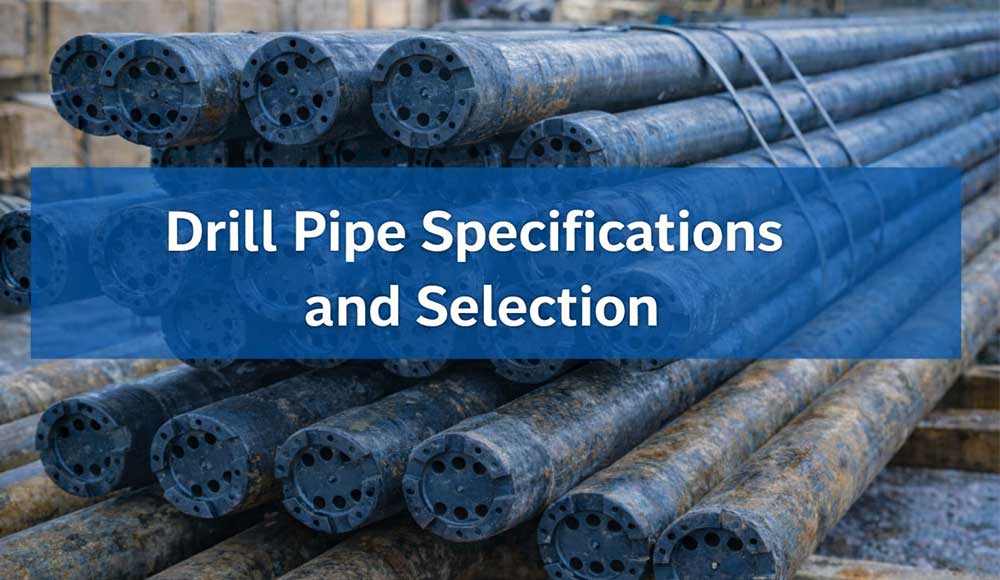
Drill pipe specifications define the key technical parameters that determine the performance, strength, and suitability of a drill pipe in different drilling conditions. These parameters are standardized under API systems and form the basis for drill pipe design and selection.
A complete drill pipe specification typically includes:
- Size (OD & ID)
- Weight (lbs/ft)
- Wall thickness
- Steel grade
- Connection type
Each parameter will be explained in detail below, along with how they affect drilling performance and selection.
2. Key Technical Parameters Explained
2.1 OD and ID
Outer diameter (OD) and inner diameter (ID) do not function independently—they together determine two core capabilities of a drill pipe: structural strength and fluid transport efficiency.
A larger OD generally provides higher torsional resistance and overall stiffness, helping maintain stable torque transmission in deep or directional wells.
A larger ID improves drilling fluid circulation, enhances cuttings transport, and reduces pressure loss.
There is rarely an “absolute optimal” combination of OD and ID; the choice is usually a trade-off based on well depth, trajectory, and operational conditions.
2.2 Weight (lbs/ft)
Drill pipe weight, expressed in pounds per foot (lbs/ft), is a key design parameter for the drill string.
Heavier pipes can help stabilize weight-on-bit (WOB) transmission, allowing the bit to drill more effectively. However, increased weight also adds load to the drill string and can raise friction in complex well sections. This effect is amplified in horizontal or extended-reach wells.
For this reason, weight is rarely the sole decision factor—it must be considered alongside well depth, trajectory, and equipment limitations.
2.3 Wall Thickness
Thicker walls improve collapse and burst resistance, which is critical in deep or high-pressure wells. They also extend the drill pipe’s fatigue life under cyclic loads.
However, thicker walls reduce the inner diameter, which can decrease fluid circulation efficiency—an important consideration in high-flow operations.
2.4 Grade
Grade refers to the material strength of the drill pipe and is a core factor in determining suitable well depth and operating conditions.
Common API grades include:
E75: Suitable for shallow wells or low-load conditions
G105: Medium strength, ideal for conventional oil and gas wells
S135: High-strength steel for deep or complex wells
2.5 Connection / Tool Joint
Drill pipes are connected via threaded joints to form a complete drill string. Connection type directly affects torque transmission and sealing reliability.
Common connections include NC38, NC50, as well as high-torque specialized joints such as XT and HT.
3. Standard Drill Pipe Specifications (API)
In practical drilling operations, most drill pipe specifications are based on the API standard system, with API 5DP being the core reference. This standard defines pipe size ranges, weight classifications, and wall thicknesses, providing a consistent framework for design and selection.
To facilitate engineering selection, the table below summarizes commonly used API drill pipe specifications, covering mainstream sizes and typical parameter combinations:
Common API Drill Pipe Size Chart (Optimized)
|
OD (in)
|
Nominal Weight (lbs/ft)
|
ID (in)
|
Wall Thickness (in)
|
Typical Application
|
Recommended Grade
|
Typical Connection
|
Selection Focus
|
|
2 3/8
|
4.85 – 6.65
|
1.815 – 1.995
|
0.190 – 0.280
|
Shallow / Exploration Wells
|
E75
|
NC26
|
Cost & Efficiency Priority
|
|
2 7/8
|
6.85 – 10.40
|
2.151 – 2.441
|
0.217 – 0.362
|
Light / Mid-Depth Wells
|
E75 / G105
|
NC31
|
Low-Load Operations
|
|
3 1/2
|
9.50 – 15.50
|
2.602 – 2.992
|
0.254 – 0.449
|
Conventional Oil & Gas Wells
|
G105
|
NC38
|
Balanced Performance & Cost
|
|
4
|
11.85 – 15.70
|
3.240 – 3.476
|
0.262 – 0.380
|
Medium-Depth Wells
|
G105 / S135
|
NC38 / NC50
|
Overall Performance
|
|
4 1/2
|
13.75 – 22.82
|
3.500 – 3.958
|
0.271 – 0.500
|
Deep / Directional Wells
|
S135
|
NC50
|
Torque & Strength
|
|
5
|
16.25 – 25.60
|
4.000 – 4.408
|
0.296 – 0.500
|
Extended Reach / Deep Wells
|
S135
|
NC50 / XT
|
Torque & Load Transfer Efficiency
|
|
5 1/2
|
19.20 – 24.70
|
4.670 – 4.892
|
0.304 – 0.415
|
High-Load Operations
|
S135
|
XT / HT
|
High Load Stability
|
|
6 5/8
|
25.20 – 27.70
|
5.901 – 5.965
|
0.330 – 0.362
|
Ultra-Deep / Offshore Wells
|
S135
|
HT
|
Extreme Strength & Safety
|
4. Drill Pipe Specifications vs. Performance
In practical drilling design, drill pipe parameters are rarely considered in isolation. What truly matters is how these specifications translate into overall downhole performance.
4.1 Torque Transmission
A larger outer diameter (OD) enhances overall torsional strength, while the connection type determines whether torque can be reliably transmitted across tool joints. In long horizontal sections or extended-reach wells, differences in connection performance become even more pronounced.
4.2 Grade and Weight
Axial load capacity depends critically on the combination of steel grade and pipe weight. Steel grade sets the material’s maximum load limit, while weight influences the actual load distribution along the drill string. If the steel grade is insufficient, even well-dimensioned pipes may become limiting in deep wells. Conversely, improper weight distribution can create localized overloading.
4.3 Wall Thickness and Structural Integrity
Fluid circulation performance is largely determined by the interplay between internal diameter (ID) and wall thickness. A larger ID improves pumping efficiency and cuttings transport, but reducing wall thickness can compromise collapse resistance. In high-flow, high-pressure operations, these factors must be carefully balanced.
Summary: Drill pipe specifications are essentially a dynamic balance between strength, hydraulics, weight, and cost. Optimizing a single parameter in isolation inevitably affects other aspects of the system.
5. How to Choose Drilling Pipe Specifications
In practice, selecting the right drill pipe typically starts with the fundamental well conditions.
Well depth and trajectory are the primary constraints. For shallow wells or conventional vertical wells, the load path is relatively simple, so standard steel grades and connection types are usually sufficient. In contrast, deep wells, horizontal wells, or extended-reach wells present significantly more complex load environments. In these cases, steel grade, weight, and connection type must be upgraded in tandem to avoid localized performance bottlenecks.
Operational conditions further influence parameter priorities. In high-pressure wells or challenging formations, wall thickness and material strength take precedence to ensure adequate safety margins. For high-flow drilling operations, the internal diameter (ID) plays a key role in circulation efficiency. If cuttings transport is insufficient, overall drilling performance can be compromised even if other parameters are adequate.
Equipment limitations also impose practical constraints. The rig’s hoisting capacity, torque output, and circulation system all restrict feasible drill pipe specifications. A theoretically optimal configuration may be impractical if it exceeds equipment capabilities. Therefore, selection is always a balance between specification requirements and rig capacity.
In complex wells, it is uncommon to use a single pipe specification throughout. Segmenting the drill string according to the load characteristics of different well sections allows for optimized performance while maintaining safety. For example, lighter pipes may be used in the upper sections to reduce system load, while steel grade and connection type are gradually upgraded in deeper sections to handle higher stresses.
Recommended Drill Pipe Configurations by Application:
|
Application
|
Recommended OD
|
Grade
|
Wall Thickness
|
Connection
|
Key Consideration
|
|
Shallow Wells
|
2 3/8” – 2 7/8”
|
E75 / G105
|
Light
|
NC26 / NC31
|
Cost and efficiency priority
|
|
Conventional Wells
|
3 1/2” – 4 1/2”
|
G105 / S135
|
Medium
|
NC38 / NC50
|
Balanced performance
|
|
Deep Wells
|
4 1/2” – 6 5/8”
|
S135
|
Thick
|
NC50 / High torque
|
Strength and safety margin
|
|
Directional / Horizontal Wells
|
4” – 5”
|
G105 / S135
|
Medium–Thick
|
XT / HT
|
Torque and fatigue resistance
|
|
Extended Reach Wells
|
5” – 5 1/2”
|
S135
|
Optimized
|
High torque
|
Load transfer efficiency
|
6. Common Standards and API Requirements
In the global oil and gas drilling industry, drill pipe design, manufacturing, and inspection typically follow the API (American Petroleum Institute) standards to ensure consistency in strength, dimensions, and connection performance.
The most relevant standards include:
6.1 API 5DP
API 5DP standard is the fundamental standard for drill pipes. It specifies the range of pipe sizes, steel grade classifications, mechanical properties, and testing requirements. Most drill pipes on the market today are manufactured and certified according to this standard.
API 5DP not only defines performance requirements for commonly used steel grades such as E75, G105, and S135, but also provides clear guidelines on the compatibility between the pipe body and tool joint. This makes it a crucial reference for drill pipe selection and procurement.
6.2 API SPEC 7
API SPEC 7 covers technical requirements for drill string tools and connection components, including the dimensions, tolerances, and performance criteria for threaded connections (e.g., NC series).
In practice, the design and manufacturing quality of tool joints directly affects torque transmission and connection reliability, making this standard particularly critical for high-torque or complex well applications.
Summary: Together, API 5DP and API SPEC 7 form a complete standard framework for drill pipes—from material selection to connection design—providing a solid foundation for safe, consistent drilling operations.
7. Further Resources for Drill Pipe Selection
Given the complexity of drill pipe specifications, a single page rarely covers all technical details. For deeper insights into pipe sizes, grades, and connection types, the following resources are recommended:
Drill Pipe Size Chart – Comprehensive drill pipe dimensions for engineering selection.
2 3/8 Drill Pipe Specs – Typical parameters for small-diameter wells.
2 7/8 Drill Pipe Size – Mid-size drill pipe for shallow/mid-depth wells.
4 XT39 Drill Pipe Specs – Specifications for standard horizontal drilling.
API Drill Pipe Thread Types – Standardized tool joint specs.
Steel Grade & Classification – Selection guide for different well depths.





 Eastern Steel Manufacturing Co.,Ltd not only improve product production and sales services, but also provide additional value-added services. As long as you need, we can complete your specific needs together.