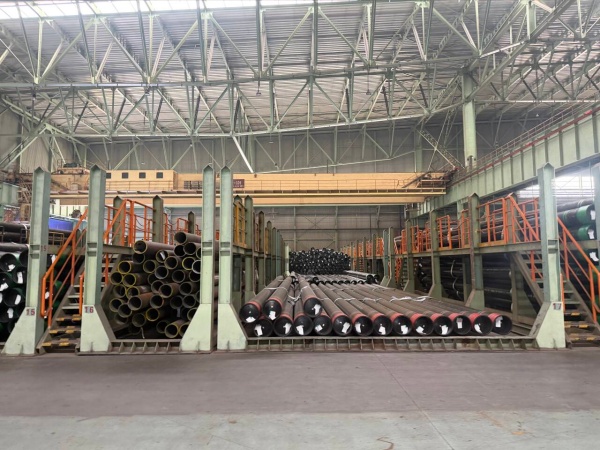
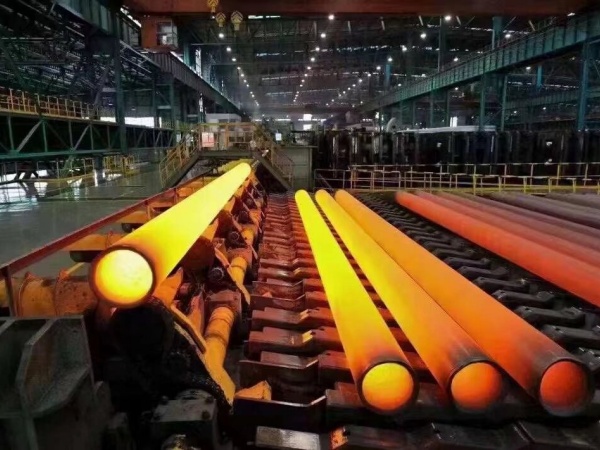
1. What Is 2-7/8" Drill Pipe
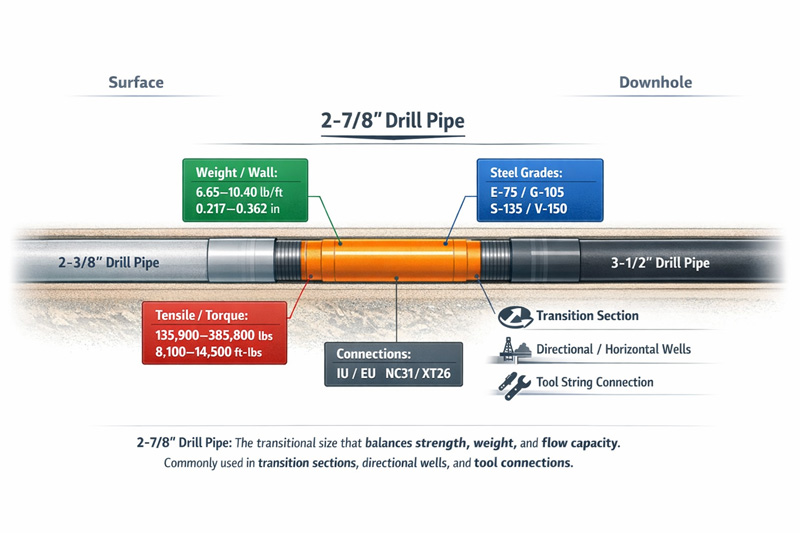
The 2-7/8" drill pipe is not considered a “primary large-size” option in the drill string, but it serves as a highly typical transitional size. It is most commonly positioned in the middle section of the downhole assembly—not subjected to the most extreme loads, nor limited to the lightest-duty conditions. Instead, it plays a key role in connection, transition, and structural adjustment.
In practical applications, this size is commonly used in the following scenarios:
1.Conventional drilling in small boreholes or medium-depth wells
2.Transition sections in directional and horizontal wells (e.g., connecting drill collars and larger-diameter drill pipe)
3.Connection segments within downhole tool strings (such as fishing tools or logging tools)
4.Workover operations or geological exploration, where higher flexibility is required
Compared to lighter sizes such as 2-3/8", the 2-7/8" drill pipe offers significantly improved tensile and torsional strength. At the same time, compared to mainstream larger sizes like 3-1/2" or 4-1/2", it is lighter in weight and easier to handle.
As a result, it often functions as a “bridging” size—striking a balance between strength, weight, and flow capacity.
From a design perspective, the 2-7/8" drill pipe is better understood as a versatile, balanced specification that accommodates multiple operational requirements, rather than being optimized for a single extreme condition. This is precisely why it is widely used in directional wells and complex well architectures.
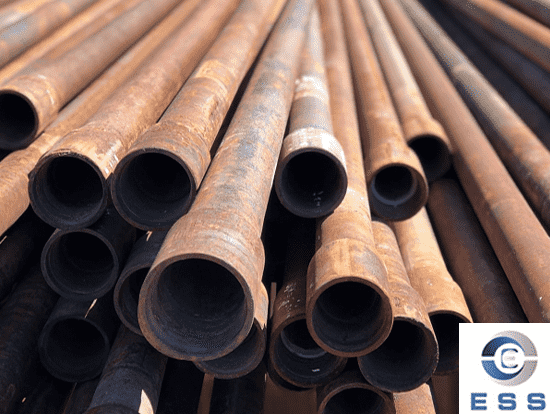
2. 2-7/8" Drill Pipe Dimensions (API 5DP Standard)
Within the standard system, 2-7/8" drill pipe is typically manufactured and inspected in accordance with API Spec 5DP, one of the most widely adopted international standards in the oil and gas drilling industry. Dimensions are expressed in imperial units, and 2-7/8" refers to the nominal outside diameter (OD) of the drill pipe.
Its basic geometric parameters are relatively consistent:
Outside Diameter (OD): 2.875" (approximately 73.03 mm)
Inside Diameter (ID): typically ranges from 2.1" to 2.44", depending on wall thickness
Wall Thickness (WT): commonly 0.217" and 0.362"
It is important to note that these dimensions do not exist in isolation. In real-world engineering applications, pipe dimensions interact closely with tool joint configuration (IU / EU), thread type (such as NC31 / REG), and steel grade, all of which collectively determine the overall performance of the drill pipe.
For example:
IU (Internal Upset): enhances connection strength by increasing wall thickness at the pipe ends internally
EU (External Upset): more commonly used in certain connection structures
Connections like NC31: directly influence torque transmission capacity
Therefore, when selecting 2-7/8" drill pipe, it should be understood not simply as a size, but as part of an integrated design system—where geometry, connection type, and mechanical strength are tightly coupled.
3. Weight, Wall Thickness, and Grades
For 2-7/8" drill pipe, weight and wall thickness are the two most direct factors influencing mechanical performance. Different combinations correspond to entirely different operating scenarios.
3.1 Common Weight and Wall Thickness Options
The most widely used configurations in the industry include:
(1) 6.65 lb/ft / 6.85 lb/ft
These correspond to a thinner wall (approximately 0.217"), resulting in lighter weight. They are suitable for medium to low load conditions or applications where higher flow capacity is required.
(2) 10.40 lb/ft
This corresponds to a thicker wall (approximately 0.362"), offering significantly improved tensile strength, torsional resistance, and collapse resistance. It is better suited for medium-depth wells or more complex drilling conditions.
From an engineering perspective, increasing weight is essentially achieved by increasing wall thickness, which leads to two direct effects:
(1)Higher strength
(2)Reduced internal diameter (lower flow capacity)
This trade-off is a key consideration in drill pipe selection.
3.2 Common Steel Grades
2-7/8" drill pipe typically covers a range of steel grades from medium to high strength:
(1) E-75
A baseline grade, suitable for shallow wells or low-stress environments
(2) X-95 / G-105
Medium-to-high strength grades, commonly used in general drilling operations
(3) S-135
A high-strength standard, widely applied in deep wells and complex well conditions
(4) V-150 / Z-140
Higher strength grades, designed for high-load or specialized applications
Increasing the steel grade primarily enhances tensile strength and torque capacity, but it also places higher demands on material toughness and fatigue resistance. As a result, in real-world projects, selection is rarely based on simply choosing the “highest grade,” but rather on achieving the right match with well depth, trajectory, and operational requirements.
4. 2-7/8" Drill Pipe Size Chart
Under the API 5DP standard system, 2-7/8" drill pipe can be configured in multiple combinations based on wall thickness, steel grade, and upset type. The table below summarizes some of the most common industry configurations, providing a quick reference to understand how these parameters relate to one another.
Common Specifications (Typical Configurations)
|
Size (in)
|
Weight (lb/ft)
|
Grade
|
Upset Type
|
Wall Thickness (in)
|
ID (in)
|
Connection
|
|
2-7/8
|
6.65
|
E-75
|
IU
|
0.217
|
2.441
|
XT26
|
|
2-7/8
|
6.65
|
G-105
|
IU
|
0.217
|
2.441
|
XT26
|
|
2-7/8
|
6.65
|
S-135
|
IU
|
0.217
|
2.441
|
XT26
|
|
2-7/8
|
6.65
|
X-95
|
IU
|
0.217
|
2.441
|
XT26
|
|
2-7/8
|
6.85
|
E-75
|
EU
|
0.217
|
2.441
|
NC31
|
|
2-7/8
|
6.85
|
G-105
|
EU
|
0.217
|
2.441
|
NC31
|
|
2-7/8
|
6.85
|
S-135
|
EU
|
0.217
|
2.441
|
NC31
|
|
2-7/8
|
6.85
|
X-95
|
EU
|
0.217
|
2.441
|
NC31
|
|
2-7/8
|
10.40
|
E-75
|
EU
|
0.362
|
2.151
|
NC31
|
|
2-7/8
|
10.40
|
G-105
|
EU
|
0.362
|
2.151
|
NC31
|
|
2-7/8
|
10.40
|
S-135
|
EU
|
0.362
|
2.151
|
NC31
|
|
2-7/8
|
10.40
|
X-95
|
EU
|
0.362
|
2.151
|
NC31
|
From the table, it is clear that variations in 2-7/8" drill pipe are primarily concentrated in three dimensions: weight (wall thickness), steel grade, and upset type.
In practical engineering applications, these three factors are typically selected in combination:
Lighter weights (6.65 / 6.85 lb/ft): emphasize flow capacity and operational flexibility
Heavier weight (10.40 lb/ft): prioritizes strength and safety margins
IU vs EU: mainly differ in tool joint structure and applicable operating conditionsDetailed Parameters Reference (API 5DP)
In actual project design, drill pipe performance depends not only on basic dimensions, but also on factors such as torsional strength, tensile capacity, and internal/external pressure resistance.
The following section provides reference data for several typical configurations.
(1) 6.65 lb/ft (IU)
E-75: Torque capacity ~8,100 ft·lbs, Tensile strength ~135,900 lbs
G-105: Torque capacity ~11,300 ft·lbs, Tensile strength ~190,300 lbs
S-135: Torque capacity ~14,500 ft·lbs, Tensile strength ~244,600 lbs
(2) 6.85 lb/ft (EU)
Commonly paired with NC31, HT31, XT31 and similar connections
Performance is similar to IU types, but connection strength and compatibility differ
(3) 10.40 lb/ft (Thick Wall)
S-135: Tensile strength up to ~385,800 lbs
V-150: Suitable for higher-load applications
Note: Complete parameter combinations are typically provided by manufacturers according to specific standards. The above values are intended as reference for selection, not as final design specifications.
5. Thread Types (IF vs REG Explained)
For 2-7/8" drill pipe, the choice of thread type affects not only connection strength but also fluid flow efficiency, operational performance, and applicable well profiles. In practice, the two most common thread types are IF (Internal Flush) and REG (Regular).
5.1 IF (Internal Flush / NC31)
IF connections maintain nearly consistent internal diameter, minimizing flow resistance, while providing good structural strength at the tool joint. These connections are particularly suited for:
Directional and horizontal wells where circulation efficiency is critical
High-flow operations, medium-depth wells, and high-strength applications
IF connections typically use NC series threads (e.g., NC31) and are widely applied in modern drilling operations.
5.2 REG (Regular)
REG connections are a more traditional thread type with simpler structure and broader compatibility. They are still used in smaller-diameter wells or conventional operations. Key advantages include:
Mature, proven design
Wide adaptability
Easier manufacturing and maintenance
In 2-7/8" drill pipe, REG is usually labeled as “2-7/8 REG”, and it still finds use in older wells or specific tool connections.
5.3 Practical Selection Recommendations
Based on current drilling trends, IF connections generally offer more balanced advantages, especially in scenarios that require both fluid efficiency and structural strength. Therefore, in new well designs or standardized operations, IF connections (NC series) have become the more common choice.
However, in real-world projects, the final decision on connection type should consider factors such as wellbore design, tool compatibility, and historical usage practices. It should not be determined solely by the specification sheet.
6. Comparison of 2-7/8" Drill Pipe with Other Common Sizes
The 2-7/8" drill pipe is considered a transitional size within the overall range of drill pipe diameters. Compared to smaller drill pipes, it offers higher strength and flow capacity, while compared to larger pipes, it maintains better operational flexibility. In drill string design, it is typically used in intermediate sections that balance load and operational efficiency.
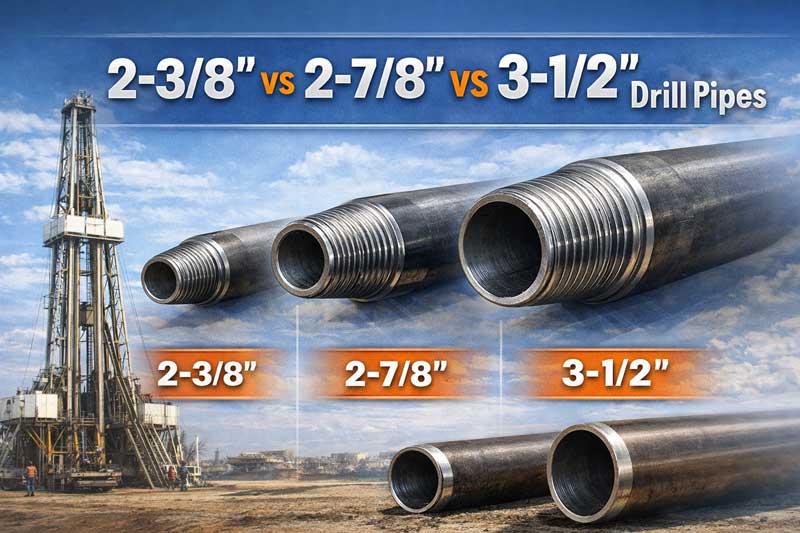
6.1 Comparison with 2-3/8" Drill Pipe
The 2-3/8" pipe is a lighter-duty size, commonly used in shallow wells, workover operations, or tasks requiring high flexibility under low loads. The 2-7/8" pipe offers significantly higher tensile and torsional strength, making it suitable for more complex downhole conditions.
6.2 Comparison with 3-1/2" and Larger Drill Pipes
Sizes like 3-1/2" and 4-1/2" are typical mainline sizes, widely used in medium- to deep-well operations. The 2-7/8" pipe has moderate strength and load capacity, but its lighter weight and improved handling provide advantages in scenarios with frequent rigging, limited space, or high operational maneuverability.
6.3 Key Dimension Comparison
|
Parameter
|
2-3/8"
|
2-7/8"
|
3-1/2" and Above
|
|
Strength & Load Capacity
|
Low
|
Medium
|
High
|
|
Weight & Handling
|
Light
|
Moderate
|
Heavy
|
|
Flow Capacity
|
Small ID
|
Moderate ID
|
Large ID
|
In practical drill string configurations, 2-7/8" drill pipe is rarely used throughout the entire well. It is typically placed in:
Transition sections between drill collars and larger drill pipe
Directional wells where both strength and flexibility are required
Tool string connections where moderate load and maneuverability must be balanced
7. Drill Pipe Size Selection Principles
Choosing a drill pipe size is not a matter of a single parameter, but a balance of multiple factors including well depth, loads, wellbore design, and system compatibility. The 2-7/8" drill pipe is widely used precisely because it falls within the overlap of several key constraints.
7.1 Well Depth and Load
Shallow wells, low loads: 2-3/8" is usually sufficient
Medium-depth wells or complex loading conditions: 2-7/8" is a more reliable choice
Greater depths or high torque requirements: consider 3-1/2" or larger sizes
7.2 Wellbore Configuration
Wellbore type often has a greater impact on size selection than expected:
Directional / horizontal wells: prioritize flexibility and flow efficiency; 2-7/8" is commonly used
Vertical wells: if load-bearing and efficiency dominate, larger sizes may be preferred
7.3 System Compatibility
Practical selection is often constrained by existing conditions, such as:
Downhole tool interface sizes
On-site drilling tool inventory
Historical operational practices
Therefore, the core of size selection is not choosing the “largest” or “strongest” size, but rather selecting the most suitable size for the given conditions.
8. Typical Application Scenarios
The main advantage of 2-7/8" drill pipe is adaptability—it is light enough to handle easily, yet strong enough for most operations, and it works well with existing tool inventories. It is not limited to a specific well type; rather, it is frequently used in sections that require a balance of flexibility and reliability.
8.1 Typical Position in the Drill String
In drilling operations, 2-7/8" pipes are most commonly used in transition sections. Examples include:
Drilling small boreholes or medium-depth wells
Sections in directional or horizontal wells that require a balance of strength and flow capacity
Connection points between drill collars and larger drill pipes
These sections cannot accommodate too heavy a pipe, but also require more strength than lighter sizes, making 2-7/8" an ideal middle ground.
8.2 Preferred Size for Tool Connections
2-7/8" is also a preferred choice for tool connections, including:
Fishing tools
Logging instruments
Measurement-while-drilling (MWD) tools
Various downhole auxiliary tools
The reason is straightforward: good compatibility, widely stocked on-site, and easy to interchange tools without interface issues.
8.3 Reliable Option for Non-Standard Operations
Additionally, in non-typical oil and gas scenarios—such as geological exploration or workover operations—2-7/8" maintains high usage frequency. The pipe is neither too heavy nor too weak, making it a practical and adaptable choice in the field.
9. FAQs
Q1. What is the outer diameter of 2-7/8" drill pipe in mm?
The nominal outside diameter of a 2-7/8" drill pipe is 2.875 inches, which converts to approximately 73.03 mm. Within the API system, this size is considered a standard medium-to-small diameter, commonly used in transition sections or medium-depth wells.
Q2. 2-7/8" vs 2-3/8" drill pipe: what’s the difference?
The most obvious difference is the size, but in practice, it affects application scenarios:
2-3/8": lighter weight, typically used in shallow wells, workover operations, or low-load conditions
2-7/8": offers greater strength margin, with higher tensile and torsional capacity
As well depth increases or wellbore geometry becomes more complex (e.g., directional wells), 2-7/8" is more commonly used.
In short: 2-3/8" is lighter and more flexible, while 2-7/8" is more balanced and durable.
Q3. What are the standard weights of 2-7/8" drill pipe?
The most common weights are 6.65, 6.85, and 10.40 lb/ft.
6.65 / 6.85 lb/ft: lighter, suitable for operations requiring higher flow capacity and easier handling
10.40 lb/ft: thicker wall, higher strength, commonly used in medium-depth wells or more demanding conditions
The weight difference mainly comes from wall thickness, which increases strength but also reduces internal diameter and flow capacity.
Q4. Is 2-7/8" drill pipe considered a standard size?
Yes. 2-7/8" is a commonly used standard size in the API system.
Although it is not a “primary size” like 3-1/2", it is frequently used in transition sections, directional wells, and tool connections, making it a typical intermediate size.
10. Conclusion
2-7/8″ drill pipe is typically used as a balanced, mid-range option in drilling operations. It offers a practical combination of strength, weight, and flexibility, making it suitable for transition sections, directional wells, and medium-depth applications.
Rather than being the primary size for all conditions, it is more often selected where adaptability is required without increasing overall load.
When choosing drill pipe, factors such as well depth, load conditions, and connection compatibility should be considered together—not just size alone.
For specific specifications or project-based recommendations, feel free to contact us for more details.
Read more: Steel grade and classification method of drill pipe and How Many Types of Drill Pipe Threads Are There





 Eastern Steel Manufacturing Co.,Ltd not only improve product production and sales services, but also provide additional value-added services. As long as you need, we can complete your specific needs together.