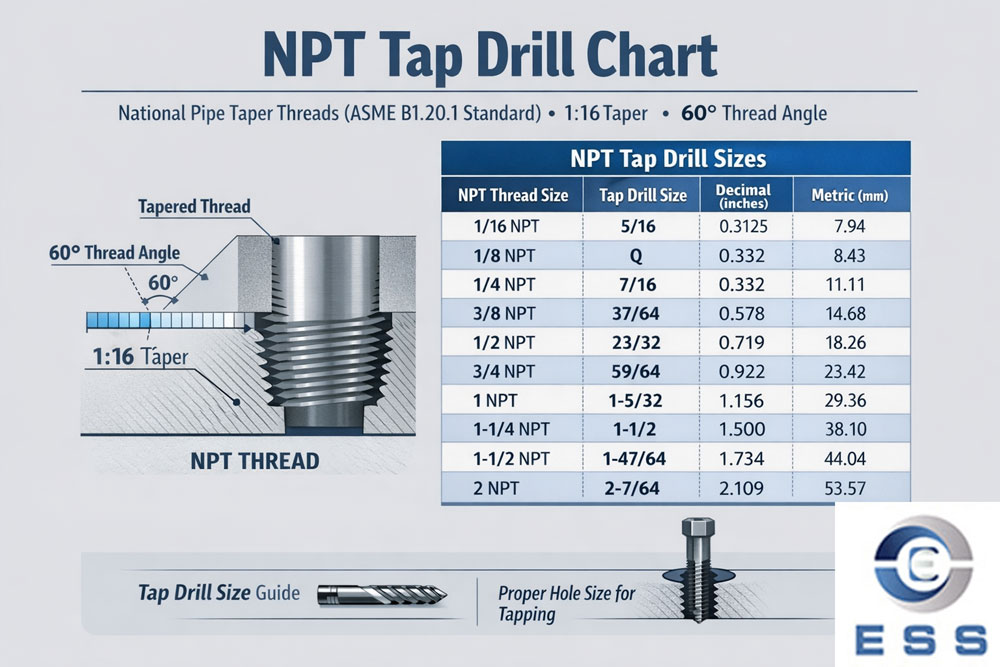
1. Complete Pipe Thread Tap Drill Chart (NPT)
Selecting the correct tap drill size is essential to ensure proper thread engagement and reliable sealing performance.
The standard dimensions for NPT pipe threads are defined by the American Society of Mechanical Engineers (ASME) under the ASME B1.20.1 National Pipe Thread Standard.
NPT threads feature a 60° thread angle and a 1:16 taper, which allows the threads to create an interference fit when tightened, helping to achieve a pressure-tight seal.
The table below lists common NPT pipe thread sizes along with their recommended tap drill sizes.
|
NPT Thread Size
|
Tap Drill Size
|
Decimal (inch)
|
Metric (mm)
|
|
1/16 NPT
|
5/16
|
0.3125
|
7.94
|
|
1/8 NPT
|
Q
|
0.332
|
8.43
|
|
1/4 NPT
|
7/16
|
0.438
|
11.11
|
|
3/8 NPT
|
37/64
|
0.578
|
14.68
|
|
1/2 NPT
|
23/32
|
0.719
|
18.26
|
|
3/4 NPT
|
59/64
|
0.922
|
23.42
|
|
1 NPT
|
1-5/32
|
1.156
|
29.36
|
|
1-1/4 NPT
|
1-1/2
|
1.500
|
38.10
|
|
1-1/2 NPT
|
1-47/64
|
1.734
|
44.04
|
|
2 NPT
|
2-7/64
|
2.109
|
53.57
|
Technical Notes:
(1) Standards Reference: This chart follows the ASME B1.20.1 standard. Drill sizes are calculated based on the thread major diameter minus a thread allowance. The allowance may vary slightly depending on the pipe size to ensure proper thread engagement depth.
(2) Taper and Engagement: NPT threads have a 1:16 taper. Using a drill that is too small increases tapping resistance, while a drill that is too large can compromise sealing. The sizes listed in this chart are standard references and can be used directly for machining or verification.
(3) Typical Applications: Instrumentation fittings, pneumatic systems, hydraulic lines, and threaded connections in carbon steel pipe systems used in industrial environments.
2. Common Pipe Thread Tap Drill Sizes
Different pipe thread sizes require specific drill diameters for proper tapping. Below is a quick reference for some of the most common pipe threads and their recommended tap drill sizes.
2.1 1/8 NPT Pipe Tap Drill Size
The recommended drill size for 1/8 NPT is Q (0.332" / 8.43 mm).
Recommended pre-tap drill size:
|
Thread Size
|
Tap Drill
|
Decimal (in)
|
Metric (mm)
|
|
1/8 NPT
|
Q
|
0.332
|
8.43
|
1/8 NPT is commonly used in small pipe connections such as instrumentation fittings and pneumatic systems.
The Q drill is the standard size used for tapping this thread and is widely referenced in NPT tap drill charts.
2.2 1/4 NPT Pipe Tap Drill Size
The standard drill size for 1/4 NPT is 7/16 inch (0.438" / 11.11 mm).
Recommended pre-tap drill size:
|
Thread Size
|
Tap Drill
|
Decimal (in)
|
Metric (mm)
|
|
1/4 NPT
|
7/16
|
0.438
|
11.11
|
1/4 NPT threads are widely used in industrial equipment, hydraulic systems, and cooling lines.
Using a 7/16 drill ensures proper thread engagement and reliable sealing performance.
2.3 3/8 Pipe Tap Drill Size
The recommended drill size for 3/8 NPT is 37/64 inch (0.578" / 14.68 mm).
Recommended pre-tap drill size:
|
Thread Size
|
Tap Drill
|
Decimal (inch)
|
Metric (mm)
|
|
3/8 NPT
|
37/64
|
0.578
|
14.68
|
3/8 NPT is commonly used in medium-flow piping systems such as gas lines, cooling systems, and industrial piping.
The 37/64 drill bit provides the correct hole size for proper thread formation.
2.4 1/2 Pipe Tap Drill Size
The standard drill size for 1/2 NPT is 23/32 inch (0.719" / 18.26 mm).
Recommended pre-tap drill size:
|
Thread Size
|
Tap Drill
|
Decimal (inch)
|
Metric (mm)
|
|
1/2 NPT
|
23/32
|
0.719
|
18.26
|
1/2 NPT is one of the most commonly used sizes in industrial piping systems and fluid transport lines.
The 23/32 drill size ensures proper thread engagement and sealing performance in most applications.
3. What Is a Pipe Thread Tap Drill Chart?
A pipe thread tap drill chart is used to determine the correct drill size before tapping pipe threads.
Before threading, a hole must be drilled to a specific diameter. This is known as the tap drill size.
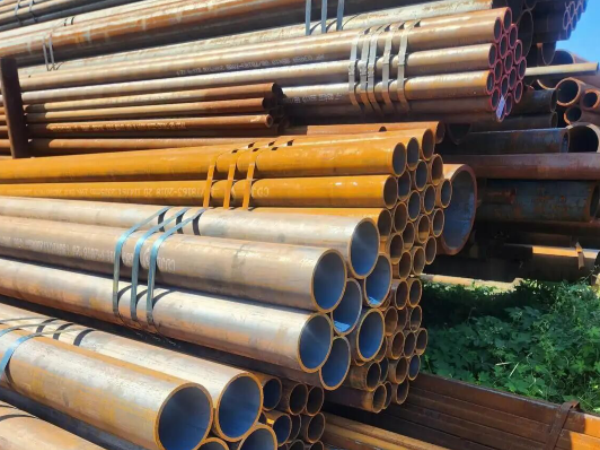
Pipe threads such as NPT are commonly used in systems built with seamless steel pipe, where reliable sealing under pressure is required.
In practice, machinists rely on tap drill charts to quickly select the correct drill size for each thread specification.
4. Common Pipe Thread Types
Different pipe thread standards and types have varying thread angles, tapers, and dimensional systems:
4.1 NPT (National Pipe Taper)
Most common in North America; standard: ASME B1.20.1
Characteristics: Tapered threads with interference fit for sealing
Applications: Industrial piping systems, hydraulic equipment, oil & gas pipe fittings
4.2 BSP (British Standard Pipe)
Commonly used in the UK and parts of Europe
Includes parallel threads (BSPP) and tapered threads (BSPT)
Applications: Industrial piping systems in Europe and parts of Asia
4.3 BSPT (British Standard Pipe Taper)
BSPT threads are tapered threads within the BSP system.
They are similar to NPT threads but differ in thread angle and dimensions. BSPT threads cannot be directly interchanged with NPT threads.
Applications: European equipment connections and mechanical system interfaces.
5. Principles for Determining Tap Drill Size
For NPT pipe threads, the drill size is determined by several key factors:
5.1 Thread Major Diameter
The major diameter of a thread is a fundamental parameter in determining the drill size. In any thread system, the major diameter refers to the maximum diameter of an external thread or the theoretical maximum diameter of an internal thread.
For NPT threads, standard dimensions are defined by ASME B1.20.1. The tap drill size is generally smaller than the major diameter to leave enough material for the tap to form a full thread profile.
A simplified formula can be expressed as:
Tap Drill Size ≈ Major Diameter − Thread Height Allowance
The Thread Height Allowance ensures that, after tapping, the thread maintains the proper profile. If the drill size is too large, the resulting thread height will be insufficient, directly affecting connection strength and sealing performance.
5.2 Thread Taper
Unlike standard machine threads, NPT threads are tapered threads. According to ASME B1.20.1, NPT threads have a taper of 1:16, meaning the diameter increases by 1 unit for every 16 units of axial length.
This taper is designed to create thread interference during tightening, providing a mechanical seal.
5.3 Thread Engagement
Thread engagement refers to the portion of the internal and external threads that actively bear load. In pipe connections, engagement depth directly affects:
① Threaded connection strength
② Vibration resistance
③ Sealing performance
5.4 Manufacturing Tolerance
In practice, manufacturing tolerances must be considered during drilling and tapping. Even with a standard drill size, the actual hole diameter can be affected by:
① Drill wear
② Machine accuracy
③ Material machinability
④ Cooling and lubrication conditions
Therefore, standard tap drill sizes typically include an allowance to ensure the resulting thread meets specifications under normal machining conditions.
For high-precision or high-strength applications (e.g., industrial equipment or oilfield pipe connections), it may also be necessary to inspect the threads using a thread gauge to confirm that the dimensions meet the required standard.
6. Common Mistakes When Choosing Tap Drill Sizes
In industrial steel piping systems and equipment manufacturing, pipe thread connections are widely used for various removable pipelines, such as instrument connections, pneumatic systems, hydraulic lines, and small- to medium-diameter industrial pipelines. Selecting the correct tap drill size before tapping is a critical step to ensure sufficient thread strength and reliable sealing performance.
Internal threads are typically formed through tapping. During the drilling stage, the hole diameter must be determined according to a standard tap drill chart, such as the ASME B1.20.1 NPT pipe thread standard. Using the correct drill size ensures that the tapped threads achieve the proper thread height and engagement depth.
Some common mistakes that can affect thread quality include:
(1) Using a non-standard drill chart
Standard machine thread drill charts differ from pipe thread charts. Using the wrong chart can result in threads that are either too tight or have insufficient engagement.
Mixing different thread standards
For example, NPT and BSPT threads are both tapered, but they differ in thread angle and sizing. Mixing standards often results in incompatible fittings.
(2) Relying solely on experience to select drill sizes
For threads that require proper sealing or are under pressure, it is essential to follow a standard tap drill chart rather than relying on guesswork.
(3) Ignoring drilling tolerances
Drill wear, material hardness, and machine precision all affect the actual hole diameter, which in turn impacts thread engagement and sealing performance.
In industrial piping systems, strictly following standard tap drill sizes is the fundamental prerequisite for achieving high-quality threads and reliable connections.
7. Related Industrial Pipe Products
Thread technology is equally important in the oil and gas industry. Casing, tubing, and drill pipe all rely on precisely machined threaded connections to maintain structural integrity under demanding operating conditions.
.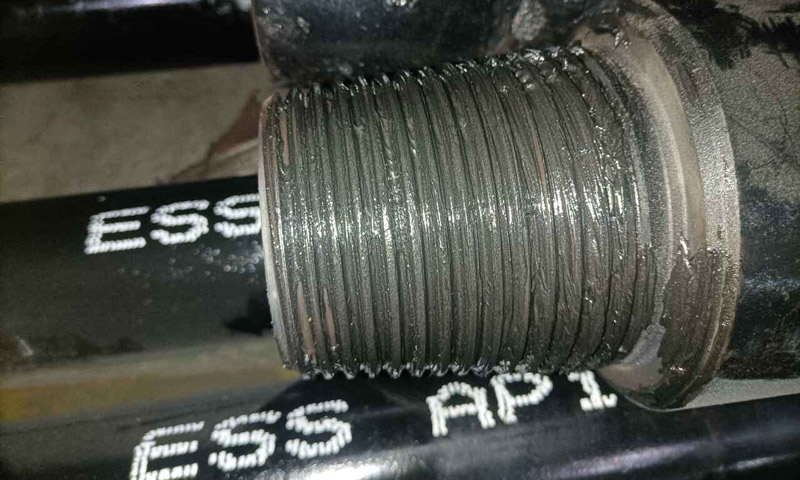
While drill pipe threads differ significantly from standard NPT threads in both design and function, machining accuracy remains a key factor affecting connection strength, sealing performance, and service life.
Learn more about the different types of drill pipe threads used in oilfield operations.
8. FAQs
Q1: What is the drill size for a 1/8 NPT pipe tap?
A: For a 1/8 NPT pipe thread, the standard pre-tap drill size is Q drill bit (0.332 in / 8.43 mm). This size is used as the standard reference in most NPT tap drill charts.
Q2: What drill size is used for a 1/4 NPT tap?
A: A 7/16 in (11.11 mm) drill bit is commonly used for pre-tapping a 1/4 NPT pipe. This size ensures the threads achieve the proper engagement depth after tapping.
Q3: What is a pipe thread tap drill chart?
A: It is a reference chart used to determine the correct drill size before tapping pipe threads. The chart lists standard drill sizes for different thread types, including NPT, BSP, and BSPT.
Q4: Are NPT and BSP tap drill sizes the same?
A: No. NPT and BSP tap drill sizes are generally not interchangeable. They differ in thread angle and sizing, so each standard requires its own chart.
Q5: What drill size is used for a 3/8 NPT tap?
A: The standard drill size is 37/64 in (0.578 in / 14.68 mm), based on ASME B1.20.1. This size ensures proper thread engagement without excessive cutting resistance and maintains sealing performance.
Q6: Why is the tap drill size smaller than the thread size?
A: The drill size is smaller than the thread’s major diameter to form a full thread profile, ensure proper engagement depth, and achieve sealing. This is a core engineering principle in pipe thread machining.
9. Conclusion
Choosing the correct tap drill size is essential for achieving precise thread engagement and reliable sealing in pipe connections. Following standard charts like ASME B1.20.1 ensures consistent quality, reduces errors, and guarantees the performance of both industrial and oilfield piping systems.
For related technical references, you may also find the following topics useful:
- BSP vs NPT Thread Comparison
- BSP Tap Drill Size Chart Overview
- Seamless vs Welded Pipe Selection Guide





 Eastern Steel Manufacturing Co.,Ltd not only improve product production and sales services, but also provide additional value-added services. As long as you need, we can complete your specific needs together.