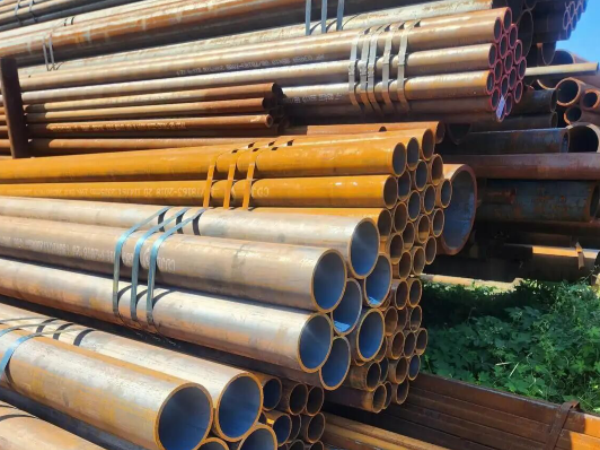
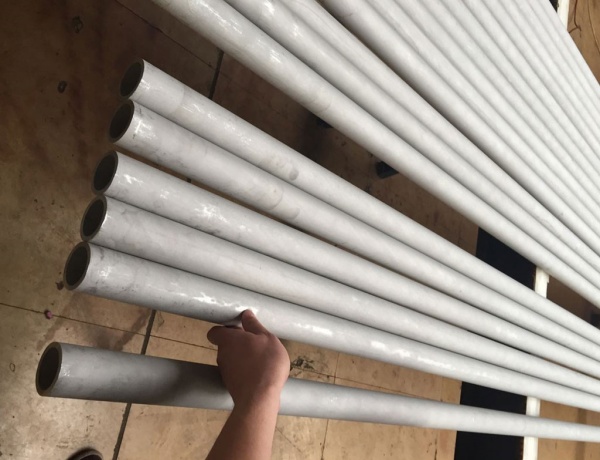
In oil, gas, and geological drilling engineering, weight of drill pipe is one of the core parameters in drilling design, equipment selection, and well control calculations. Accurately determining drill pipe weight is crucial not only for the rig's hook load capacity and drill string strength verification but also for drilling efficiency and operational safety.
This article will systematically analyze drill pipe weight from multiple dimensions, including specification relationships, weight calculation methods, weight tables, and influencing factors.
1. Drill Pipe Weight and Specifications
The weight of drilling pipes is closely related to their specifications. The weight of drill pipes is mainly determined by the following geometric parameters:
Outer Diameter (OD)
Wall Thickness (WT)
Single Length (Range)
Steel Density (usually carbon steel or low alloy steel)
Tool Joint Weight
According to the American Petroleum Institute (API) standards, the common drill pipe diameter ranges from 60.3 to 139.7 mm, and the length mainly varies from 8 to 10 meters. Within these specification ranges, the weight of a single drill pipe generally ranges from 74.56 to 335.7 kg. However, in actual use, other non-standard drill pipe specifications may be encountered, and their weights will vary.
2. Drill Pipe Weight Chart
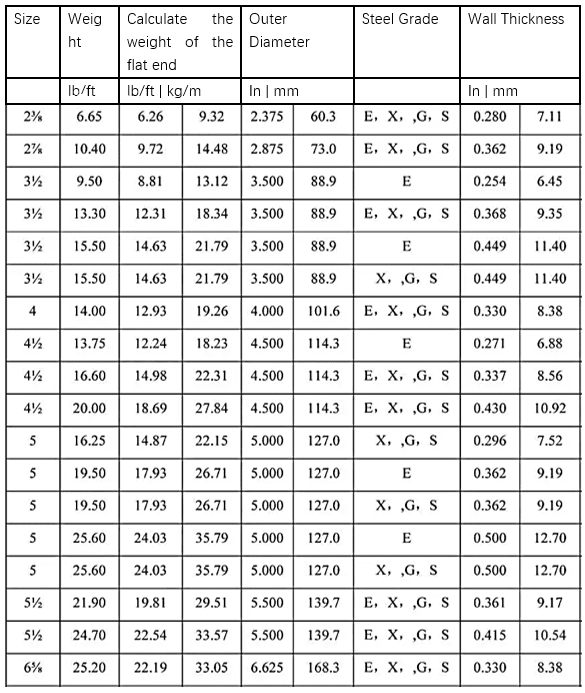
The drill pipe weight chart below provides the nominal weight, outside diameter (OD), wall thickness, and available steel grades for common API 5DP drill pipe sizes. These values are widely used for drill string design, load calculations, and drilling equipment selection.
-
Nominal Weight: Standard drill pipe weight used in API specifications.
-
OD (Outside Diameter): External diameter of the drill pipe body.
-
Wall Thickness: Thickness of the pipe wall corresponding to each weight class.
-
Steel Grade: Available grades such as E-75, X-95, G-105, and S-135.
|
Drill Pipe Size
|
Nominal Weight (lb/ft)
|
Weight (kg/m)
|
WT (in)
|
WT (mm)
|
Available Grades
|
|
2 3/8"
|
6.65
|
9.32
|
0.280
|
7.11
|
E, X, G, S
|
|
2 7/8"
|
10.40
|
14.48
|
0.362
|
9.19
|
E, X, G, S
|
|
3 1/2"
|
9.50
|
13.12
|
0.254
|
6.45
|
E
|
|
3 1/2"
|
13.30
|
18.34
|
0.368
|
9.35
|
E, X, G, S
|
|
3 1/2"
|
15.50
|
21.79
|
0.449
|
11.40
|
E, X, G, S
|
|
4"
|
14.00
|
19.26
|
0.330
|
8.38
|
E, X, G, S
|
|
4 1/2"
|
13.75
|
18.23
|
0.271
|
6.88
|
E
|
|
4 1/2"
|
16.60
|
22.31
|
0.337
|
8.56
|
E, X, G, S
|
|
4 1/2"
|
20.00
|
27.84
|
0.430
|
10.92
|
E, X, G, S
|
|
5"
|
16.25
|
22.15
|
0.296
|
7.52
|
X, G, S
|
|
5"
|
19.50
|
26.71
|
0.362
|
9.19
|
E, X, G, S
|
|
5"
|
25.60
|
35.79
|
0.500
|
12.70
|
E, X, G, S
|
|
5 1/2"
|
21.90
|
29.51
|
0.361
|
9.17
|
E, X, G, S
|
|
5 1/2"
|
24.70
|
33.57
|
0.415
|
10.54
|
E, X, G, S
|
|
6 5/8"
|
25.20
|
33.05
|
0.330
|
8.38
|
E, X, G, S
|
2.1 Common Drill Pipe Weight in kg
|
Drill Pipe Size
|
Outside Diameter (OD) (mm)
|
Weight Range (kg/m)
|
|
2 3/8"
|
60.3
|
7.22–9.89
|
|
2 7/8"
|
73.0
|
9.52–15.48
|
|
3 1/2"
|
88.9
|
14.14–23.07
|
|
4"
|
101.6
|
17.63–24.71
|
|
4 1/2"
|
114.3
|
20.46–29.76
|
|
5"
|
127.0
|
24.11–37.23
|
|
5 1/2"
|
139.7
|
29.02–41.37
|
|
5 7/8"
|
149.2
|
33.04–48.06
|
2.2 Drill Pipe Weight in Special Materials
Some drill pipes are made of special materials, such as high-strength aluminum alloy drill pipes and carbon fiber composite drill pipes. These special materials have lighter weight, higher strength, and corrosion resistance, and are widely used in high-end fields such as deep-sea drilling and oilfield exploration.
The weight per meter of these special material drill pipes is usually lower than that of conventional steel drill pipes of the same type.
(1) Carbon Steel/Alloy Steel Drill Pipe
Density approximately 7.85 g/cm³, standard weight, used in conventional oil and gas wells.
(2) High-Strength Alloy Steel Drill Pipe
Density approximately 7.80 g/cm³, similar weight, but higher strength, used in deep and ultra-deep wells.
(3) Aluminum Alloy Drill Pipe
Density approximately 2.8 g/cm³, weight reduced by 40%+, used in directional and extension wells.
(4) Composite Material Drill Pipe
Customizable, extremely lightweight, used in specialized high-end projects.
3. How to Measure Drill Pipe Weight
3.1 Obtain the Drill Pipe Outer Diameter
(OD)
The outer diameter (OD) is the external
dimension of the drill pipe body, directly affecting its cross-sectional area.
This basic dimension is usually printed on the drill pipe or found in the
specification sheet.
3.2 Determine the Wall Thickness
This measurement can be obtained from the
manufacturer's specifications or measured using a dedicated ultrasonic
thickness gauge. A thicker wall means more material, resulting in a heavier
drill pipe and stronger structural integrity.
3.3 Determine the Steel Grade and Density
The steel
grade of the drill pipe (e.g., E-75, X-95, G-105, S-135) specifies the
material's strength characteristics, but density is crucial for weight
calculations.
Please consult the manufacturer's
specifications or industry standards (e.g., API 5DP) for accurate density
values. By combining the drill
pipe sizes, the weight per foot or meter of drill pipe can be
accurately calculated, which forms the basis for calculating the total weight
of the drill string.
3.4 Consider the Weight and Length of the
Joints
Joints are the threaded connections at both
ends of the drill pipe and are typically heavier and thicker than the drill
pipe body.
The dimensions of the joints (outer
diameter, inner diameter, and length) must be considered, as they significantly
affect the total weight of each drill pipe joint.
The total length of the pin and sleeve ends
affects the effective weight distribution. Manufacturers typically provide a
"nominal weight per foot," which already includes the average weight
of the tool joints.
3.5 Calculate the Nominal Weight per Foot
The nominal weight per foot is usually an
average weight provided by the manufacturer, which simplifies the calculation
of the entire drill string.
This value is derived by dividing the
weight of the pipe body and the heavier tool joints by the weight of a standard
length of pipe joint.
4. Drill Pipe Weight Calculation Formulas
4.1 Weight per Foot (lb/ft) Calculation
Formula
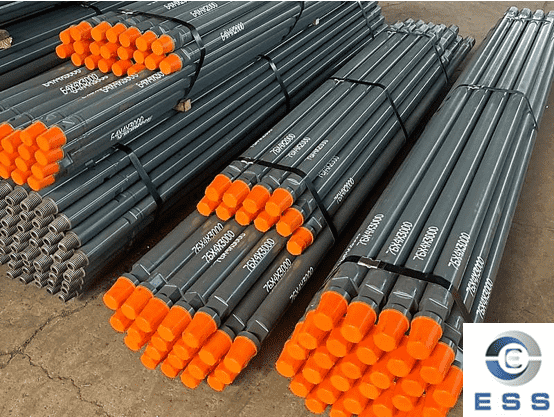
The formula is: Wt/Ft = 10.69 * (OD – Wall Thickness) * Wall Thickness
OD, WT Units: Inches
Result: Pounds per foot (lb/ft)
4.2 Metric Conversion Formula
kg/m = lb/ft × 1.488
5. Drill Pipe Weight in Common Diameter
5.1 Weight per Meter of 26mm Diameter Drill Pipe
For 26mm diameter drill pipe, the weight per meter varies depending on the material and manufacturing process. For example, a certain brand of high-strength steel drill pipe weighs approximately 2.3kg per meter.
5.2 Weight per Meter of a 42mm Diameter Drill Pipe
Similarly, the weight per meter of a 42mm diameter drill pipe is also affected by the material and manufacturing process. For example, a high-quality alloy steel drill pipe from another brand weighs approximately 6.8 kg per meter.
6. Factors Affecting Drill Pipe Weight
Besides length and diameter, the weight of a drill pipe is also affected by the following factors:
6.1 Material Density
Differences in the density of different drill pipe materials will lead to variations in weight.
6.2 Wall Thickness Design
Thicker-walled drill pipes are heavier but stronger. In the API 5DP system, different wall thicknesses typically correspond to different weight classes.
6.3 Connector Type
Different connector structures result in significant weight differences. Tool joints are the thickened threaded connections at both ends of the drill pipe, and their weight typically accounts for 15%–25% of the total weight of the drill pipe.
6.4 Coatings and Threads
Additional coatings or drill
pipe threads can also cause slight variations in weight. Although the
increase in weight per pipe is limited, the cumulative weight change is
significant when hundreds of drill pipes are used in a drill string.
7. FAQ
Q1. Does the drill pipe weight include the
tool joint?
In engineering and API 5DP standards, the
"nominal weight" is typically used, which is the weight of the drill
pipe plus the average weight of the tool joint.
Q2. Why do drill pipes with the same outer
diameter have different weights?
This is because of different weight
classes.
With the same outer diameter (OD), drill
pipes can be configured with different weight classes by varying the wall
thickness (WT), corresponding to different weights per unit length and
load-bearing capacities.
Q3. How should weight information be
correctly described when purchasing drill pipes?
A complete and standardized description
should include: Outer diameter × Weight class × Steel grade × Length class × Applicable standard
For example:
5" × 25.6
lb/ft × G105 × R2 × API 5DP
Q4. How is drill pipe weight calculated?
Drill pipe weight is commonly calculated using the pipe outside diameter (OD) and wall thickness (WT). According to the standard formula:
Weight (lb/ft) = 10.69 × (OD − WT) × WT
where OD and WT are measured in inches.
For metric units:
Weight (kg/m) = Weight (lb/ft) × 1.488
In practice, most drilling engineers also refer to API drill pipe weight charts to verify calculated values and select the appropriate weight class.
Q5. What is the standard weight of drill pipe?
There is no single standard weight for all drill pipes. The weight depends on the outside diameter, wall thickness, and weight class.
For example:
2 3/8" drill pipe: approximately 6.65 lb/ft
3 1/2" drill pipe: approximately 9.50–15.50 lb/ft
5" drill pipe: approximately 16.25–25.60 lb/ft
API 5DP specifications define multiple weight classes for the same drill pipe size to meet different drilling requirements.
8. Summary
Because drill pipe weight varies by size, wall thickness, and steel grade, selecting the correct specification is critical for drilling performance. Always verify drill pipe dimensions and weight classes before finalizing a drilling or purchasing decision.
Read more: API 5DP Drill Pipe Specs & Sizes or 2 7/8″ Drill Pipe Size





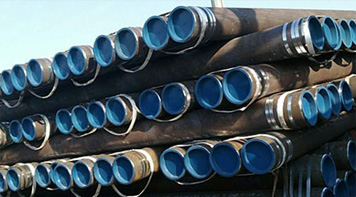 Eastern Steel Manufacturing Co.,Ltd not only improve product production and sales services, but also provide additional value-added services. As long as you need, we can complete your specific needs together.