1. Cold Drawn vs Hot Rolled Pipes: Key Engineering Differences
Cold drawn and hot rolled seamless pipes use different production processes. These differences affect the pipe's dimensions, surface finish, and mechanical properties.
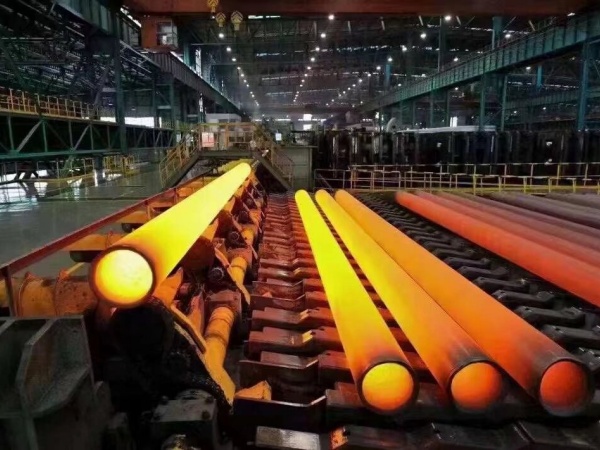
A hot rolled seamless pipe is produced by heating, piercing, and rolling a steel billet at elevated temperature:
Billet → Heating → Piercing → Hot Rolling → Sizing → Cooling
Cold drawn seamless pipe generally starts with a hot-finished seamless tube and undergoes further cold drawing through a die:
Hot-finished tube → Cold Drawing → Heat Treatment / Finishing
This additional cold-working process provides tighter dimensional control and a smoother surface, while the final properties depend on the steel grade and delivery condition.
2. Core Performance Comparison Table
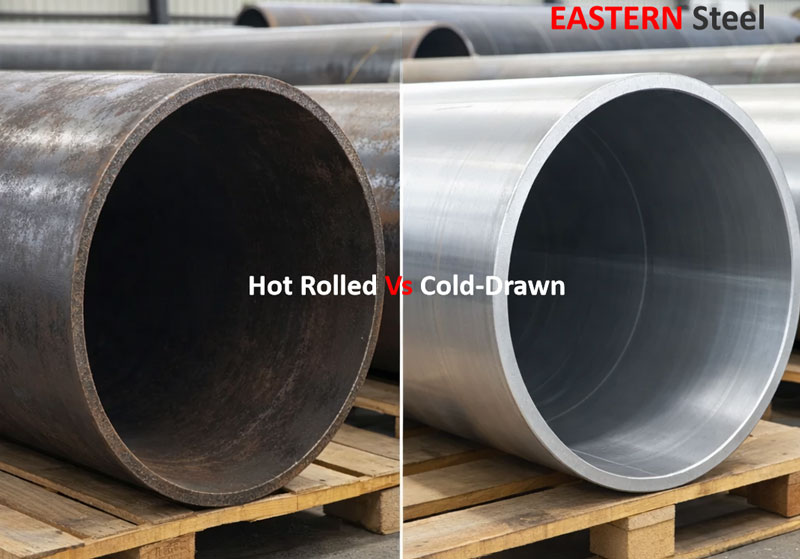
The table below highlights the differences in precision, strength, ductility, and typical applications between cold drawn and hot rolled seamless steel pipes.
|
Comparison Item
|
Cold Drawn Seamless Steel Pipe
|
Hot Rolled Seamless Steel Pipe
|
|
Manufacturing Route
|
Cold working after hot-finished tube production
|
Hot forming and rolling
|
|
Dimensional Accuracy
|
Generally higher
|
Generally lower
|
|
Surface Finish
|
Smoother and more uniform
|
Generally rougher
|
|
Mechanical Properties
|
Cold working can increase strength and hardness
|
Mainly determined by steel grade and heat treatment
|
|
Ductility
|
May decrease after cold working
|
Generally higher
|
|
Size Range
|
Commonly used for small to medium sizes
|
Available across a wider size range, including larger sizes
|
|
Typical Applications
|
Hydraulic cylinders, precision mechanical parts, instrumentation, heat exchanger tubes
|
Structural applications, large-size fluid service, general industrial applications
|
|
Cost
|
Generally higher due to additional processing
|
Generally lower
|
|
Applicable Standards
|
ASTM A179, GB/T 3639, ASTM A519
|
ASTM A106, API 5L, EN 10216
|
|
Main Selection Factor
|
Dimensional accuracy, surface finish, and tighter dimensional requirements
|
Size availability, processing requirements, and cost
|
3. Differences in Engineering Applications
The difference between cold drawn and hot rolled pipes becomes most evident in how they are used.
Cold drawn pipes are typically selected for precision-driven applications, where dimensional accuracy and surface finish directly affect assembly and performance.
Typical cases include:
• Hydraulic cylinders (internal bore matching)
• Precision sleeves and bushings
• Components in automated machinery
In these applications, the key concern is not whether the material is strong enough, but whether it can meet tolerance requirements and be used with minimal additional machining.
Hot rolled pipes, by contrast, are used in capacity-driven applications, where strength, size range, and cost efficiency are the primary factors.
Typical cases include:
• Long-distance oil and gas pipelines
• Structural supports
• Large-diameter fluid transmission systems
These applications allow wider tolerances and place less emphasis on surface condition.
In practice, the decision can often be simplified:
If the challenge is “fit and precision” : choose cold drawn, If the challenge is “capacity and cost” : choose hot rolled
4. Selection Considerations
In most cases, the choice depends on service requirements rather than process preference.
Cold drawn pipes are suitable when tight tolerances, smooth surfaces, or direct assembly are required.
Hot rolled pipes are more appropriate for large diameters, structural applications, or cost-sensitive projects.
Cold drawing can increase strength through work hardening, while ductility may decrease depending on the degree of cold reduction and subsequent heat treatment.
In H₂S or corrosive environments, residual stresses in cold drawn pipes must be considered, and stress-relief heat treatment may be required.
5. Common Selection Misconceptions
In engineering practice, several recurring misconceptions may lead to improper material selection:
(1) Cold drawn is always superior
Cold drawn pipes offer advantages in precision and surface quality, but not in overall performance.
For applications requiring:
Large diameters
Higher ductility
Forming operations (e.g., bending, expansion)
Hot rolled pipes are often the more appropriate choice.
(2) Neglecting residual stress effects
Residual stresses from cold drawing are often overlooked.
Under corrosive conditions or cyclic loading, these stresses may:
Accelerate crack initiation
Reduce service life
Proper evaluation of service environment is essential.
(3) Using cold drawn pipes for large diameters
Cold drawing has inherent process limitations in size range.
For outer diameters typically exceeding 200 mm, the process becomes:
Economically inefficient
Technically impractical
In such cases, hot rolled or welded pipes are the standard solution.
(4) Focusing only on strength, ignoring ductility
While cold drawn pipes exhibit higher strength due to work hardening, they also show reduced ductility.
They are therefore not suitable for applications involving:
Bending
Flaring
Deformation during installation
6. FAQs
Q1. Is cold drawn pipe stronger than hot rolled pipe?
Cold drawing can increase the strength of seamless steel pipe through work hardening. However, the resulting mechanical properties depend on the steel grade, amount of cold reduction, heat treatment, and final delivery condition. Higher strength may also be accompanied by reduced ductility.
Q2. Can cold drawn pipes replace hot rolled pipes?
Only in applications where size limitations and ductility requirements are acceptable. For large diameters or forming operations, hot rolled pipes remain the preferred option.
Q3. Cold drawn vs hot rolled: which one should I choose?
If your application requires tight tolerance, smooth surface, or precision fit → cold drawn
If your priority is large size, structural strength, or cost → hot rolled
Q4. Are cold drawn pipes suitable for corrosive environments?
They can be used, but residual stress must be considered. In environments containing H₂S or similar media, stress relief heat treatment is recommended.
Q5. What is the main limitation of cold drawn pipes?
The primary limitation is size range, typically restricted to small and medium diameters. Large-diameter applications are usually not feasible.
7. Conclusion
For practical decision-making, the difference can be simplified into the following engineering rules:
If the application requires tight tolerance, smooth surface, or direct assembly → choose cold drawn
If the application prioritizes large size, structural strength, or cost efficiency → choose hot rolled
Choosing the right process is not about performance ranking, but about matching the pipe to the actual service conditions.
Read more: Annealing vs normalizing of cold drawn seamless steel pipes and Why Do Cold Drawn Seamless Steel Pipes Crack?





 Eastern Steel Manufacturing Co.,Ltd not only improve product production and sales services, but also provide additional value-added services. As long as you need, we can complete your specific needs together.