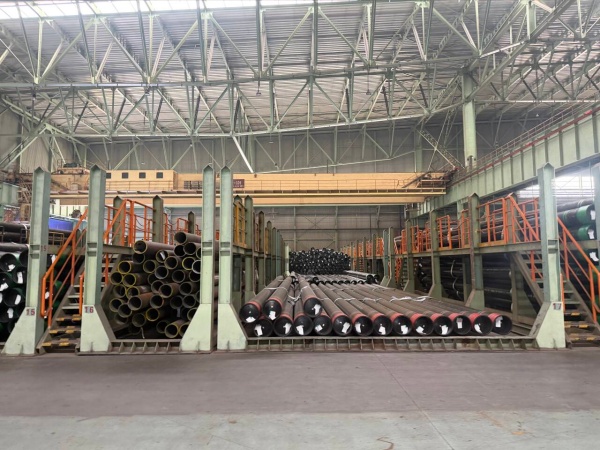
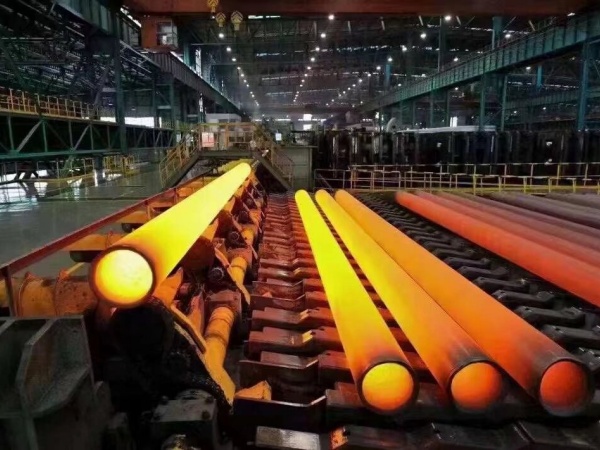
In practical engineering applications, cold drawn seamless steel pipe refers to a high-precision tube produced by further processing hot rolled seamless pipes through cold working methods such as cold drawing or cold rolling.
Compared with standard seamless pipes, the key distinction is not the absence of welds, but the significantly improved dimensional accuracy and surface finish.
During manufacturing, hot rolled seamless pipe is prepared by surface treatment and then subjected to cold working through a drawing die. Depending on the steel grade, dimensions, and drawing route, intermediate heat treatment and additional surface treatment may be applied.
As a result, cold drawn seamless steel pipes typically offer:
High dimensional accuracy (up to H8–H10 tolerance grades)
Smooth surface finish, suitable for further machining
Stable mechanical properties, with improved fatigue performance
It should be noted that cold drawing is essentially a secondary finishing process. Its performance characteristics and application scenarios differ significantly from those of hot rolled seamless steel pipes.
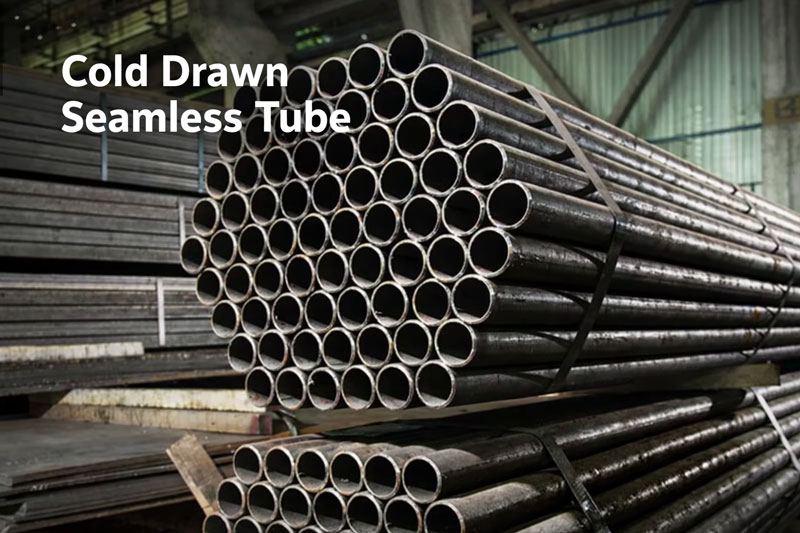
2. Core Characteristics and Advantages of Cold Drawn Seamless Steel Pipe
Cold drawn seamless steel pipe is mainly selected for applications where dimensional accuracy, surface finish, and consistency are more important than the lower processing cost of hot rolled pipe.
The main features are as follows:
(1) High dimensional accuracy
During the cold drawing process, the steel pipe is plastically deformed under the constraint of a die, allowing precise control of the outer diameter and wall thickness. Compared with hot rolled pipes, dimensional tolerances are significantly reduced.
This characteristic is particularly important in applications requiring tight assembly fits or subsequent machining, such as hydraulic cylinder tubes or shaft components.
(2) Smooth surface finish
Cold drawn pipes have a smoother internal and external surface with lower roughness, which can significantly reduce machining allowance in downstream processes.
In some applications (e.g., honed tubes), cold drawn pipes can even be used directly as semi-finished products, thereby reducing overall manufacturing costs.
(3) Improved mechanical properties
During cold working, the material undergoes work hardening, which can increase yield and tensile strength while reducing ductility. Residual stresses may also be introduced during deformation.
However, this strengthening effect also introduces internal stresses, which is why heat treatment processes such as annealing are often required to restore material stability.
(4) Suitable for precision applications
Cold drawn tubes are well suited to precision components that require controlled dimensions and consistent surface quality, particularly where further machining or close-fit assembly is involved.
(5) Not universally superior in all applications
It should be emphasized that cold drawn seamless steel pipe is not “overall superior” to hot rolled pipe.
For large-diameter applications or services where temperature, pressure, or design-code requirements govern the selection, the applicable seamless pipe specification and manufacturing route should be evaluated together.
3. Manufacturing Process
Cold drawn seamless steel pipe is not an independently starting product. It is typically manufactured using hot rolled seamless steel pipes as the base material, followed by a series of cold working processes to improve dimensional accuracy and surface quality.
A typical manufacturing process is as follows:
Step 1: Pickling
Removes scale and surface impurities from the steel pipe, providing a clean surface for subsequent processing.
Step 2: Phosphating
Forms a lubricating film on the pipe surface, reducing friction during the drawing process and minimizing the risk of surface scratches.
Step 3: Cold Drawing
The pipe is plastically deformed at room temperature through a drawing die, reducing and homogenizing the outer diameter and wall thickness. This is the core process that determines dimensional accuracy and surface finish.
Step 4: Annealing
Used to relieve internal stresses generated during cold working and restore material ductility, preventing cracking or failure during subsequent processing or service.
Step 5: Finishing
Includes straightening, cutting, inspection, and other final processes to ensure the pipe meets end-use requirements.
In actual production, depending on size specifications and precision requirements, multiple drawing passes and intermediate heat treatments may be applied to balance strength and ductility.
4. Cold Drawn vs Hot Rolled Seamless Steel Pipe
In engineering selection, there is no simple “better or worse” relationship between cold drawn seamless steel pipes and hot rolled seamless steel pipes. The differences mainly lie in the processing methods and the resulting performance priorities.
A brief comparison is shown below:
|
Item
|
Cold Drawn Seamless Steel Pipe
|
Hot Rolled Seamless Steel Pipe
|
|
Precision
|
High (strict dimensional control)
|
Relatively lower
|
|
Surface quality
|
Smooth, suitable for precision finishing
|
Relatively rough
|
|
Typical applications
|
Precision components, hydraulic systems
|
Structural parts, fluid transportation
|
From an application perspective:
When the system requires tight dimensional tolerances, low surface roughness, or high fitting accuracy, cold drawn pipes are usually preferred.
When the priority is pressure resistance, large diameter, or cost control, hot rolled pipes are more advantageous.
A full comparison can be found here: Cold Drawn vs Hot Rolled Seamless Steel Pipe
5. Typical Applications
Cold drawn seamless steel pipe is not a “general-purpose pipe material”, but a base material used in precision manufacturing. Its applications typically share a common requirement: strict demands on dimensional accuracy, surface quality, or fitting performance, often with reduced need for secondary machining.
5.1 Hydraulic and Pneumatic Systems
Typical products: hydraulic cylinder tubes, piston rod tubes, pneumatic cylinder sleeves
Hydraulic cylinder bores usually require H8/H9 tolerance and a smooth surface (Ra 0.4–0.8 μm). Cold drawn pipes can often be used as semi-finished material, reducing honing allowance by 30%–50%.
Wall thickness consistency is another key factor. Cold drawn pipes typically control this within ±5%, while hot rolled pipes may reach ±12.5%, which can affect seal life.
For high-pressure systems (≥16 MPa), standards like GB/T 3639 or DIN 2391 are commonly used.
For low-pressure pneumatic lines, hot rolled pipes with secondary machining can be a more economical option.
5.2 Machined Components and Precision Structural Parts
Typical products: shafts, sleeves, bearing housings, guide columns
Cold drawn pipes can achieve IT8–IT10 tolerance (±0.05–0.10 mm), while hot rolled pipes are usually around IT12–IT13 (±0.2–0.5 mm). The smoother surface (Ra ≤ 1.6 μm) also reduces machining allowance.
If additional heat treatment (e.g., quenching or carburizing) is required, machining allowance should be planned carefully due to higher surface hardness.
For high-volume parts, cold drawn pipes can help reduce overall processing cost.
5.3 Automotive and Heavy Machinery
Typical products: drive shafts, shock absorber tubes, structural parts
Cold working can increase yield strength by around 15%–20%, allowing some reduction in wall thickness for lightweight design. It also provides better control of wall thickness (typically within ±0.10 mm), which is important for parts like shock absorber tubes.
For rotating parts such as drive shafts, straightness and uniformity are critical. For non-critical structural parts, hot rolled pipes are usually sufficient.
5.4 Heat Exchangers and Boiler Tubes (Selected Applications)
Typical products: heat exchanger tubes, boiler tubes
A smoother internal surface can reduce surface roughness and may help improve flow and heat-transfer performance, depending on the tube design and service conditions.
Cold drawing is commonly used for small-diameter and thin-wall tubes where tighter dimensional control and surface quality are required.
For high-temperature or high-pressure conditions (>400°C), standards such as ASTM A179 or A192 should be followed. Material grade selection is more critical than the process itself.
5.5 Instrumentation and Precision Equipment
Typical products: instrument tubing, capillary tubes, measurement lines
For very small diameters (<20 mm) and thin walls (<1 mm), cold drawing is essentially required.
It also provides better batch consistency, which is important for precision systems (OD variation typically within ±0.05 mm).
For low-pressure applications (<5 MPa), stainless steel (304/316L) is often used.
For air or inert gas systems, carbon steel pipes are usually sufficient.
If your application involves high-pressure hydraulics, precision fit assemblies, mass automated assembly, or small-diameter thin-walled tubing, cold drawn seamless steel pipe is usually the better choice. If it is only for general structural support or low-pressure fluid transport, hot rolled pipes with simple machining are typically sufficient.
6. Common Issues and Defects
In actual production and service conditions, the performance of cold drawn seamless steel pipes is not determined solely by material grade; process control and quality management are equally critical.
Due to work hardening and residual stress introduced during cold working, several typical issues may occur:
(1) Cracking Issues (Cracking)
Including longitudinal cracks, transverse cracks, and internal wall cracks.
These are usually caused by:
Excessive cold drawing reduction (beyond allowable limits)
Impurities or internal defects in the raw material
Insufficient intermediate annealing leading to stress accumulation
(2) Surface Defects (Surface Defects)
Such as scratches, pitting, and residual oxidation.
These defects are often amplified during cold drawing and can directly affect subsequent processing quality, such as honing or coating.
(3) Dimensional Deviation (Dimensional Deviation)
Although cold drawn pipes are known for high precision, deviations may still occur under the following conditions:
Die wear
Insufficient lubrication
Unstable drawing process
These issues are typically directly related to production process control.
(4) Residual Stress Issues (Residual Stress)
Internal stresses generated during cold working, if not relieved through annealing, may lead to:
Cracking during service
Stress corrosion cracking in corrosive environments (e.g., H₂S environments)
Therefore, when evaluating cold drawn seamless steel pipes, attention should not only be paid to material standards, but also to the stability of the manufacturing process and the level of quality control.
Related technical reading:
Defects and Failure Analysis:
- Why do cold drawn seamless steel pipes crack
- Common defects and causes of cold drawn seamless steel pipes
Heat Treatment and Material Stability: - Annealing vs normalizing of cold drawn seamless steel pipes
7. Sizes and Specifications
Cold drawn seamless steel pipes are typically focused on medium-to-small diameters and high-precision applications. Their dimensional capabilities are primarily limited by the cold working process.
The common size range is as follows:
Outer Diameter (OD): approximately 5 mm – 200 mm
Wall Thickness (WT): approximately 0.5 mm – 12 mm
For detailed dimensions and specific combinations, refer to the full seamless steel pipe size chart.
In terms of standards, cold drawn seamless steel pipes are commonly manufactured and supplied according to the following specifications:
China standard: GB/T 3639 (precision seamless steel tubes)
ASTM standards: ASTM A106, ASTM A179, ASTM A192
European standards: EN 10305, EN 10216
It should be noted that the exact size range may vary depending on steel grade, manufacturing process, and application requirements. Cold drawing technology has a clear advantage, particularly in small-diameter and thin-wall tube production.
8. FAQ
Q1. What is cold drawn seamless steel pipe?
Cold drawn seamless steel pipe is a high-precision steel pipe produced by further processing hot rolled seamless pipe through cold drawing or cold rolling processes.
It is characterized by tighter dimensional tolerances, smoother surface finish, and improved mechanical properties compared to standard seamless pipes.
Q2. What is the difference between cold drawn and hot rolled seamless pipe?
The main difference lies in the manufacturing process and resulting performance.
Cold drawn pipes are processed at room temperature, offering higher precision and better surface quality, while hot rolled pipes are produced at high temperatures, making them more suitable for large diameter and structural applications.
Q3. What sizes are available for cold drawn seamless steel pipes?
Cold drawn seamless pipes are typically available in outer diameters ranging from 5 mm to 200 mm, with wall thickness from approximately 0.5 mm to 12 mm.
For detailed dimensions and specific combinations, refer to the full size chart.
Q4. Where are cold drawn seamless steel pipes commonly used?
They are widely used in applications requiring high precision and surface quality, such as hydraulic cylinders, mechanical components, automotive parts, heat exchangers, and precision instruments.
9. Related Articles
To explore more technical details and related topics, you may find the following articles helpful:
Manufacturing and Process:- Cold Drawn Seamless Steel Pipe Manufacturing Process
Comparison:
- Cold Drawn vs Hot Rolled Seamless Steel Pipe
Defects and Problems:
- Common Defects in Cold Drawn Seamless Steel Pipe
- Why Do Cold Drawn Seamless Steel Pipes Crack
Specifications:
- Cold Drawn Seamless Steel Pipe Size Chart
Heat Treatment:
- Annealing vs Normalizing of Steel Pipe





 Eastern Steel Manufacturing Co.,Ltd not only improve product production and sales services, but also provide additional value-added services. As long as you need, we can complete your specific needs together.