Drill
pipe threads are crucial components connecting
the drill
pipe and drill bit, responsible for transmitting drilling power and
load. The quality of the thread directly determines drilling efficiency,
connection reliability, and the service life of the entire drilling tool set.
In applications such as geological
exploration, water well drilling, and mining drilling, threads typically need
to operate for extended periods under high torque, high impact, and high wear
environments. This article will detail the classification, tooth profile,
dimensions, and API specifications of geological drill pipe threads.
Classification of Geological Drill Pipe
Threads
From an industry application perspective,
geological drill pipe threads can be mainly divided into two systems:
Following standards such as API Spec 5DP /
API Spec 7-1, these threads offer good interchangeability, are globally
applicable, and are widely used in petroleum, geological, water well, and
mining drilling.
2. Non-API Threads (Custom or
Industry-Specific)
Commonly found in mining and engineering
drilling systems, usually custom-made for factory standards or specific
projects. Advantages include optimization for specific working conditions, but
interchangeability is poor.
Tooth Profiles of Geological Drill Pipe
Thread
Geological drill pipes come in various
thread types according to tooth profile, each suitable for different drilling
needs and conditions.
1. Triangular Threads
Triangular threads are a common type, with
a triangular tooth profile. They offer good sealing and self-locking
properties, effectively preventing drilling fluid leakage.
Suitable for scenarios with high sealing
requirements, such as drilling in geological environments with water or other
fluids.
2. Trapezoidal Threads
Trapezoidal threads have a trapezoidal
tooth profile. They have strong load-bearing capacity and can transmit large
torques and axial forces.
Suitable for drilling depths requiring
large power transmission, widely used in drilling through hard rock formations.
3. Rectangular Threads
Rectangular threads have a rectangular
tooth profile. They offer high transmission efficiency and low friction between
threads.
Suitable for scenarios requiring rapid
drilling and frequent disassembly, but due to its poor self-locking
performance, it needs to be used in conjunction with other locking devices.
4. Others
In addition, there are some special types
of threads, such as sawtooth threads, which combine the advantages of
trapezoidal and rectangular threads, can withstand larger unidirectional axial
forces, and play a role in specific working conditions.
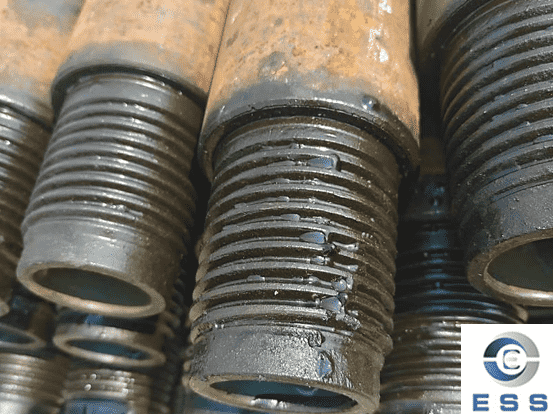
Geological Drill Pipe Thread Sizes
1. Thread Outer Diameter
The thread outer diameter, also known as
the "tooth diameter," is the standard size for the maximum diameter
of the drill pipe thread. Its value is usually equal to or slightly smaller
than the drill pipe diameter.
Common thread outer diameters specified by
API standards include 2-3/8 inches, 2-7/8 inches, 3-1/2 inches, 4 inches, 4-1/2
inches, and 5 inches.
2. Pitch
The pitch is the distance between two
adjacent teeth on the thread helix, and is an important parameter describing
the degree of thread engagement.
Common API thread pitches include 4, 4.5,
5, and 5.5. Generally, a larger pitch results in a larger engagement area and
contact pressure, and a relatively smaller volume and weight.
4 TPI: Deep fit, high load capacity
4.5 TPI: Balanced type
5 / 5.5 TPI: Faster assembly and
disassembly, lighter weight
3. Nominal Diameter
Nominal diameter, also known as
"finger diameter," is the distance between the thread peak line and
the thread axis, usually corresponding to the diameter of the middle of the
thread unit.
Common API thread nominal diameters include
2.063 inches, 2.469 inches, 2.875 inches, 3.5 inches, and 4 inches.
4. Nominal Length
Nominal length, also known as "thread
length," is an important parameter describing the thread length,
representing the effective length of the fit within the thread unit.
Common nominal lengths specified by API
standards include 2.4 inches, 2.7 inches, and 3.1 inches.
API Geological Drill Pipe Thread Types
Common API thread types include STC, LTC,
BTC, NC, and REG.
|
Thread Types
|
Full Names
|
Characteristics
|
Applicable Scenarios
|
|
STC
|
Short Thread Coupling
|
Short teeth, light load
|
Conventional geological drilling.
|
|
LTC
|
Long Thread Coupling
|
Long coupling length, high strength
|
Mining, oil fields.
|
|
BTC
|
Buttress Thread
|
Rear edge type, ultra-high load capacity
|
Deep wells, high pressure.
|
|
REG
|
Regular
|
Traditional tapered thread
|
Light to medium load.
|
|
NC
|
Numbered Connection
|
Digital standard
|
High-performance drilling.
|
Causes of Damage to Geological Drill
Pipe Threads
1. Improper Installation
Forcing tightening without proper thread
alignment or using excessive tightening force during drill pipe connection can
damage and deform the thread profile, even leading to stripping.
2. Wear
Increased drilling depth and duration
result in frequent friction between threads. The presence of rock cuttings,
mud, and other impurities accelerates thread wear, reducing sealing performance
and connection strength.
3. Material Issues
Insufficient material strength or defects
in the drill pipe thread material can easily lead to thread breakage and
chipping under high torque and pressure.
4. Harsh Geological Conditions
Encountering hard rock layers or complex
geological structures can subject drill pipes to severe impacts and vibrations,
causing additional damage to the threads and resulting in thread failure.
Geological Drill Pipe Thread Selection
Principles
1. Select the appropriate thread type,
outer diameter, and length based on the operating environment.
2. Use standardized API threads whenever
possible to facilitate thread interchange and connection.
3. Pitch and thread length should be
balanced according to requirements to obtain optimal thread parameters that
meet operational needs.
FAQ
1. Can API threads and non-API threads be
mixed?
Generally, mixing them is not recommended.
Different thread standards have differences
in thread profile angle, taper, pitch, and tolerances. Mixing them can easily
lead to: insufficient fit, seal failure, premature thread wear, or stripping.
On-site, threads of the same standard and
series should always be used together.
2. What is the angle of geological drill
pipe threads?
Different thread types have different
angles:
Triangular thread (V-type): Typically 60°
Trapezoidal thread: Commonly 30°
Sawtooth (BTC) thread: Asymmetrical angle,
one side is close to the perpendicular bearing surface.
The specific angle should be based on API
standards or manufacturer technical drawings.
3. Is a larger pitch always better for
drill pipe threads?
Not necessarily.
Larger pitch: Faster assembly and
disassembly, relatively lighter weight.
Smaller pitch: Larger contact area,
stronger load-bearing capacity.
In deep wells and high-torque conditions,
pitch combinations with higher load-bearing capacity are usually preferred over
simply pursuing assembly and disassembly efficiency.
Summary
In summary, geological drill pipe threads
are not only a connection structure but also a key component determining
drilling safety and economy. Appropriate selection of thread type, size, and
standard can significantly improve drilling efficiency and effectively reduce
risks such as pipe breakage and stripping.
Read more: API 5DP Drill Pipe Specs & Sizes





 Eastern Steel Manufacturing Co.,Ltd not only improve product production and sales services, but also provide additional value-added services. As long as you need, we can complete your specific needs together.