1. Drilling Pipe Systems
Types of drill pipe in a typical drill string include:
- Kelly (Drive section)
- Drill Pipe (Standard section)
- Heavy Weight Drill Pipe (HWDP)
- Drill Collar
These components are arranged from top to bottom to balance torque transmission, weight distribution, and fatigue resistance. This arrangement represents the typical types of drill pipe used within a complete drill string structure.
While this classification looks straightforward, in real drilling operations, drill pipe is rarely considered in isolation. Instead, it is evaluated as part of the entire drill string, where each section performs a different mechanical role.
The purpose of classification is not simply to distinguish names, but to address practical engineering challenges—how torque is transmitted, how weight reaches the bit, and how fatigue is distributed during continuous rotation.
If a single structure were used throughout the entire drill string, it might seem simpler, but in deep or directional wells, it often leads to premature failure in specific sections. In contrast, combining different types of drill string components improves overall stability and operational reliability
2. Drill Pipe Types by Function in the Drill String
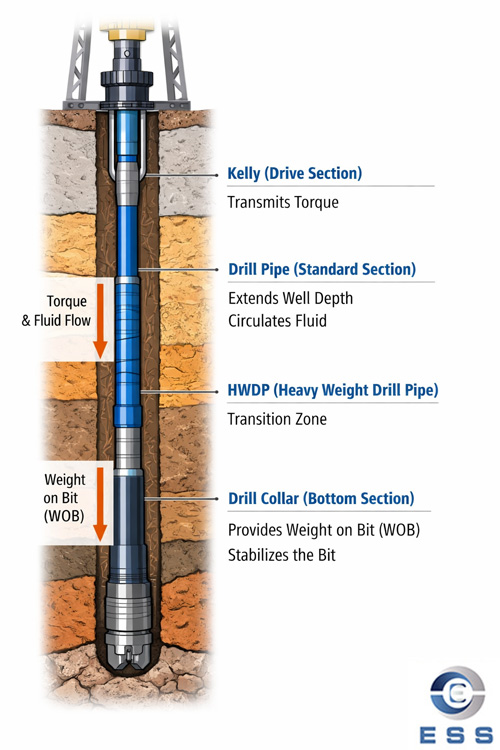
In drill string design, different types of drill components are not assembled randomly; they are arranged along the wellbore according to their function. A typical layout includes the upper drive section, the standard drill pipe section, a transition section, and the bottom-weighted section.
This segmentation determines how loads are transmitted through the drill string—from torque applied at the surface, through the midsection, down to the bottom where it converts into weight on bit (WOB). Each section does not act independently; rather, it plays a specific role within the overall mechanical system.
Instead of thinking of these as “different types of drill pipe,” it is more accurate to view them as a mechanical structure that gradually changes along the well depth.
2.1 Kelly (Drive Section)
The Kelly sits at the top of the drill string, directly connecting to the surface driving equipment. Its non-circular cross-section (square or hexagonal) allows it to transmit rotational torque through the rotary table, making it the core driving component in conventional rotary drilling systems.
With the adoption of top drive systems, torque can be applied directly from the rig top to the drill string, significantly reducing the use of Kellys. However, in some conventional or cost-sensitive operations, Kellys are still used, mainly due to equipment compatibility and operational habit.
2.2 Drill Pipe (Standard Section)
Drill pipe forms the main body of the drill string, responsible for transmitting torque and circulating drilling fluid from the surface to the bottom, while extending well depth through successive connections. As one of the primary drill string components, drill pipe plays a critical role in the overall system performance.
This section is typically designed for consistency rather than extreme performance. In practice, fatigue under repeated loading—especially at joints and areas of stress concentration—has a greater impact on service life than maximum strength. Therefore, standard drill pipe emphasizes structural uniformity and predictability rather than frequent variation.
2.3 Heavy Weight Drill Pipe (HWDP)
Heavy Weight Drill Pipe (HWDP) is a specialized type of drill pipe used in operations where load transition becomes critical.
HWDP is typically positioned between the standard drill pipe and the drill collar to smooth out differences in stiffness and weight between the two.
Without this transition, directly connecting a relatively flexible drill pipe to a highly rigid drill collar would create a sharp change in stress at the interface, increasing the risk of fatigue damage. By designing HWDP with moderate wall thickness and weight, the load variation along the drill string becomes more gradual, making it an effective tool for reducing stress concentration and extending drill string life.
2.4 Drill Collar (Bottom Section)
Drill collars are positioned at the bottom of the drill string, primarily to provide weight on bit (WOB) and maintain the stability of bottom hole tools.
Their design features high wall thickness and rigidity, allowing effective axial load at the bottom while minimizing unwanted bending. This stiffness helps control the drill trajectory but also increases the transmission of vibration and shock.
As a result, drill collars are concentrated at the bottom of the string rather than extending upward, preventing negative impacts on the dynamic response of the entire drill string.
The following table compares the main types of drill pipe and other drill string components based on their roles and engineering significance:
Comparison of Drill String Components by Function
|
Component
|
Position in Drill String
|
Core Function
|
Engineering Value
|
Critical Usage Scenario
|
|
Kelly
|
Top section
|
Transmit surface torque
|
Ensures direct torque transfer from rotary system; prevents slippage due to non-round profile
|
Relevant in conventional rotary drilling; largely replaced in top drive systems
|
|
Drill Pipe
|
Main body
|
Transmit torque & circulate fluid
|
Provides balance between flexibility and strength; dominant factor in fatigue life of the drill string
|
Becomes fatigue-critical in deep wells and extended reach drilling
|
|
HWDP
|
Transition section
|
Smooth load transition
|
Reduces stiffness mismatch between drill pipe and drill collar; minimizes stress concentration
|
Critical in directional and deep wells where load gradients are high
|
|
Drill Collar
|
Bottom section
|
Apply WOB & stabilize BHA
|
High stiffness enables efficient weight transfer and improves trajectory control
|
Essential for drilling efficiency and stability at the bottom hole
|
3. Classification by Structural Design
Beyond their functional roles, drill pipes can also be classified based on structural design.
These differences are generally not intended to change the basic purpose of the pipe, but rather to address specific operational conditions, such as pressure tolerance, friction management, or overall weight. In practice, variations in structural design usually appear when well conditions become more demanding, rather than in standard drilling operations.
3.1 Standard Drill Pipe
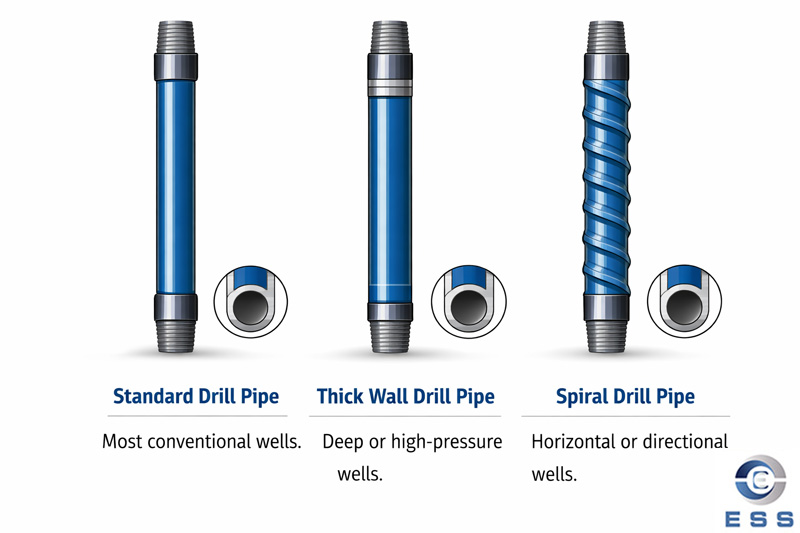
Standard drill pipe is the most common structural type, with wall thickness, weight, and stiffness balanced within a moderate range.
Its main advantage is versatility, making it suitable for most conventional well designs. For wells with relatively stable depth, load, and trajectory, using standard pipe reduces unnecessary complexity and simplifies maintenance and replacement.
3.2 Thick Wall Drill Pipe
Thick wall drill pipe is used in operations that require higher load-bearing capacity, such as deep wells or high-pressure environments.
By increasing wall thickness, these pipes can better resist internal and external pressure and provide greater safety margins under high axial loads. The trade-offs include increased weight and reduced internal diameter, which can negatively affect fluid circulation. Thick wall pipes are typically deployed selectively in well sections where high strength is necessary, balancing load capacity against fluid performance.
3.3 Spiral Drill Pipe
Spiral drill pipe features a helical pattern on its outer surface. The design is not intended to increase strength, but to improve interaction with the wellbore.
In long horizontal or directional wells, the drill string can experience significant contact with the wellbore, increasing friction and torque resistance. The spiral design reduces continuous contact, allowing the pipe to rotate and slide more efficiently. This design is generally reserved for sections where friction is a significant issue, rather than standard vertical wells.
4. Drill Pipe Types for Different Drilling Conditions
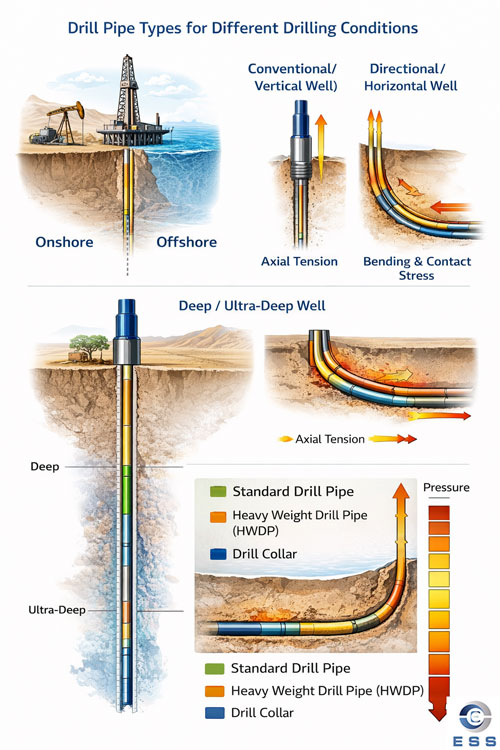
The selection of drill pipe types depends on well conditions such as depth, trajectory, and the operating environment. Different well designs, depths, and drilling methods change how loads are distributed and how forces act on the drill string, which in turn affects which pipe characteristics are most critical.
4.1 Onshore vs Offshore Drill Pipe
Onshore and offshore operations face distinct environmental challenges.
Onshore drilling generally emphasizes operational efficiency and cost control. Offshore operations, however, must contend with more complex factors, including space constraints, platform load limits, and corrosive environments. These conditions affect the drill pipe’s service life and maintenance strategy. As a result, offshore operations typically require higher reliability and consistency, rather than just single-instance performance.
4.2 Conventional vs Directional Drilling
Conventional vertical wells and directional wells experience fundamentally different stress conditions.
In vertical wells, loads are primarily axial, and the drill pipe experiences relatively limited bending. In directional or horizontal wells, however, the drill string must slide along the wellbore while undergoing continuous bending and contact loads, significantly increasing friction and cumulative fatigue. Consequently, directional drilling places greater demands on torque transmission and fatigue resistance, beyond simple load-bearing capacity.
4.3 Deep and Ultra-Deep Wells
As well depth increases, the total load on the drill string accumulates, raising material and structural requirements.
In deep wells, axial tension, torque, and circulating pressure often act simultaneously and over extended periods. Under these conditions, improving a single performance metric offers limited benefit; the key is maintaining stability under combined loads. Deep well drill pipes typically achieve this by combining multiple pipe types throughout the drill string to distribute stresses more evenly.
5. Classification by Connection Type
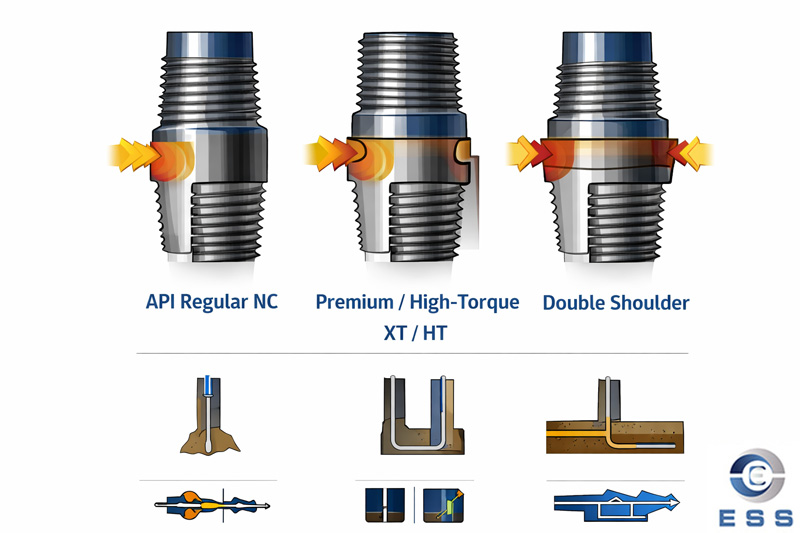
The connection type of a drill pipe often reveals engineering weaknesses more readily than the pipe body itself. Choosing the right connection affects not only torque transmission and fatigue life but also the operational sustainability of each well section. Here, we focus on three typical connection types and highlight their preferred applications and potential risks.
5.1 API Regular Connections (NC Series)
The NC series is the most common and well-established standard connection, designed for general-purpose use and ease of handling.
Engineering insight:
In vertical or shallow wells, NC connections usually do not impose limitations. However, in long horizontal sections or high-cycle load environments, the connection tends to fail before the pipe body, becoming the limiting factor for the drill string’s overall fatigue life.
5.2 Premium / High-Torque Connections (XT, HT)
XT and HT high-torque connections feature enlarged shoulder areas to withstand higher cyclic torque and repeated make-up/break-out stresses than standard NC connections.
Engineering insight:
In deep wells or extended-reach horizontal sections, NC connections are prone to fatigue cracking under repeated cycles and high torque. XT/HT connections can significantly delay fatigue failure, improving continuous operational reliability in critical sections. The trade-offs include higher costs and stricter machining and installation requirements; they are not suitable for entire wells and are best applied only in high-torque or high-cycle segments.
5.3 Double Shoulder Connections
Double shoulder connections add a second load-bearing shoulder, distributing stress more evenly and reducing localized load concentrations.
Engineering insight:
In high-cycle deep wells or frequent make-up/break-out operations, standard connections may crack at the shoulder first, whereas double shoulder designs extend service life. However, these connections are more complex, require precise installation, and improper use can introduce new localized stress issues. Therefore, they are suited for critical lower well sections or high-fatigue areas rather than shallow or low-load segments.
6. Drill Pipe vs Drill Collar and Other Drill String Components
Understanding the differences between drill pipe and drill collar is critical in drill string design. In practice, "drill pipe" is often used as a general term, but it differs significantly from other drill string components in function and load-bearing behavior.
Drill Pipe: Moderately flexible, responsible for torque transmission and extending the well depth.
Drill Collar: High rigidity, positioned at the bottom, provides weight on bit (WOB) and stabilizes the drill bit orientation.
Engineering insight:
Overusing drill collars in the upper sections increases overall rigidity, concentrating stress in curved sections and raising fatigue risk. Conversely, replacing drill collars at the bottom with drill pipe reduces WOB and lowers drilling efficiency. In deep or directional wells, proper sectioning is essential: drill collars should remain at the bottom, and sufficient lower drill pipe flexibility is preferable over artificially increasing rigidity.
6.2 Drill Pipe vs HWDP
HWDP serves as a transition section, smoothing the rigidity change between drill pipe and drill collar.
Engineering insight:
Without HWDP, connection fatigue can appear earlier, particularly in long horizontal or high-cycle sections. For low-load, shallow wells, HWDP may be omitted, but in deep or complex wells, it is essential.
6.3 Drill Pipe vs Tubing / Casing
Drill Pipe: Dynamic component, repeatedly run in and out of the hole, subjected to rotation and cyclic loads.
Tubing / Casing: Static components, primarily exposed to internal/external pressure and corrosion.
7. Conclusion
Selecting the appropriate combination of drill pipe types, connection designs, and structural features is key to a drill string that performs reliably across varying conditions—onshore, offshore, conventional, directional, or deep well operations. Understanding these distinctions allows for a well-balanced, durable, and efficient drilling system.
Read More: Steel grade and classification method of drill pipe and Guide To Drill Pipe Steel Grade





 Eastern Steel Manufacturing Co.,Ltd not only improve product production and sales services, but also provide additional value-added services. As long as you need, we can complete your specific needs together.