1. What Is a Wear Resistant Steel Tube?
A wear-resistant steel tube is designed for service where abrasion, impact, or erosion can cause rapid wall loss. Its wear performance is determined by the material, tube construction, and service conditions.
2. What Determines Wear Resistance in Steel Tubes
Wear resistance is governed by the hardness and microstructure of the wear surface, the construction of the tube wall, the type of wear occurring in service, and the operating conditions.
|
Factor
|
What to Check
|
Effect on Wear Performance
|
|
Hardness
|
HBW or HRC of the wear surface
|
Higher hardness generally improves resistance to abrasive wear
|
|
Microstructure
|
Matrix structure, heat treatment, and wear-resistant phases
|
Affects the balance between wear resistance, toughness, and cracking behaviour
|
|
Tube Construction
|
Hardened wall, overlay, lining, or composite structure
|
Determines how the tube provides wear protection and structural support
|
|
Wear Mechanism
|
Sliding abrasion, impact wear, erosion, or a combination
|
Determines the required balance between hardness and toughness
|
|
Operating Conditions
|
Particle size and hardness, velocity, temperature, pressure, and impact conditions
|
Determines the severity of wear and the suitable tube construction
|
2.1 Hardness and Microstructure
Hardness is a primary factor in abrasive wear. A harder surface generally resists material loss from particle contact, while microstructure affects the balance between wear resistance and toughness. Hardness should therefore be evaluated together with the material grade and heat-treatment condition.
Hardness is commonly reported in HBW for wear-resistant steels and in HRC for high-hardness wear layers. The two scales are not directly interchangeable and should be compared using an applicable hardness conversion standard.
2.2 Tube Construction
Wear-resistant tubes use either the tube wall itself or a separate internal layer to provide the required wear resistance.
A fully hardened steel tube uses a wear-resistant steel throughout the tube wall. The same material provides the structural section and the wear-resistant surface. This construction is relevant where the tube must withstand both mechanical loading and abrasive service.
A composite or lined tube uses different materials for structural support and wear protection. A structural steel base pipe provides the supporting section, while an internal wear-resistant layer, such as a metallic overlay or ceramic lining, provides the wear surface.
3. Wear Resistant Steel Tube Types and Hardness
Wear-resistant steel tubes can be classified by the hardness of the steel wall or by the construction of the wear-resistant layer.
|
Nominal Hardness
|
Material / Wear Surface
|
General Characteristics
|
Typical Service
|
|
400 HBW class
|
Quenched and tempered wear-resistant steel
|
Balance of abrasion resistance and toughness
|
Abrasive conveying, aggregate, ash and slurry service
|
|
500 HBW class
|
Higher-hardness quenched and tempered wear-resistant steel
|
Higher resistance to abrasive wear, particularly sliding abrasion
|
More severe abrasive conveying and material handling
|
|
High-hardness overlay
|
Chromium Carbide Overlay (CCO)
|
High surface hardness concentrated in the wear layer
|
Severe sliding abrasion and erosion
|
|
Ceramic lining
|
Alumina ceramic (Al₂O₃) or other specified ceramic
|
Very high resistance to abrasive wear
|
Fine-particle conveying and severe sliding abrasion where impact is limited
|
For fully hardened tubes, 400 HBW and 500 HBW refer to the steel tube wall. For CCO tubes, the specified HRC value applies to the deposited wear layer. Ceramic-lined tubes are specified by ceramic material, lining thickness, and lining construction.
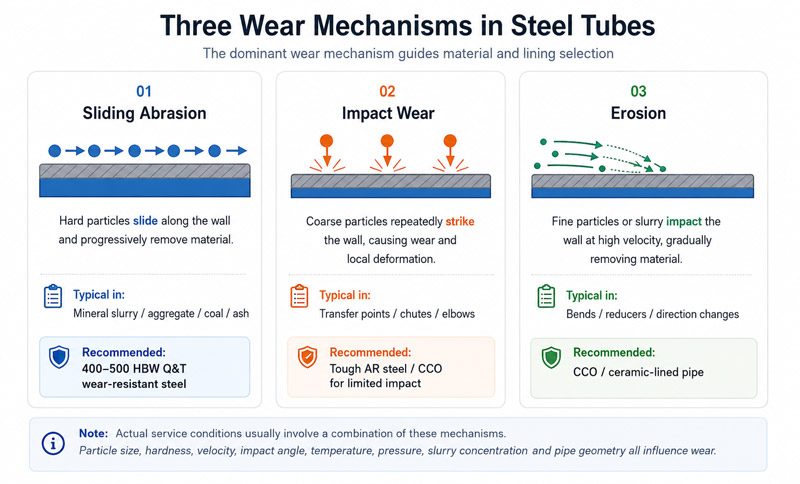
4. Wear Mechanisms in Steel Tubes
Steel tube wear is mainly associated with sliding abrasion, impact wear, and erosion. The dominant mechanism depends on the material being conveyed and how it contacts the tube wall.
4.1 Sliding Abrasion
Hard particles slide along the tube wall and progressively remove material from the surface. Typical conditions include mineral slurry, aggregate, coal, ash, and other abrasive solids conveyed through pipelines.
Typical Construction: 400 HBW or 500 HBW quenched and tempered wear-resistant steel for general to severe abrasive service. CCO or ceramic lining can be considered when the abrasive load is particularly severe.
4.2 Impact Wear
Coarse or heavy particles repeatedly strike the tube wall, causing both surface wear and local deformation. This is common at material transfer points, chutes, elbows, and pipe sections exposed to direct impact from ore or aggregate.
Typical Construction: 400 HBW or 500 HBW wear-resistant steel where impact toughness is required together with abrasion resistance. A high-hardness CCO layer is more suitable where sliding abrasion dominates and impact is limited.
4.3 Erosion
Fine particles or slurry moving at high velocity cause continuous material loss from the tube surface. The effect can become more severe at bends, elbows, reducers, and changes in flow direction.
Typical Construction: A hardened steel tube can be used for moderate erosive service. CCO or ceramic-lined construction is suitable for more severe erosion where the wear surface requires higher resistance to particle flow.
5. How to Select a Wear Resistant Steel Tube
5.1 Match the Tube Construction to the Wear Condition
Abrasion + Impact: Consider 400 HBW or 500 HBW quenched and tempered wear-resistant steel tube when the tube is exposed to both abrasive particles and repeated impact. A seamless steel tube can provide a continuous hardened wall without a longitudinal weld seam, while the same material provides the structural wall and wear surface.
Severe Sliding Abrasion: Consider a Chromium Carbide Overlay (CCO) pipe when wear is concentrated on the internal surface and impact is limited. The hardfaced layer provides a high-hardness wear surface over a structural steel pipe.
Severe Fine-Particle Abrasion or Erosion: Consider a ceramic-lined steel pipe when the operating conditions are suitable for the selected ceramic lining system. Ceramic provides very high resistance to abrasive material loss, but the lining construction must be compatible with the impact and temperature conditions.
5.2 Check the Conditions That Limit the Selection
Wear severity is only one selection factor. Pressure and temperature must also be checked against the structural pipe wall and the applicable wear-resistant material or lining system.
6. Wear Resistant Steel Tube Specifications and Inspection
Wear resistant steel tube specifications mainly cover OD, wall thickness, material grade, hardness, heat treatment, and inspection.
|
Parameter
|
Typical Requirement
|
|
OD
|
Nominal and actual outside diameter
|
|
WT
|
Nominal and actual wall thickness
|
|
Material
|
Grade, chemical composition, heat-treatment condition
|
|
Hardness
|
HBW for hardened steel; HRC for applicable wear layers
|
|
Mechanical Properties
|
Yield strength, tensile strength, elongation where specified
|
|
Inspection
|
Dimensions, hardness, surface condition, UT and mechanical tests where required
|
For full-wall hardened tubes, wall thickness provides both structural capacity and wear allowance. For CCO or ceramic-lined tubes, the base pipe and internal wear layer should be evaluated separately.
7. Wear Resistant Steel Tube Applications
|
Application
|
Main Wear Mechanism
|
Suitable Construction
|
|
Mining & mineral processing
|
Abrasion + impact
|
400/500 HBW Q&T steel; lined construction for severe surface wear
|
|
Cement conveying
|
Abrasion + erosion
|
Hardened steel or wear lining
|
|
Coal & ash handling
|
Abrasion + erosion
|
Hardened steel or wear layer
|
|
Slurry pipelines
|
Abrasion + erosion
|
Hardened steel, CCO, or ceramic lining depending on conditions
|
|
Pneumatic conveying
|
High-velocity erosion
|
Hardened steel or wear lining
|
|
Transfer points & bends
|
Impact + abrasion
|
Tough hardened steel or localized wear protection
|
8. FAQs
Q1. What is the difference between NM400, NM500, and CCO pipe?
NM400 and NM500 are Chinese abrasion-resistant steel grades with nominal hardness levels around 400 HBW and 500 HBW. CCO pipe uses a separate chromium-carbide-rich hardfacing layer, whose hardness is specified for the deposited wear layer.
Q2. Can wear-resistant steel tubes be welded?
Yes, but welding requirements depend on steel grade, wall thickness, carbon equivalent, hardness, and the qualified WPS. High-hardness Q&T steels may require controlled preheating and low-hydrogen welding practices.
Q3. Is a seamless wear-resistant steel tube better than a welded tube?
Not universally. Seamless construction removes the longitudinal weld seam, while welded construction can accommodate larger diameters and different wear-layer configurations. Selection depends on size, pressure, wear mechanism, and applicable specification.
Q4. What is the difference between HBW and HRC?
HBW is commonly used for hardened wear-resistant steels, while HRC is often used for high-hardness wear layers such as CCO. The two scales should not be directly substituted without an applicable conversion standard.
Q5. What pipe is suitable for abrasive slurry?
400/500 HBW Q&T steel is suitable where abrasion is combined with particle impact. CCO or ceramic-lined pipe may be considered for severe internal abrasion or erosion where direct impact is limited.
Q6. How long does a wear-resistant steel tube last?
Service life depends on the actual wear rate, not hardness alone. Particle size and hardness, velocity, impact, temperature, wall thickness, and tube construction all affect material loss.
9. Related Steel Pipe Resources
Seamless Steel Pipe Sizes
How Seamless Carbon Steel Pipe Is Made
ASTM A106 Seamless Carbon Steel Pipe





 Eastern Steel Manufacturing Co.,Ltd not only improve product production and sales services, but also provide additional value-added services. As long as you need, we can complete your specific needs together.