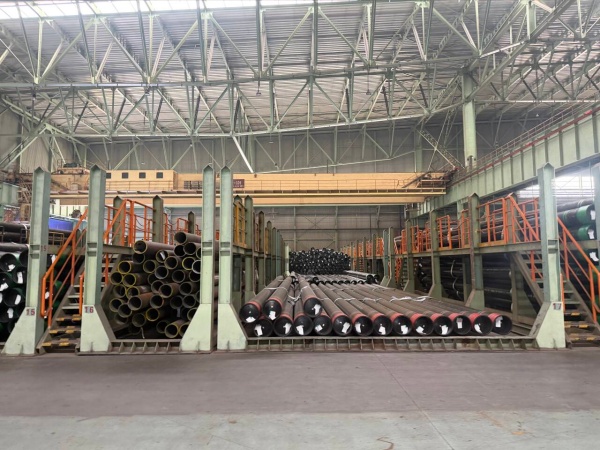
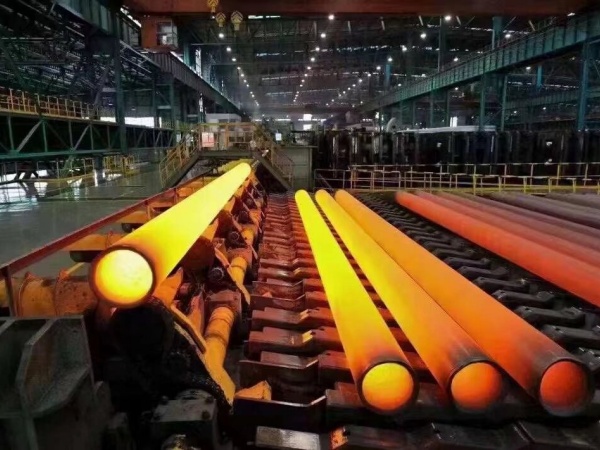
SMLS pipe, longitudinally welded steel pipes (LSAW pipe), forged steel pipes, precision dense steel pipes, high-precision precision steel pipes, and other steel pipes will cause the steel pipe body to bend to varying degrees in the longitudinal direction (that is, the length direction) during the production process. However, the degree of bending of some steel pipe products is visible to the naked eye, and the steel pipe is not a qualified product. As long as it is a regular manufacturer, such products are absolutely not allowed to leave the factory, and some require special equipment to measure straightness.
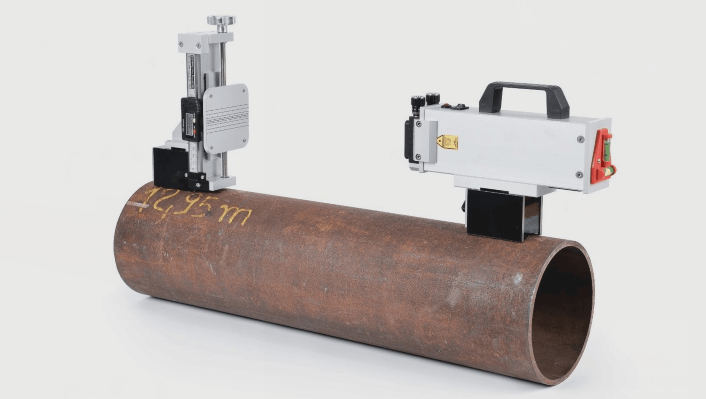
For the straightness of steel pipes, the requirements are not high in general fluid transportation pipelines. This kind of pipe mainly requires the concentricity of the nozzles to facilitate the welding of the pipeline. However, if steel pipes are used in processing machinery and equipment, especially rubber rollers, middle shafts, etc., they have higher requirements for straightness or curvature, and this is also a very important index for them. Because it involves a processing problem, the amount of processing directly affects the size of the production cost. If it cannot be processed, the steel pipe will be a waste product. Therefore, manufacturers like the production of roller body equipment pay special attention to the straightness of the steel pipe when they buy seamless steel pipes or straight seam steel pipes.
For seamless steel pipes, straight seam steel pipes, and forged steel pipes, the straightness is best to be forged steel pipes. Because the outer diameter is produced by the processing equipment bit by bit, the straightness is generally not a problem. Secondly, seamless steel pipes have a three-roll straightening process in the production process of this steel pipe. The pipes with high straightness requirements use a computer-controlled multi-function integrated hydraulic straightening machine imported from South Korea, which can basically meet the straightness requirements of customers. The worst is the straight steel pipe. Although the basic process also has this process, it is made of steel plate or coil. If the internal stress of the steel cannot be released well, it will also cause the deformation of the steel pipe after processing. .
Pipe Straightness Calculation
1. Partial Curvature of Seamless Steel Pipe or Straight Seam Steel Pipe
Use a one-meter ruler to measure the maximum bend of the steel pipe and measure the chord height (mm), which is the value of local curvature, and its unit is mm/m, means such as 2.5mm/m. This method is also suitable for tube end curvature.
2.The Total Bending Degree of the Steel Tube
use a thin rope to pull tight from both ends of the tube, measure the maximum chord height (mm) at the bend of the steel tube, and then convert it into a percentage of the length (in meters), which is the length of the steel tube The full-length curvature of the direction. For example: the length of the steel pipe is 10m, and the measured maximum chord height is 30mm, the total length of the pipe is: 0.03+10m*100%=0.3%.
Straightness Requirements for Seamless
Pipes
The straightness requirements for seamless
steel pipes vary depending on their application. For ordinary fluid transport
pipes, the straightness deviation per meter should not exceed 1mm, and the
total length deviation should not exceed 0.1% of the total length.
Seamless steel pipes for precision
machinery have higher requirements, with a straightness deviation of ≤0.5mm per meter to ensure accurate positioning during processing.
High-pressure pipelines require a straightness deviation of ≤0.8mm/meter to avoid obstructed media flow or excessive local
pressure due to bending.
Straightness testing can be performed by
placing the steel pipe on a platform and measuring the maximum gap between the
pipe and the platform using a feeler gauge, or by using a straightness
measuring instrument for automatic detection.
Pipes exceeding the standard must be
straightened using a straightening machine. Small-diameter pipes can be
straightened using pressure, while large-diameter pipes require heated roller
straightening to ensure compliance with usage requirements.
Pipe Straightness Measurement
Commonly used methods for measuring
straightness include the ruler method, collimation method, gravity method, and
straightness method.
Straightness measurement primarily measures
the straightness error of the generatrix of cylinders and cones, the
straightness error of guide surfaces of machine tools and other machines, and
the straightness error of workpiece guide surfaces. Straightness measurement is
an important part of length measurement technology.
In addition, straightness errors can be
measured using optical flats, laser interferometers, and their straightness
measuring accessories, with very high measurement accuracy. The latter can
achieve a measurement accuracy of 0.4 micrometers/1000 millimeters. Many
machine tool manufacturers now use laser interferometers to measure
straightness, flatness, perpendicularity, etc.
How to Check Straightness of Pipe
1. Fitting Method
This method uses the
principle of comparing the element to be measured with an ideal element. For
example, if the cutting edge is considered as the ideal element, it is fitted
against the surface to be measured, minimizing the maximum gap between them.
This maximum gap is the straightness error of the element being measured.
When the gap is small, a standard optical
gap is used for estimation; when the gap is large, a feeler gauge is used for
estimation.
2. Micrometer Method
Used to measure the straightness of the
generatrix or axis of a cylinder.
3. Pitch Method
Suitable for measuring long parts. The
length to be measured is divided into several small segments, and the relative
reading of each segment is measured using a level, autocollimator, etc.
Finally, the straightness error is calculated through data processing.
Straightness after cold drawing: 0.7mm/m.
Inner diameter roundness: within 0.005mm. Requirements for seamless pipes in
South Korea.
4. Data Acquisition Instrument with Dial
Indicator Method
Measuring Instruments: Runout meter, dial
indicator, data acquisition instrument.
Advantages: No need for manual reading,
reducing errors caused by manual reading; No need for manual data processing,
the data acquisition instrument automatically calculates the parallelism error
value.
Measurement Result Alarm: The data
acquisition instrument will automatically alarm if the measurement result is
outside the straightness tolerance zone.
Measurements to Improve the Straightness
of Seamless Steel Pipes
In addition to relying on professional
testing equipment, manufacturers can also take a series of measures to improve
the straightness of seamless steel pipes. For example, introducing advanced
straightening equipment for precise straightening of steel pipes; strengthening
quality control during production to ensure each process meets requirements;
and regularly providing skills training to employees to improve their
operational levels.
Factors Affecting the Straightness of
Seamless Steel Pipes
1. Steel Pipe Manufacturing Process
The straightness accuracy of seamless steel
pipes is directly related to the manufacturing process. Traditional seamless
steel pipe manufacturing processes require multiple steps such as hot rolling,
piercing, annealing, and pickling, all of which affect straightness. Modern
manufacturing processes such as hot drawing and cold drawing can effectively
improve the straightness accuracy of steel pipes, offering better stability and
precision compared to traditional processes.
2. Material
Different materials also have a certain
impact on the straightness of steel pipes. Different types of materials, due to
their special physical properties, affect the shape of the steel pipe, thus
affecting its straightness. Therefore, the choice of steel pipe material should
be made based on the specific application.
3. Equipment and Facilities
The straightness of steel pipes is
constrained by the production equipment. The precision of the production
equipment directly determines the accuracy of the pipe's straightness. For
steel pipes with high straightness deviation requirements, close cooperation
between manual labor, equipment, and facilities is necessary to produce
high-quality seamless steel pipes.
The Importance of Seamless Pipe
Straightness
The straightness of seamless steel pipes
has a significant impact on their performance. If the straightness does not
meet the standards, it will not only affect the appearance quality of the steel
pipe but may also lead to problems such as bending and deformation during
installation or use. Especially in applications with high precision
requirements, such as precision machining equipment and hydraulic pipes, the
straightness of seamless steel pipes is a crucial quality indicator.
Read more: Seamless Pipe Thickness or Thermal Conductivity of Seamless Pipe



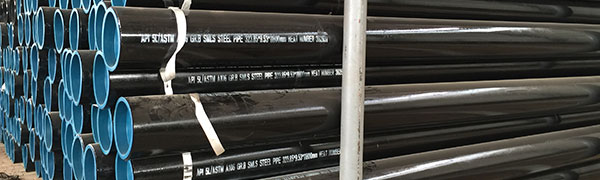


 Eastern Steel Manufacturing Co.,Ltd not only improve product production and sales services, but also provide additional value-added services. As long as you need, we can complete your specific needs together.