In large-scale industrial projects (such as
oil and gas, petrochemical, power plants, boilers, and high-rise building
structures), the quality of the seamless
steel pipe directly affects safety, lifespan, and project costs.
When purchasing seamless steel pipes, you
will typically receive a Certificate of Conformity (MTC) issued by the factory.
This document is the Material Test Report (MTR). It is not only a test document
but also the "birth certificate" of the steel pipe, used to verify
whether the product meets industry standards (such as API 5L, ASTM A106,
or EN
10210) and the requirements of specific projects.
For engineers, quality control (QC)
professionals, and purchasing teams, mastering the interpretation of MTCs is
crucial—it ensures compliance, avoids high rework
costs, and guarantees project safety.
What is MTC Certification?
MTC (Mill Test Certificate) certification is a quality certificate
issued by the metal material manufacturer or a third-party testing
organization, detailing the chemical composition, mechanical properties, and
compliant standard requirements of the batch of materials. It is an important
basis for material quality traceability and compliance acceptance, and is
widely used in the fields of steel, pipes, flanges, and pressure vessels.
According to the international standard EN
10204, MTC reports are divided into four types: 2.1, 2.2, 3.1, and 3.2. Types
3.1 and 3.2 provide the most professional certification data and offer the most
reliable evidence for determining the authenticity and quality of materials.
2.1: Non-specific inspection report issued
by the supplier (no test data), suitable for low-risk general steel.
2.2: Report containing routine test
results, for general structural steel.
3.1 (Most commonly used): Material data
report issued by authorized inspectors of the manufacturer, showing formal
testing results, suitable for pressure pipelines, boilers, and the oil and gas
industry.
3.2 (Highest level): Joint certification by
the manufacturer and third-party organizations (such as TUV, BV, LR), suitable
for high-risk projects: nuclear power, subsea pipelines, and high-pressure
vessels.
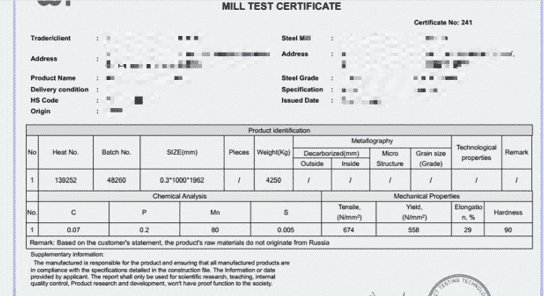
What is the Core Structure of An MTC Report?
Although the format varies slightly among
steel mills, most MTC reports include four non-negotiable parts. Skipping any
of these parts can lead to misunderstandings:
|
Section
|
Key
Content
|
Core
Application Logic
|
|
Header
Information
|
Pipe
mill name, contact details, MTC number, date of issue, and customer name.
|
Links
the certificate to a specific order/batch (critical for traceability).
|
|
Product
Identification
|
Seamless
steel pipe sizes (OD × wall thickness), specifications (e.g., API
5L X65), heat number, and quantity.
|
Confirms
the certificate matches the pipes you received (avoid mix-ups).
|
|
Test
Results
|
Chemical
composition, mechanical properties, and additional tests (e.g., NDT,
hydrostatic testing).
|
Proves
the pipe meets standard/ project requirements.
|
|
Certification
|
Signature
of the mill’s authorized representative, and (if required) accreditation from
a third-party body
|
Validates
the accuracy and authenticity of the test results.
|
Verify the Heat Number on the Seamless
Steel Pipe's MTC
Develop the good habit of carefully
checking that the heat number (a unique identifier for the metal batch) on the
Metal Testing Certificate (MTC) matches the heat number engraved on the
seamless steel pipe.
Check:
The Heat No. on the MTC
The Heat No. on the steel stamp/inkjet
marking on the outer wall of the pipe
The Heat No. on the mill's Packing List
If a discrepancy is found, it indicates a
problem with the product material. The factory should be contacted immediately
to follow up, identify the cause, and develop a solution to minimize the
adverse effects of the error.
Understanding the Chemical Composition
in the Seamless Steel Pipe's MTC
The "Chemical Composition"
section lists the percentages of elements such as carbon, manganese, and
chromium in the seamless steel pipe. These factors directly affect the
strength, corrosion resistance, and weldability of the steel pipe. Here's how
to interpret it:
Step 1: Identify the "Elements"
and "Values" columns.
Common indicators include:
Carbon (C): Higher carbon content results
in stronger corrosion resistance, but excessive carbon content can reduce
weldability. In the API 5L X65 standard, the upper limit for carbon content is
typically 0.22%.
Manganese (Mn): Improves toughness and
corrosion resistance. ASTM A106 Class B (a commonly used seamless steel pipe
for pressure applications) requires a manganese content between 0.27% and
0.93%.
Phosphorus (P) and Sulfur (S): Considered
"impurities"—excessive content can cause the
steel pipe to become brittle. Most standards limit the content of phosphorus
and sulfur to 0.035% or less.
To improve the corrosion resistance of
pipes, alloying elements are added. For example, in the ASTM A335 P91 standard,
chromium (Cr: 8.0-10.5%) and molybdenum (Mo: 0.85-1.05%) are added to resist
high temperatures and harsh environments.
Step 2: Compare the results with your own
standards.
Don't just look at the numbers; compare
them to applicable standards or project specifications.
For example, if your project requires the
use of API 5L X70 seamless steel pipe with a carbon content ≤ 0.20% (according to API 5L PSL2 standard), then a result of 0.23%
indicates that the pipe does not meet the standard, even if it is very close.
When steel pipes are used in seawater, the
sulfur content can be adjusted to improve corrosion resistance.
Typically, the sulfur content is reduced.
The content is within this range (≤0.035% vs. ≤0.035%). 0.025% is optimal. When specifying a particular component
content ratio, this custom requirement must be reflected in the MTC (Mechanical
Properties Test).
Understanding the Mechanical Properties
in Seamless Steel Pipe MTC
The "Mechanical Properties"
indicator is a crucial factor in measuring the performance of seamless steel
pipes under pressure. This indicator is critical for projects involving
pressure, weight, or temperature fluctuations. A deeper understanding of this
indicator will benefit project management. Please focus on the following three
key indicators.
|
Metric
|
Definition
|
How
to Use It
|
|
Yield
Strength (YS)
|
The
stress at which the pipe begins to deform permanently.
|
For
high-pressure oil pipelines (API 5L X65), YS must be ≥448 MPa. If the MTC
shows 430 MPa, the pipe can’t handle the design pressure.
|
|
Tensile
Strength (TS)
|
The
maximum stress the pipe can withstand before breaking.
|
TS
is often paired with YS—API 5L X65 requires TS ≥535 MPa. A TS/YS ratio
<1.2 indicates poor ductility (risk of brittle failure).
|
|
Elongation
|
The
percentage the pipe stretches before breaking (measures ductility).
|
ASTM
A106 Grade B requires ≥30% elongation. Low elongation (e.g., 25%) means the
pipe may crack under sudden pressure changes.
|
Professional Tip:
Pay Attention to "Average" vs.
"Minimum".
Some steel mills report the
"average" mechanical properties of a batch of steel pipes, but
standards usually require each pipe to meet the minimum value.
For example, if the Material Testing
Certificate (MTC) shows "average pressure: 450 MPa," but the API 5L
X65 standard requires a minimum pressure of 448 MPa for each pipe, individual
test results are needed—a single poorly performing pipe
could jeopardize the entire system.
Common Additional Tests in MTC
Hydrostatic Test: Checks pipe sealing.
NTD (UT/ET) Non-destructive Testing: Checks
for cracks/inclusions.
Impact Test (Charpy V-notch):
Low-temperature toughness (e.g., -20°C).
Dimensional Tolerance Testing: Outer
diameter/wall thickness/ovality.
Hardness Testing (HB/HRC): Determines
brittleness and heat treatment quality.
Why is MTC Important for Seamless Steel
Pipes?
A Material Testing Certificate (MTC) is
more than just a document; it's the foundation of a project's Quality Assurance
(QA) program. Here are the reasons why an MTC is indispensable:
1. Preventing Non-Conforming Materials from
Entering the Site
Without an MTC, it's impossible to prove
that seamless steel pipes meet specifications.
For example, mistaking ASTM A53B pipe (low pressure) for A106B pipe (high pressure steam).
2. Promoting Regulatory and Safety
Compliance
Most industries (oil and gas, nuclear,
etc.) have stringent regulations requiring documentation of material quality.
In the United States, the Piping and
Hazardous Materials Safety Administration (P
HMSA) mandates that all pipelines
transporting hazardous fluids must obtain MTC certification.
3. Ensuring Traceability of Failure Sources
If a problem occurs with seamless steel
pipes (such as pressure cracking), an MTC (Mechanical Traceability Inspection)
can help determine the root cause.
In the event of cracks or pipe bursts, the
MTC can quickly pinpoint the furnace responsible.
4. Production Guidance
Provides key chemical composition and
mechanical property parameters for subsequent processing (such as welding, heat
treatment, and cold bending).
5. Dispute Resolution
When questions arise about material quality
or quality incidents occur, the MTC report serves as primary verification and
legal evidence.
How to Verify the Authenticity of MTC
Certification for Seamless Steel Pipes?
1. Verify Certificate Information
Check if the manufacturer's name and
address match the contract information.
Verify that the batch number matches the
physical identification (such as stamps and labels).
2. Compare Test Data
Compare the chemical composition with
standard requirements to determine if it is within the allowable range.
Check if the mechanical properties match
the material grade reasonably.
3. Confirm Certificate Type
For high-risk projects, it is recommended
to choose MTC 3.1 or 3.2 certification to ensure data accuracy.
4. Verify Third-Party Witnessing
If the certificate indicates a third-party
organization (such as TUV, BV), verify with their official channels.
5. Anti-counterfeiting Technology
Inspection
Some manufacturers add QR codes and
anti-counterfeiting codes to the MTC (Mill Test Certificate), which can be
verified directly online.
FAQ
1. Is a Mill Test Certificate mandatory for
seamless steel pipes?
In most oil and gas, pressure pipelines,
boilers, and power engineering projects, the MTC is a mandatory document.
It is not mandatory in general building
structures, but it is still recommended to provide it to ensure traceability.
2. What is the mill tolerance for seamless
pipes?
The rolling tolerance for seamless steel
pipes is typically ±12.5%, as specified by mainstream
standards such as API 5L, ASTM A106, and ASTM A53.
Conclusion
The MTC (Mill Test Certificate) serves as
an important proof of material quality. It not only verifies whether the metal
material meets standards but also effectively prevents counterfeit and
substandard products from entering the market. Interpreting a seamless steel
pipe material inspection certificate involves verifying the consistency of the
heat number, ensuring that the chemical composition and mechanical properties
meet specifications, and confirming that the testing has been completed. If any
questions arise—such as a missing signature or values that are
"close but not acceptable"—please contact the steel mill immediately.
Read more: Latest Top 6 Seamless Steel Pipe Manufacturers in China





 Eastern Steel Manufacturing Co.,Ltd not only improve product production and sales services, but also provide additional value-added services. As long as you need, we can complete your specific needs together.