1. What Is Mild Steel Pipe?
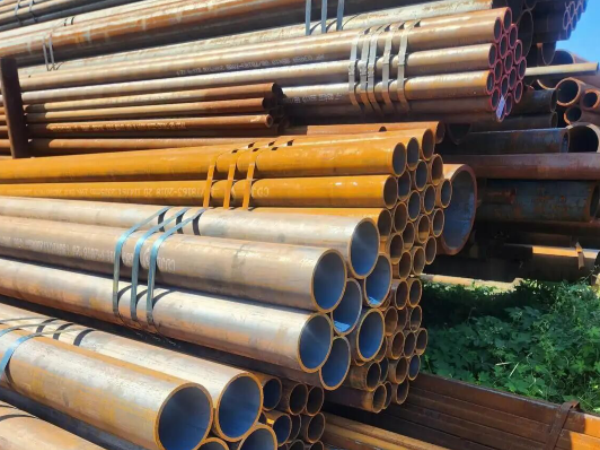
Mild steel pipe (MS pipe) is a low-carbon steel pipe with a carbon content generally below 0.25%, offering a balance of strength, weldability, ductility, and cost-effectiveness. Because of its excellent formability and machinability, it is one of the most widely used materials for structural fabrication, water distribution, general piping, and industrial applications.
MS stands for Mild Steel, a type of carbon steel with lower carbon content than medium- or high-carbon steel. Mild steel pipes are available in both seamless and welded (ERW) forms and can be supplied with black, painted, or galvanized finishes depending on the service environment.
Although mild steel is a category of carbon steel, not all carbon steel pipes are considered mild steel. Higher-carbon grades are designed for greater hardness and wear resistance, while mild steel focuses on weldability, toughness, and ease of fabrication.
2. Common Mild Steel Pipe Standards and Grades
International standards specify the chemical composition, mechanical properties, dimensional tolerances, and testing requirements for mild steel pipe.
|
Standard
|
Common Grade
|
Typical Applications
|
|
ASTM A53
|
Grade A / Grade B
|
Water, gas, structural and general piping
|
|
ASTM A106
|
Grade B
|
High-temperature and pressure service
|
|
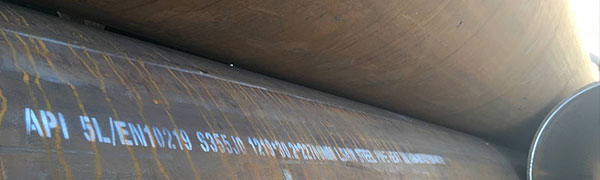
API 5L
|
Grade B
|
Oil and gas pipeline transportation
|
|
EN 10255
|
Various grades
|
Water, gas and general engineering piping
|
|
JIS G3444
|
STK Grades
|
Structural steel tubing
|
|
GB/T 3091
|
Q195 / Q215 / Q235
|
Water supply, gas transmission and structural use
|
ASTM standards are widely used in North America, while EN and JIS standards are more common in Europe and Asia. Project location usually determines the governing specification.
3. Common Mild Steel Pipe Specifications
A mild steel pipe specification typically includes the manufacturing method, material grade, outside diameter, wall thickness, end type, and applicable standard. Actual specifications vary depending on project requirements and the governing standard.
|
Specification Item
|
Typical Options
|
|
Manufacturing Method
|
Seamless / ERW
|
|
Material Grades
|
ASTM A53 Gr.A, ASTM A53 Gr.B, ASTM A106 Gr.B, API 5L Gr.B
|
|
Outside Diameter
|
Standard-dependent
|
|
Wall Thickness
|
Schedule 10, 20, 40, 80, 160, XS, XXS
|
|
Surface Finish
|
Black, Painted, Galvanized
|
|
End Type
|
Plain End (PE), Beveled End (BE), Threaded
|
|
Standard Length
|
6 m, 12 m, Random Length
|
Specification requirements should always be verified against the applicable project standard to ensure compatibility with pressure, temperature, and installation requirements.
Eastern Steel supplies mild steel pipe in both seamless and ERW forms according to ASTM, API, EN, and GB standards for structural, industrial, and pipeline applications.
4. Types of Mild Steel Pipe
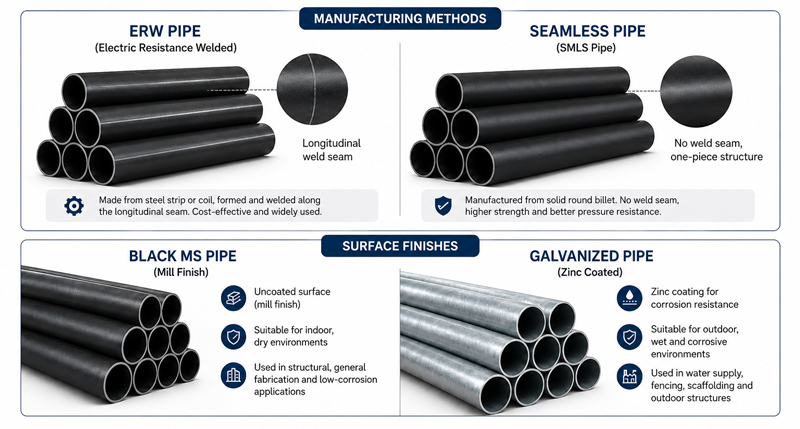
Based on manufacturing method and surface finish, mild steel pipe is commonly divided into four categories.
4.1 Seamless Mild Steel Pipe
Seamless mild steel pipe is manufactured from a solid steel billet without a welded seam. It offers higher pressure resistance and better structural integrity, making it suitable for high-pressure piping, boilers, and industrial process systems.
4.2 ERW Mild Steel Pipe
Electric Resistance Welded (ERW) mild steel pipe is produced by forming steel strip into a tube and welding the longitudinal seam. It provides excellent dimensional accuracy, consistent quality, and lower production cost, making it the most common choice for structural applications, water supply, and general fabrication.
4.3 Black Mild Steel Pipe
Black mild steel pipe is supplied without a zinc coating and retains its original mill finish. It is widely used for structural fabrication, gas lines, fire protection systems, and applications where corrosion resistance is not the primary concern.
4.4 Galvanized Mild Steel Pipe
Galvanized mild steel pipe is protected by a zinc coating that significantly improves corrosion resistance. It is commonly used in outdoor structures, water distribution systems, fencing, and humid environments where longer service life is required.
5. Mild Steel Pipe Properties
The popularity of mild steel pipe comes from its balanced mechanical performance, excellent fabrication characteristics, and economical cost. Compared with higher-carbon steels, it provides sufficient strength for most engineering applications while remaining easy to process and weld.
5.1 Mechanical Properties
Mechanical properties determine how the pipe performs under load, pressure, and deformation.
|
Property
|
Typical Value
|
|
Yield Strength
|
≥ 240 MPa (ASTM A53 Gr.B)
|
|
Tensile Strength
|
≥ 415 MPa
|
|
Elongation
|
≥ 20%
|
|
Hardness
|
Approximately 120–160 HB
|
Values vary depending on the applicable grade and manufacturing standard.
5.2 Chemical Composition
The relatively low carbon content gives mild steel its excellent weldability and formability.
|
Element
|
Typical Content
|
|
Carbon (C)
|
≤ 0.25%
|
|
Manganese (Mn)
|
0.30–1.20%
|
|
Silicon (Si)
|
≤ 0.35%
|
|
Phosphorus (P)
|
≤ 0.05%
|
|
Sulfur (S)
|
≤ 0.05%
|
5.3 Physical Properties
Physical properties influence heat transfer, weight, and structural performance during fabrication and service.
|
Property
|
Typical Value
|
|
Density
|
7.85 g/cm³
|
|
Elastic Modulus
|
Approximately 200 GPa
|
|
Thermal Conductivity
|
Approximately 50 W/m·K
|
|
Melting Point
|
Approximately 1,420–1,540°C
|
6. Advantages and Typical Applications of Mild Steel Pipe
Mild steel pipe remains one of the most widely used steel piping materials because it combines reliable mechanical performance, excellent fabrication characteristics, and competitive cost. With the appropriate grade and surface treatment, it can be used in a wide range of structural, industrial, and utility applications.
6.1 Key Advantages
1) Easy welding and fabrication reduce installation time and manufacturing costs.
2) Good ductility and formability, making it suitable for bending, cutting, threading, and machining.
3) Lower material costs make mild steel pipe one of the most economical choices for general engineering projects.
4) Available in multiple forms, including seamless, ERW, black, and galvanized pipe.
5) Easy surface treatment, allowing painting, galvanizing, and other protective coatings to improve corrosion resistance.
6) Wide availability in various grades, sizes, and specifications for commercial and industrial projects.
6.2 Typical Applications
|
Industry
|
Common Applications
|
|
Construction
|
Structural frames, scaffolding, columns, handrails, and building supports
|
|
Water Supply
|
Water distribution systems, utility pipelines, and irrigation projects
|
|
Oil & Gas
|
Low-pressure transmission lines, equipment fabrication, and auxiliary piping
|
|
Manufacturing
|
Machine frames, equipment supports, process piping, and production facilities
|
|
Mechanical Engineering
|
Shafts, supports, brackets, and fabricated steel components
|
|
Agriculture
|
Irrigation systems, greenhouses, fencing, and farm structures
|
The appropriate pipe type, material grade, and protective coating should always be selected according to the service environment, operating pressure, and corrosion conditions.
6.3 Selection Considerations
Although mild steel pipe offers an excellent balance of strength, weldability, and affordability, additional corrosion protection may be required for outdoor installations or corrosive environments. For higher-pressure service, elevated temperatures, or aggressive media, selecting the appropriate grade or alternative material is recommended.
7. Mild Steel Pipe vs Other Pipe Materials
Choosing the right pipe material depends on the required strength, corrosion resistance, operating environment, and budget. The following comparisons provide a quick overview of the differences between mild steel pipe and other commonly used pipe materials.
|
Comparison
|
Main Difference
|
|
Mild Steel Pipe vs Carbon Steel Pipe
|
Mild steel is a low-carbon type of carbon steel with excellent weldability and formability, while carbon steel also includes medium- and high-carbon grades with higher strength and hardness.
|
|
Mild Steel Pipe vs Black Steel Pipe
|
Mild steel refers to the material, whereas black steel refers to the pipe's uncoated surface finish. Many black steel pipes are manufactured from mild steel.
|
|
Mild Steel Pipe vs Stainless Steel Pipe
|
Stainless steel provides much better corrosion resistance but is generally more expensive than mild steel.
|
|
Mild Steel Pipe vs Galvanized Steel Pipe
|
Galvanized steel pipe is mild steel coated with zinc to improve corrosion resistance and outdoor durability.
|
For a detailed comparison of specifications, performance, and applications, see the related comparison guides.
8. FAQs
Q1. What is MS pipe?
MS pipe stands for mild steel pipe. It is a low-carbon steel pipe widely used in construction, water supply, structural fabrication, machinery manufacturing, and general industrial applications due to its good weldability, strength, and cost-effectiveness.
Q2. Is mild steel pipe the same as carbon steel pipe?
No. Mild steel is a type of carbon steel with a relatively low carbon content, typically below 0.25%. Carbon steel is a broader category that also includes medium-carbon and high-carbon steels with higher strength and hardness.
Q3. What are the most common grades of mild steel pipe?
Common grades include ASTM A53 Grade A, ASTM A53 Grade B, ASTM A106 Grade B, and API 5L Grade B. The appropriate grade depends on the required pressure, operating temperature, and application.
Q4. Can mild steel pipe rust?
Yes. Mild steel pipe will rust when exposed to moisture because it contains very little chromium. For outdoor installations or wet environments, galvanized pipe or protective coatings are commonly recommended to extend service life.
Q5. Is mild steel pipe seamless or welded?
Both. Mild steel pipe is available in ERW (Electric Resistance Welded) and seamless forms. ERW pipe is commonly used for general structural and low-pressure applications, while seamless pipe is preferred for higher-pressure and higher-temperature service.
Q6. What is the difference between mild steel pipe and black steel pipe?
Mild steel refers to the material, while black steel refers to the surface finish. Black steel pipe is typically an uncoated carbon steel pipe, and many black steel pipes are manufactured from mild steel.
9. Related Guides
SCH 40 Mild Steel Pipe: Specifications, Grades and Applications
Mild Steel Pipe Standards
Mild Steel Pipe HS Code List
Difference Between Mild Steel Pipe and Carbon Steel Pipe
Mild Steel Pipe vs. Black Steel Pipe
Mild Steel Pipe vs. Stainless Steel Pipe vs. Alloy Steel Pipe





 Eastern Steel Manufacturing Co.,Ltd not only improve product production and sales services, but also provide additional value-added services. As long as you need, we can complete your specific needs together.