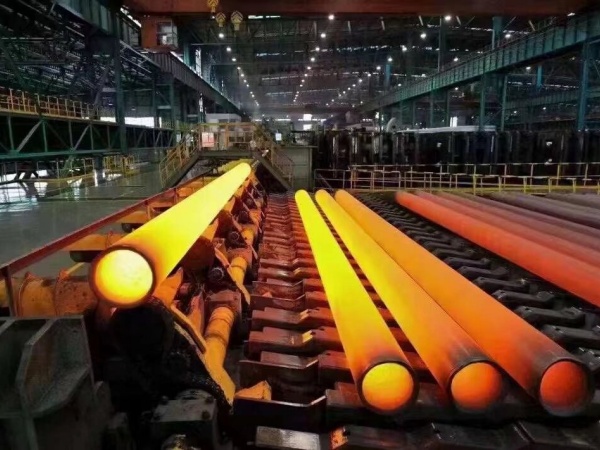
In most industrial applications, ERW pipe is generally less expensive than seamless pipe. However, the cost difference is influenced by raw material pricing, manufacturing efficiency, pipe dimensions, project volume, and market conditions.
1. Cost Comparison at a Glance
|
Cost Factor
|
ERW Pipe
|
Seamless Pipe
|
|
Raw Material
|
Steel Coil
|
Round Billet
|
|
Manufacturing Efficiency
|
Higher
|
Lower
|
|
Material Yield
|
Higher
|
Lower
|
|
Energy Consumption
|
Lower
|
Higher
|
|
Large-Diameter Cost
|
More Competitive
|
Higher
|
|
Typical Market Price
|
Generally Lower
|
Generally Higher
|
Actual price differences vary depending on diameter, wall thickness, grade, quantity, testing requirements, and prevailing steel market conditions.
For instance, while ERW is generally more cost-effective for thin-walled and medium-diameter pipes, the price gap narrows or may even reverse in high-grade, heavy-wall applications where rigorous non-destructive testing (NDT) is mandatory.
2. Why Does ERW Pipe Usually Cost Less Than Seamless Pipe?
2.1 Raw Material Economics
The starting material for ERW pipe is steel coil, while seamless pipe is produced from solid round billets.
From a steelmaking perspective, billets require additional processing and quality control before entering the pipe manufacturing stage. As a result, the material cost base of seamless pipe is generally higher even before production begins.
This difference becomes more noticeable when market prices for billets and hot-rolled coil diverge, particularly during periods of steel market volatility.
2.2 Manufacturing Yield and Energy Consumption
One factor that is often overlooked in pipe cost comparisons is manufacturing yield.
Modern ERW production lines typically achieve coil-to-pipe yield rates exceeding 95%, allowing manufacturers to convert a high percentage of raw material into finished product.
Seamless pipe production involves billet heating, piercing, rolling, end cropping, and additional hot-working operations, resulting in higher material loss and greater energy consumption throughout the manufacturing process.
Over large production volumes, these differences in yield efficiency become an important contributor to the cost gap between ERW and seamless pipe.
2.3 The Impact of Pipe Size
The cost difference between ERW and seamless pipe is not identical across all diameters.
For smaller sizes, the price gap may be relatively modest. However, as diameter increases, seamless manufacturing becomes increasingly complex and capital intensive.
In large-diameter pipeline projects, ERW pipe often provides a significant economic advantage while still meeting the performance requirements of the application.
3. Dimensional Tolerance and Project Weight
Experienced piping engineers rarely evaluate pipe cost solely on a price-per-ton basis.
Dimensional tolerances can also influence total project cost.
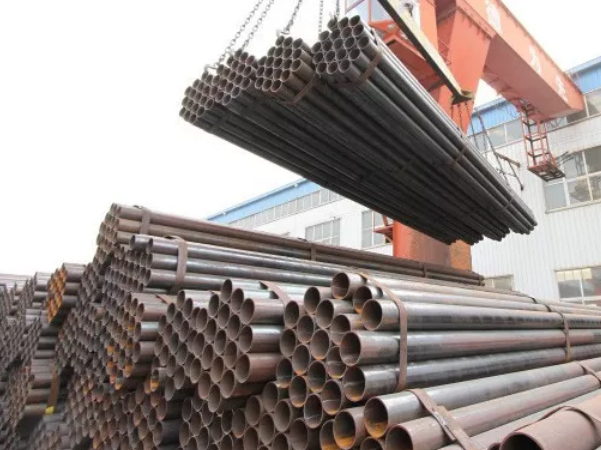
Because ERW pipe is manufactured from steel strip with tightly controlled thickness, wall thickness variation is generally lower and more predictable. In contrast, seamless pipe standards often permit larger wall thickness tolerances.
To ensure the minimum required design thickness is achieved throughout the pipe body, engineers may specify a heavier nominal wall thickness when selecting seamless pipe. Across large projects, the additional steel weight can increase material, transportation, handling, and installation costs.
4. Installed Cost vs Purchase Cost
Pipe purchase price is only one component of total project cost.
Transportation, storage, handling, welding, inspection, installation, and maintenance can all influence the overall economics of a piping system.
A lower pipe purchase price may not always result in the lowest installed cost if additional inspection, field work, or fabrication is required. Conversely, a pipe product with a higher unit price may reduce labor hours, improve installation efficiency, or lower long-term maintenance requirements.
5. When Does ERW Offer the Greatest Cost Advantage?
ERW pipe typically delivers the greatest cost advantage in projects where large quantities of pipe are required and seamless construction is not mandated by the applicable code or specification.
Examples include:
1)Long-distance oil and gas transmission pipelines
2)Water transmission and distribution systems
3)Structural and piling applications
4)Large-diameter pipeline projects
In these applications, ERW pipe often provides the lowest overall project cost while still meeting applicable performance and specification requirements.
Read more: ERW Pipe Specifications and Models or ERW Pipe vs Seamless Pipe: Key Differences, Performance and Selection





 Eastern Steel Manufacturing Co.,Ltd not only improve product production and sales services, but also provide additional value-added services. As long as you need, we can complete your specific needs together.