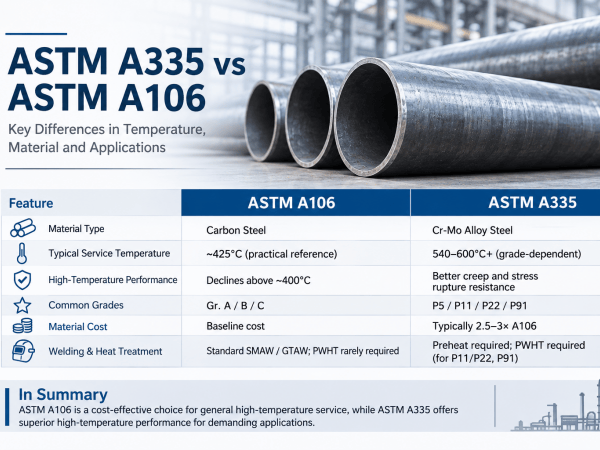
A106 and A335 are both seamless steel pipe standards for high-temperature service, yet they serve fundamentally different operating windows. The core distinction comes down to chemistry: ASTM A106 is carbon steel, while ASTM A335 is chrome-moly (Cr-Mo) alloy steel — a difference that dictates allowable design temperatures, welding procedures, and total project cost.
The selection-critical differences:
|
|
ASTM A106
|
ASTM A335
|
|
Steel type
|
Carbon steel
|
Chrome-moly (Cr-Mo) alloy steel
|
|
Common grades
|
Gr. A, Gr. B (most specified), Gr. C
|
P5, P11, P22, P91
|
|
Continuous service limit
|
~425 °C (per ASME B31.1/B31.3)
|
540–600 °C+ (grade-dependent)
|
|
Strength at temperature
|
Allowable stress drops above ~400 °C
|
Retains creep strength at high temp
|
|
Welding
|
Standard SMAW / GTAW; PWHT rarely needed
|
Preheat required; PWHT mandatory for code work
|
|
Relative material cost
|
Baseline
|
2.5–3× carbon steel (varies by grade)
|
|
Typical service
|
Steam, water, air and process lines at moderate temperature
|
Superheaters, reheaters, hydrocrackers, high-pressure power piping
|
1. Temperature Sets the Boundary
A106 Grade B is specified for high-temperature service, though the ASTM standard itself carries no temperature ceiling.
The practical limit comes from piping codes: ASME B31.3 allowable stress for carbon steel holds steady up to about 400 °C, then drops quickly. Above roughly 425 °C, a carbon steel wall becomes too thick to be economical, while risking creep and graphitization. Some sources quote 538 °C (1,000 °F) for A106 — that is a short-term code limit, not a continuous service rating.
A335 grades exist for the range above that line. Chromium and molybdenum hold allowable stress at temperature: P11 and P22 are the standard choices from 540 °C to about 565 °C, while P91 (rated at 415 MPa minimum room-temperature yield strength) extends service to 593 °C. For supercritical power piping, P91 is the reference grade.
2. Composition and What It Changes in Service
A106 chemistry is carbon, manganese, and silicon — Grade B caps carbon at 0.30% and relies on manganese for strength. A335 adds chromium and molybdenum to that base. The two elements work together: molybdenum raises creep strength, while chromium slows surface oxidation and scaling and improves resistance to flow-accelerated corrosion in high-temperature water and steam.
In service, the difference shows up as wall thickness and service life. At the same pressure above 450 °C, A335 P11 carries the load with a thinner wall than A106 Gr. B; the carbon steel option would need heavy wall and would still creep faster. Full grade chemistry and mechanical properties are covered on the dedicated pages for ASTM A106 and for A335 P-grades.
3. The Real Cost Difference
A335 pipe runs typically 2.5–3×+ the price of A106 carbon steel in most OD and wall combinations. The alloy surcharge is not the whole difference — normalizing plus tempering heat treatment and additional testing add cost on top.
Fabrication adds more. A106 welds with standard SMAW or GTAW procedures and needs no post-weld heat treatment in most wall thicknesses. A335 requires preheat for welding, and PWHT is mandatory for P11 and P22 in code work. P91 is stricter still: it demands a qualified welding procedure with controlled interpass temperature, and welds are examined to tougher criteria. Each of these steps is a line item in the fabrication budget that carbon steel does not carry.
Two mistakes cost more than either option: A106 pushed past its temperature limit and replaced mid-life, or A335 specified for a 300 °C system where it adds no technical value.
4. Specifying the Right Pipe
Specify A106 Grade B when:
-
Design temperature stays at or below ~425 °C
-
The medium is steam, water, air or non-corrosive process fluid
-
Standard welding without PWHT keeps fabrication cost down
Specify A335 when:
At 425 °C and below, Eastern Steel supplies A106 Grade B seamless pipe (as well as A335 P-grade alloy pipe for higher-temperature lines) to ASTM/ASME requirements with full material certification (MTC).
5. FAQs
Q1: Are A106 and A335 interchangeable?
A: No. The standards cover different steel types and different temperature ranges. Swapping one for the other changes wall thickness calculations, welding procedure and cost.
Q2: Is A335 stronger than A106?
A: At room temperature the gap is moderate. At service temperatures above 450 °C the gap widens: A106 allowable stress falls away while A335 grades hold design strength. P91 also carries a 415 MPa minimum room-temperature yield strength.
Q3: Can A106 replace A335?
A: Only in moderate-temperature service where A335 was over-specified to begin with. Above the carbon steel creep range there is no practical substitute — the wall thickness A106 would need is not workable.
Q4: Why does A335 cost 2–3 times more than A106?
A: Chromium and molybdenum alloy surcharge, mandatory normalizing plus tempering, and more demanding fabrication — preheat, PWHT and stricter weld examination.
Related Articles
ASTM A106 Pipe | Grades, Specifications, Dimensions & Composition
ASTM A335 Alloy Steel Pipe: Grades, Properties and Specifications
ASTM A106 vs. A53 Seamless Pipe
API 5L vs ASTM A106: Key Differences and How to Choose
ASTM A106 vs. ASTM A192: Which Is Better for Boiler Tubes?





 Eastern Steel Manufacturing Co.,Ltd not only improve product production and sales services, but also provide additional value-added services. As long as you need, we can complete your specific needs together.