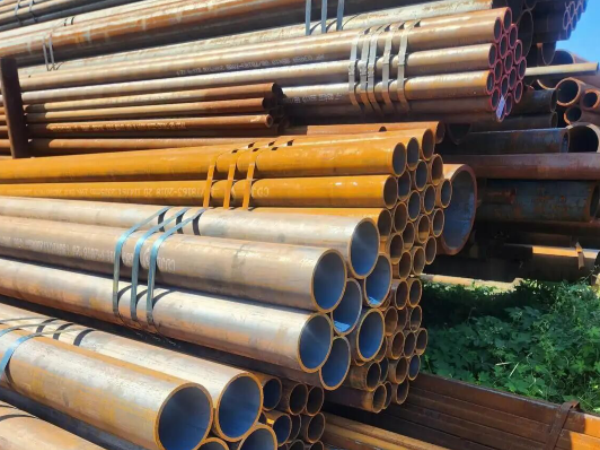
1. What Are API 5CT Casing Threads?
API 5CT casing threads are standardized threaded connections machined onto both ends of casing pipe to connect individual joints into a continuous casing string. Their primary function is to transfer mechanical loads and maintain a secure, pressure-resistant connection throughout running, cementing, and production operations.
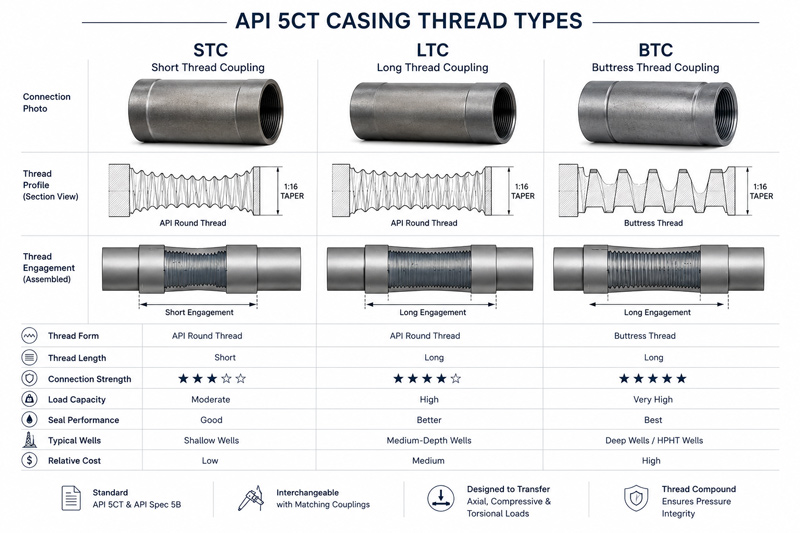
API 5CT defines three standard casing thread types: Short Thread Coupling (STC), Long Thread Coupling (LTC), and Buttress Thread Coupling (BTC). Each is designed for different well depths and loading conditions, with progressively higher connection strength and load capacity from STC to BTC.
2. API 5CT Casing Thread Types at a Glance
The following table provides a quick comparison of the three standard API 5CT casing thread types.
|
Thread Type
|
Full Name
|
Recommended Applications
|
Relative Strength
|
|
STC
|
Short Thread Coupling
|
Shallow wells and conventional drilling projects
|
Moderate
|
|
LTC
|
Long Thread Coupling
|
Medium-depth wells requiring higher tensile capacity
|
High
|
|
BTC
|
Buttress Thread Coupling
|
Deep wells, HPHT wells, and heavy-load applications
|
Very High
|
3. STC vs LTC vs BTC Comparison
|
Feature
|
STC
|
LTC
|
BTC
|
|
Full Name
|
Short Thread Coupling
|
Long Thread Coupling
|
Buttress Thread Coupling
|
|
Thread Profile
|
API Round
|
API Round
|
Buttress
|
|
Thread Length
|
Short
|
Long
|
Long
|
|
Connection Strength
|
Moderate
|
High
|
Very High
|
|
Tensile Capacity
|
Moderate
|
High
|
Excellent
|
|
Compression Resistance
|
Moderate
|
High
|
Excellent
|
|
Seal Performance
|
Good
|
Better
|
Best
|
|
Typical Applications
|
Shallow wells
|
Medium-depth wells
|
Deep and HPHT wells
|
|
Relative Cost
|
Low
|
Medium
|
High
|
STC is generally selected where cost is the primary consideration, LTC provides a balanced combination of strength and economy, while BTC is preferred for deep wells and high-load drilling conditions.
4. When to Choose STC, LTC, or BTC
Thread selection is primarily determined by well conditions, expected loads, and drilling requirements.
|
Well Condition
|
Recommended Thread
|
|
Shallow well
|
STC
|
|
Medium-depth well
|
LTC
|
|
Deep well
|
BTC
|
|
High tensile load
|
BTC
|
|
Tight budget
|
STC
|
|
Balanced cost & strength
|
LTC
|
|
HPHT wells
|
BTC
|
4.1 Well Depth
Deeper wells impose greater tensile loads on the casing string. STC is commonly used for shallow wells, LTC for intermediate depths, and BTC where maximum connection strength is required.
4.2 Formation Pressure
High-pressure and HPHT wells require stronger connections to maintain structural integrity under severe operating conditions. BTC is typically the preferred choice for these applications.
4.3 Mechanical Loads
Casing strings experience tension, compression, and bending during installation and operation. Wells subjected to higher mechanical loads generally require LTC or BTC connections.
4.4 Project Budget
Connection type also affects overall drilling costs. STC provides the lowest initial cost and is often adequate for standard wells. LTC offers a practical balance between performance and investment, BTC carries a higher initial cost but is often justified where connection reliability is critical.
5. Common Mistakes When Selecting Casing Threads
Thread selection should be based on operating conditions rather than connection strength alone.
5.1 Selecting STC for high-load wells
STC is suitable for shallow wells and moderate operating conditions. Using it in deep wells with high axial loads may increase the risk of connection failure.
5.2 Making decisions based only on price
Selecting the lowest-cost connection without considering operating conditions can increase the risk of connection failure and expensive workovers.
5.3 Mixing incompatible casing and couplings
API threads must match the corresponding coupling type and specification. Mismatched connections can lead to improper makeup, poor sealing, or thread damage during installation.
5.4 Using API standard threads where premium connections are required
High-pressure, high-temperature (HPHT), sour service, or gas-tight applications may require premium connections rather than standard API threads to achieve the necessary sealing performance.
6. FAQs
Q1. What does STC, LTC, and BTC stand for?
STC stands for Short Thread Coupling, LTC stands for Long Thread Coupling, and BTC stands for Buttress Thread Coupling.
Q2. Are STC, LTC, and BTC threads interchangeable?
No. STC, LTC, and BTC use different thread designs and require matching couplings. A casing pipe and coupling must have the same connection type to ensure correct makeup, sealing performance, and mechanical integrity.
Q3. What is the difference between API round threads and buttress threads?
STC and LTC use the standard API round thread profile, while BTC uses a buttress thread profile. Buttress threads provide a larger load-bearing surface and higher tensile capacity, making them better suited for deep wells and high-load drilling environments.
Q4. What is API Spec 5B?
API Spec 5B specifies the dimensions, tolerances, gauging, and inspection requirements for API casing and tubing threads, ensuring interchangeability between compatible casing pipes and couplings.
Q5. When should premium casing connections be used?
Premium connections are typically selected for HPHT wells, sour service, or applications requiring higher gas-tight sealing than standard API connections can provide.
Read more: API Drill Pipe Thread Types or One-Piece vs. Split Steel Casing Pipe






 Eastern Steel Manufacturing Co.,Ltd not only improve product production and sales services, but also provide additional value-added services. As long as you need, we can complete your specific needs together.