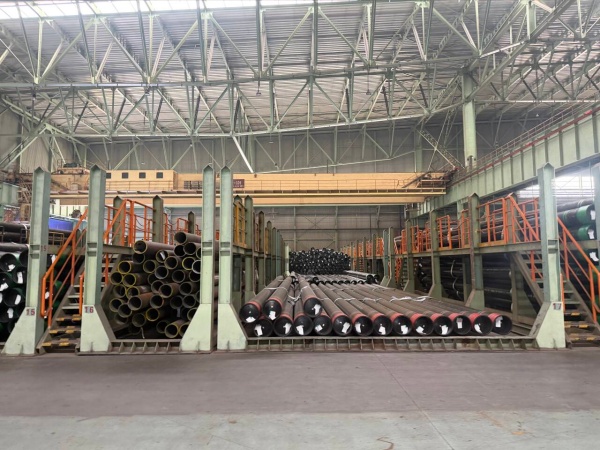
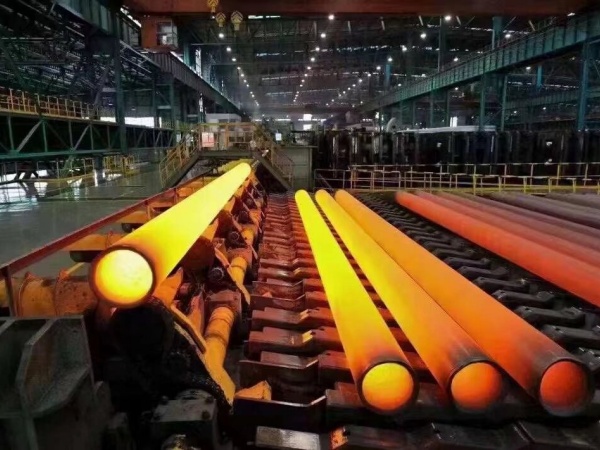
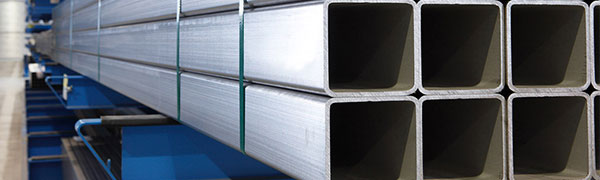
Structural and seamless steel pipe are both extruded. That means a billet of material is forced through a hole in a die shaped to form the two-dimensional cross-section.
Seamless Tubes Extrusion
Extrusion is a metal forming process in which a heated billet is placed in a closed container and forced through a die opening under pressure. The metal flows through the die to form a tube with the required cross-sectional shape. Extrusion has long been used as a manufacturing method for seamless tubes.
Based on the relationship between the extrusion force and the direction of metal flow, extrusion can be classified as forward extrusion or backward extrusion. In forward extrusion, the metal flows in the same direction as the applied force. In backward extrusion, the metal flows in the opposite direction.
Backward extrusion generally requires lower extrusion pressure and provides greater control over the extrusion conditions. It can improve dimensional accuracy and material yield, although the achievable tube dimensions depend on the extrusion tooling.
However, backward extrusion is more difficult to operate, and the achievable tube dimensions are limited by the extrusion tooling.
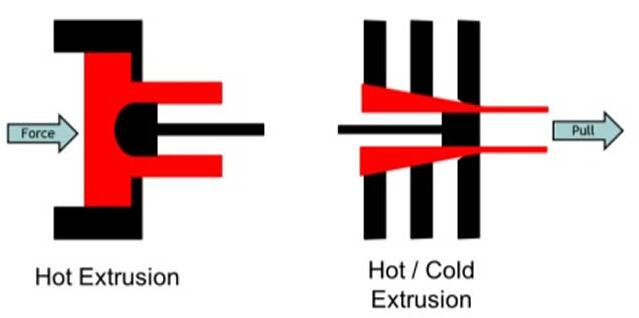
Seamless Tube Extrusion Process
Solid Round Billet → Heating → Rotary Piercing → Rolling / Extrusion → Stripping → Sizing (or Reducing) → Cooling → Straightening → Hydrostatic Testing / NDT → Marking → Warehousing
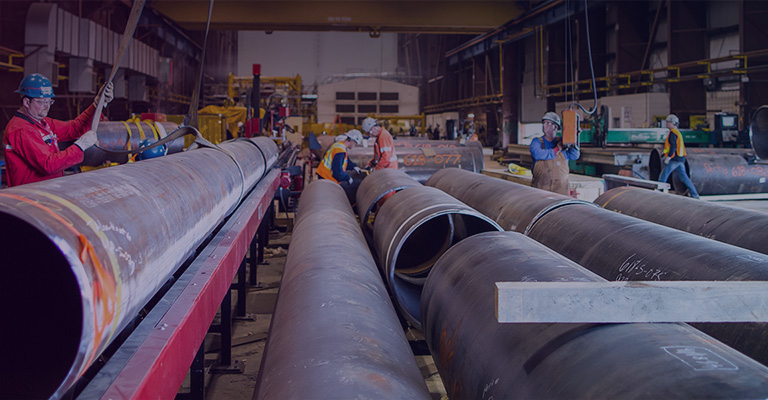
The raw material for seamless steel pipe production is the solid round billet. Billets are cropped into standard lengths using a cutting machine and fed via conveyor belt into the reheating furnace. The billets are heated to approximately 1200°C; precise furnace temperature control—typically fueled by natural gas or coal gas—is critical for uniform deformation.
Upon exiting the furnace, the heated billet undergoes rotary piercing to form a hollow shell. Rotary piercing commonly uses tapered rolls and a piercing plug to form the initial hollow shell. The piercing equipment and operating conditions vary with the billet size, steel grade, and production route.
Following piercing, the hollow shell is subjected to three-roll rolling, elongation, or extrusion to achieve the primary wall thickness, after which the mandrel is stripped.
After sizing, the pipe is cooled and straightened. Depending on the applicable specification, hydrostatic testing or non-destructive testing (NDT) may be performed to check for relevant internal or surface discontinuities.
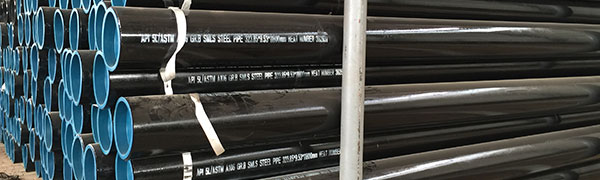
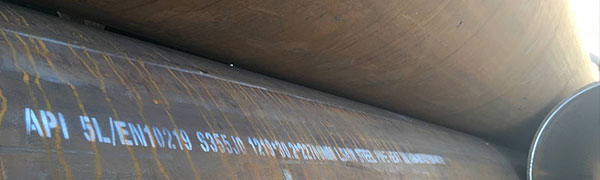
Finally, inspected pipes are marked with the required grade, dimensions, heat or batch number, and other traceability information before being transferred to storage.





 Eastern Steel Manufacturing Co.,Ltd not only improve product production and sales services, but also provide additional value-added services. As long as you need, we can complete your specific needs together.