Carbon
steel pipe (CS pipe full form) is one of the
core materials of modern industrial infrastructure. Its high strength,
excellent pressure resistance, and durability make it widely used in oil and
gas, building structures, power, machinery manufacturing, boiler thermal energy
systems, and many other fields.
However, many people only see its
engineering applications and are unaware of its manufacturing process from raw
materials to high-quality finished products. The production of carbon steel
pipe involves complex processes such as strict material selection, precise
heating and forming, advanced welding technologies (ERW,
HFI, LSAW,
SAW, etc.), precision dimensional control, multi-level inspection, and heat
treatment.
Below, we will systematically outline the
complete production process of carbon steel pipe from raw materials to finished
products, giving you a professional and comprehensive understanding of its
manufacturing technology.
Raw Material Selection and Preliminary
Processing
1. Carbon Steel Pipe Raw Materials
The production of carbon steel pipe begins
with the selection of high-quality raw materials. The main components include
iron ore, coal, and limestone.
Iron Ore: Iron ore is the main source of
iron in steel production. It needs to be mined, processed, and refined to
extract iron.
Metallurgical Coal (Coke): Metallurgical
coal, also known as coke, is a high-carbon fuel used to reduce iron ore in
blast furnaces.
Limestone: Limestone can be used as a flux
to help remove impurities such as silica and alumina from iron ore during the
smelting process.
2. Initial Treatment
Smelting and Refining
First, iron ore and coke are melted in a
blast furnace. Oxygen is then introduced to reduce the carbon content,
resulting in molten steel. This steel is then refined to achieve the desired
composition and properties.
Ingot Formation
The refined molten steel is poured into
molds to form steel ingots, which are the main material for manufacturing steel
pipes.
Rolling into Flowers or Plates
After the steel solidifies into ingots, it
is rolled into billets or plates using high-pressure rollers.
Rolling: Rolling is commonly used in the
production of seamless steel pipes, ensuring uniform structure through repeated
rolling and turning.
Bills: Billets are commonly used in the
production of welded pipes, ensuring consistent thickness through rolling.
Pickling: After rolling, the steel billet
or sheet undergoes pickling in a sulfuric acid bath to remove the oxide coating
formed during heating. The metal is then rinsed with hot and cold water to
prepare for subsequent processing.
Heating and Forming
The raw material is heated to approximately
1700 degrees Celsius to remove impurities and achieve the required chemical
composition, ensuring sufficient ductility for rolling and forming. Carbon
steel pipes are mainly divided into two categories: welded
pipes and seamless steel pipes.
1. Welded Pipes
Welded pipes use steel plates or coils as
raw materials, which are formed and then welded. Different processes are
suitable for different sizes and applications.
ERW
Raw material: Hot-rolled or cold-rolled
steel coils.
Process: Roll forming → High-frequency current heating → Extrusion
welding.
Characteristics: Uniform weld seam, high
precision.
Applications: Low-pressure conveying,
structural pipes, automotive industry, guardrails, furniture, etc.
LSAW
Raw material: Thick steel plate.
Outer diameter: Generally > 24"
(600mm).
Features: High strength, uniform wall
thickness, excellent weld quality.
Applications: Long-distance oil and gas
pipelines, submarine pipelines, large structural components.
High-frequency induction welding (HFI)
uses induction coil heating for welding.
Weld quality is higher than traditional
ERW.
Applications: Oil and gas pipelines,
high-requirement structural pipes.
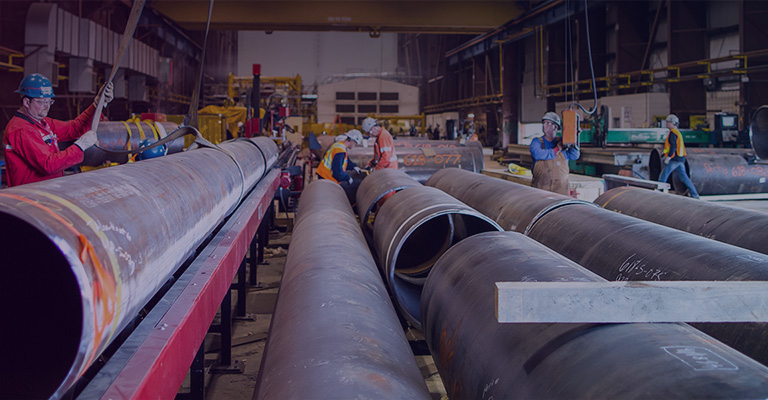
Seamless steel pipe is made from steel
billets. After the billets are melted, they are molded into a circle, called
round steel. The round steel is further heated to white in a furnace and then
rolled under high pressure.
Advantages
Seamless, more uniform structure;
Stronger pressure resistance;
More suitable for high-temperature and
high-pressure applications (such as boiler
tubes, pressure pipelines).
Sizing and Cutting
After welding or seamless forming, the pipe
needs to be dimensionally measured and cut to achieve specific dimensions.
1. Sizing
The pipe is sized using sizing rollers to
achieve the required diameter, ensuring dimensional consistency and meeting
necessary tolerances.
2. Cutting
Depending on the material and thickness of
the pipe, the pre-sized pipe is cut to the required length using mechanical or
thermal methods (such as sawing, shearing, plasma cutting, or laser cutting).
This ensures that the pipe meets its intended industrial application
requirements and conforms to the required precise specifications.
Testing and Inspection
Testing and inspection are critical steps
in ensuring that carbon steel pipes meet industry standards and operate
reliably in various applications. Different testing methods are used to
identify defects and verify the structural integrity of the pipe.
1. Non-destructive Testing (NDT)
Non-destructive testing methods are crucial
for assessing pipeline condition. They do not cause damage and ensure pipelines
meet industry standards.
Ultrasonic Testing: This technique uses
high-frequency sound waves to detect internal defects in pipeline materials or
welds.
Radiographic Testing: Radiographic testing
uses X-rays or gamma rays to generate images of the inside of the pipeline,
thereby discovering hidden defects.
Magnetic Particle Testing: This method
detects surface and near-surface discontinuities by applying a magnetic field
and observing the location of iron powder accumulation.
Eddy Current Testing: Eddy current testing
uses electromagnetic fields to identify surface and near-surface defects.
Magnetic Flux Leakage Detection: Also known
as magnetic defect detection, this technique identifies anomalies by detecting
changes in the magnetic field.
2. Hydrostatic Testing
Hydrostatic testing involves filling the
pipeline with water or other liquids and pressurizing it to detect leaks and
verify structural integrity.
3. Visual Inspection and Metallographic
Examination
Visual Inspection: Visual inspection
includes checking the pipe surface for defects such as mechanical marks,
delamination, or welding defects to ensure surface quality meets industry
standards.
Metallurgical and Chemical Testing
Microscopic and Macroscopic Analysis:
Microscopic analysis examines the chemical composition, while macroscopic
analysis assesses the fusion of welds and pipe materials to ensure compliance
with regulations.
Corrosion Testing: Corrosion testing
assesses the pipe's resistance to corrosive environments, including grain size,
intergranular corrosion, and susceptibility to hydrogen-induced cracking.
4. Destructive Testing
Destructive testing assesses the physical
properties of the pipe by intentionally applying pressure until it breaks.
Tensile Testing: Tensile testing measures
the strength of the pipe material by stretching it until it breaks, providing
data on yield strength and ultimate tensile strength.
Bending and Flattening Tests: These tests
assess the pipe's ductility and integrity by bending or flattening it to detect
defects.
Impact Testing: Impact testing is used to
determine the toughness of a material and its ability to withstand sudden
impacts at different temperatures.
Creep Testing: Creep testing assesses the
long-term performance of the pipe under sustained stress and high temperatures.
5. Quality Control and Advanced Technology
Quality control is maintained through
rigorous inspection to ensure pipelines meet safety and performance standards.
Automated and advanced inspection technologies, such as high-energy-density
welding, improve inspection accuracy, reduce human error, and enhance overall
product quality.
Heat Treatment and Finishing Processes
1. Heat Treatment of Carbon Steel Pipes
Heat treatment is crucial for improving the
strength and durability of carbon steel pipes. It helps to make the steel more
uniform, stronger, less stressed, and more durable. These improvements enhance
the overall performance and service life of the carbon steel pipe.
Types of Heat Treatment:
Annealing: Eliminating stress and producing
uniformity through slow cooling.
Normalizing: Utilizing air cooling to make
the steel harder and stronger.
Quenching and Tempering: Combining rapid
cooling and reheating to balance hardness and toughness.
Thickness Limitations: Heat treatment is
particularly important for pipes thicker than 25 mm to prevent internal stress
and ensure strength.
2. Finishing Process
After heat treatment, pipe performance can
be improved through the following steps:
Sizing and Cutting: The pipe is sized using
rollers and then precisely cut to the required length using a saw or welding
torch.
Straightening and Surface Cleaning: Straightening
ensures the pipe is not bent, while cleaning methods such as shot blasting
remove impurities.
Coating and Lining: Coating with zinc or
epoxy resin prevents corrosion and extends the pipe's service life.
Testing and Inspection: Finally,
comprehensive testing (hydraulic pressure testing, ultrasonic testing, X-ray
testing) ensures the pipe meets quality standards. Any defects found are
repaired or the pipe is scrapped, guaranteeing that all delivered pipes are
high-quality products.
Summary
The production process and standards for
carbon steel pipes are crucial for ensuring their quality and performance.
Through reasonable production processes and strict standard requirements,
high-quality carbon steel pipes meeting the needs of various fields can be
produced. When using carbon steel pipes, products that meet the standard
requirements should be selected, and installation and use should be carried out
in accordance with relevant regulations to ensure their safety and reliability.
Read more: Seamless Carbon Steel Pipe Life Expectancy





 Eastern Steel Manufacturing Co.,Ltd not only improve product production and sales services, but also provide additional value-added services. As long as you need, we can complete your specific needs together.