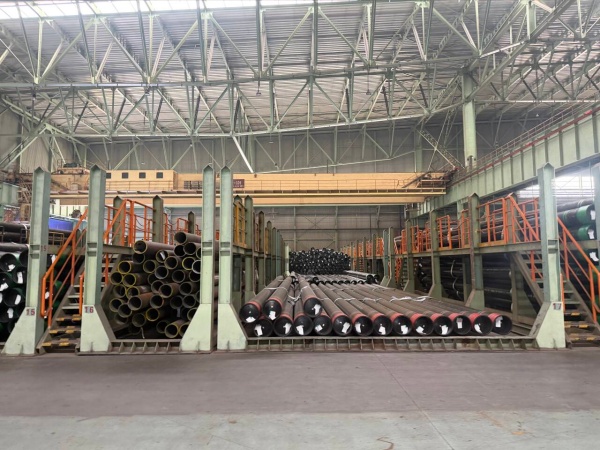
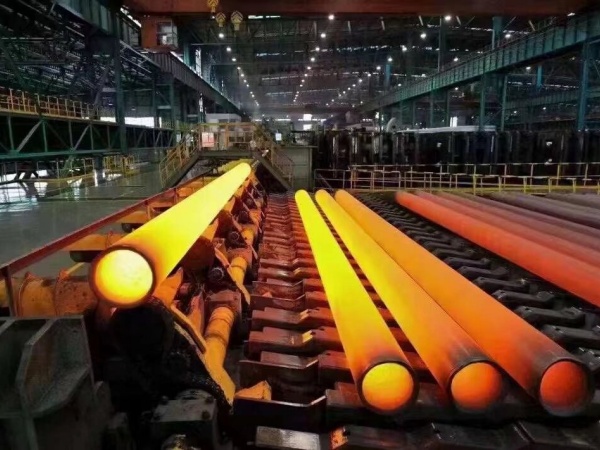
Common applications of RHS steel in construction and structural work include:
❶ structural frames and building supports
❷ machinery and equipment structures
❸ automotive and transport components
❹ architectural fabrication such as railings and fences
❺ general construction applications
Each of these use cases has slightly different requirements in terms of load, fabrication, and performance.
1. Applications of RHS Steel
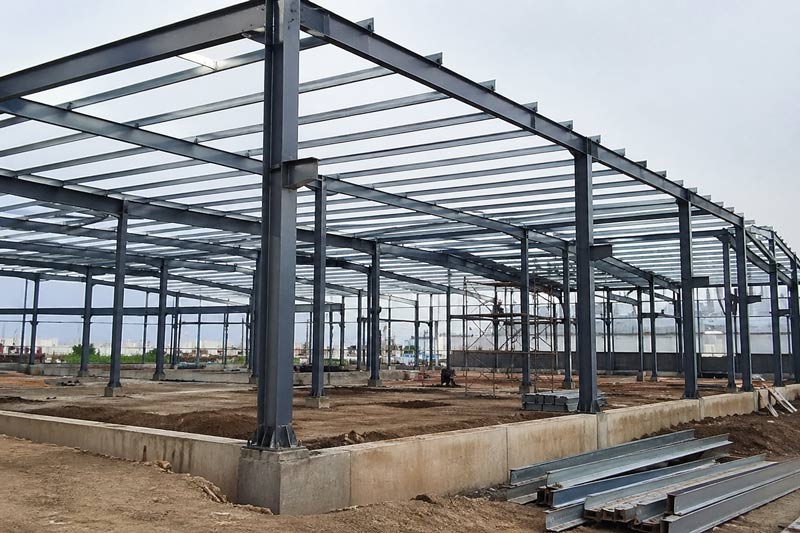
(1) RHS in Structural Frames and Building Supports
In construction, one of the most common uses of RHS steel is in structural frames where stability under load is not optional.
It shows up in columns and vertical supports quite often, but just as frequently in beams and horizontal members — especially in cases where bending performance starts to matter more than pure compressive strength.
For larger structures, like bridges or long-span frameworks, rectangular tubes are used where a bit more control over torsion and deflection is needed.
(2) RHS in Machinery and Equipment Structures
Outside of construction, rectangular tube uses are just as common in machinery and equipment structures.
In workshop or factory settings, RHS is often used for base frames, support structures, or machine beds where alignment and rigidity need to stay consistent over time.
It’s not unusual to see it in welded frames for industrial platforms or equipment supports, simply because the straight edges make positioning and assembly more manageable.
(3) RHS in Automotive and Transport Applications
RHS steel is commonly used in automotive and transport applications where strength and weight efficiency must be balanced.
It’s commonly seen in vehicle frames, chassis sections, and trailer structures, especially where the load direction is relatively predictable.
Rectangular tubes are also used as reinforcement members in areas that need extra stiffness without adding too much weight.
RHS is rarely used alone. It’s usually combined with other profiles, depending on how the structure is designed and what kind of loads it needs to handle.
(4) RHS in Architectural and Fabrication Work
In fabrication and architectural work, RHS steel is used in a lot of visible parts of a project.
You’ll often see it in railings, fences, gates, or exposed frames where the lines need to stay clean after installation.
It’s also a common choice in custom fabrication, especially for pieces that are cut and welded on site.
In many cases, it’s simply used because it’s straightforward to work with and fits well into standard fabrication processes.
(5) RHS in General Construction
Beyond major structural uses, RHS steel is also applied across a wide range of general construction scenarios.
Typical applications include fence posts, rails, decking supports, flooring structures, and secondary framing elements. Its ease of connection and minimal edge preparation make it efficient for on-site fabrication and installation.
Depending on the size and thickness, the same section can be used in lighter applications or scaled up for more demanding structural work.
For applications where bending performance is critical, rectangular tubes are often preferred over square sections.
For a detailed comparison, see: Square Tube vs Rectangular Tube (SHS vs RHS): Which Is Better?
When selecting RHS steel, the specification should match the actual application conditions rather than simply choosing a larger size.
2. How to Select RHS Steel for Your Application
Selecting the right RHS steel depends on actual application conditions, not simply choosing a larger or thicker section.
Key factors include:
- Load requirements: RHS performs efficiently under bending loads, while SHS may be preferred for multi-directional loading
- Environment: Galvanized or coated RHS is recommended for outdoor or corrosive conditions
- Wall thickness and section size: These directly affect strength, stiffness, and overall weight
- Fabrication requirements: Consider cutting, welding, and connection methods during design
In practice, selecting the right RHS specification helps balance structural performance, material cost, and fabrication efficiency.
3. FAQs
Q1: What is RHS steel typically used for in construction?
Most of the time, it ends up in structural roles rather than decorative ones.
You’ll see it in frames, supports, and sometimes beams — especially where a balance between strength and fabrication simplicity is needed.
It’s not usually the first choice for highly complex loading conditions, but for standard structural work, it’s widely used.
Q2: Can rectangular tube be used as a beam?
Yes, and in many projects that’s exactly how it’s used.
Compared with square sections, RHS tends to perform better when the load is primarily in one direction, which is often the case for beams.
That said, whether it’s suitable still depends on span, load, and how the structure is designed overall.
Q3: How do I choose between RHS and square tube?
It usually comes down to how the load is applied.
If the structure mainly experiences bending in one direction, RHS is often the more efficient option.
If loads are more evenly distributed, square sections may be easier to work with.
In practice, the choice is rarely about “which is stronger” — it’s about which one fits the actual use case better.
4. Conclusion
RHS steel is used across construction, machinery, transport, and fabrication due to its efficient performance under bending loads and ease of fabrication.
For structural applications, selecting the correct size, thickness, and standard is critical to ensure safety and cost efficiency.
If you are working on a project and need support in selecting suitable RHS specifications, feel free to contact us for technical assistance and quotation.
Read More
If you’re comparing options or working out specifications, these resources may also be useful:
- RHS steel size chart — standard dimensions and tolerances used in practice
- Rectangular tube weight chart — quick reference for weight per meter and calculation methods
- Square vs rectangular tube — a practical comparison for structural applications



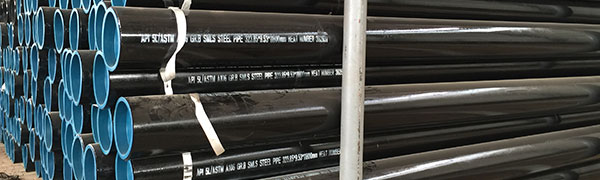


 Eastern Steel Manufacturing Co.,Ltd not only improve product production and sales services, but also provide additional value-added services. As long as you need, we can complete your specific needs together.