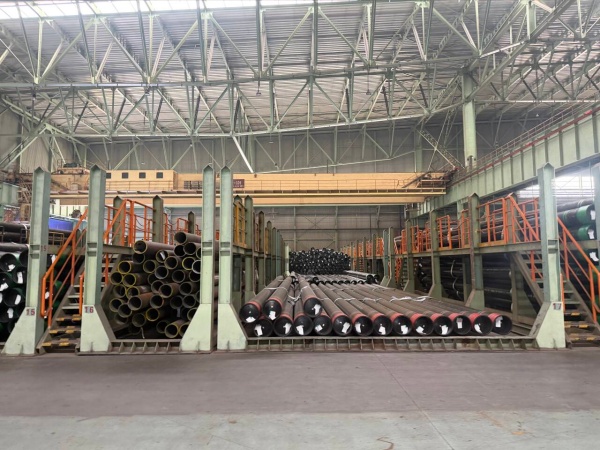
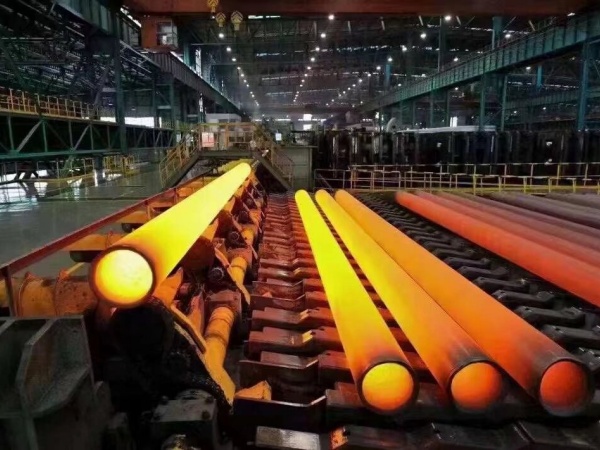
ERW pipe has become one of the most widely used steel pipe products in modern industry.
Its widespread adoption is largely driven by manufacturing efficiency, dimensional consistency, and competitive production costs.
1. Advantages of ERW Pipe
The widespread adoption of ERW pipe is driven by a combination of manufacturing efficiency, dimensional control, and economic advantages.
Compared with many alternative pipe manufacturing methods, ERW technology allows producers to deliver large volumes of steel pipe with consistent quality while maintaining competitive costs.
1.1 Lower Cost
Cost remains one of the strongest competitive advantages of ERW pipe.
The primary reason is not simply that ERW production is faster than seamless manufacturing. The difference starts with the raw material itself.
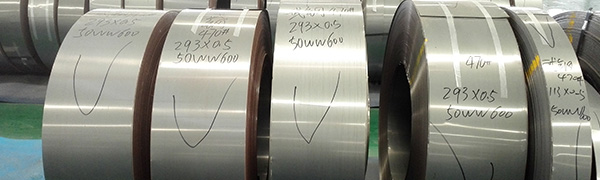
ERW pipe is produced directly from steel coil, while seamless pipe begins with solid round billets that must undergo piercing, elongation, and multiple rolling operations. These additional processes require more equipment, higher energy consumption, and longer production cycles.
For standard sizes used in line pipe, water transmission, and structural applications, the cost difference becomes particularly noticeable in large procurement volumes.
When a project requires several thousand tons of pipe, even a relatively small difference in unit price can translate into a substantial difference in total material cost.
For this reason, ERW pipe is often the preferred choice when project specifications do not require the specific advantages offered by seamless pipe.
1.2 High Production Efficiency
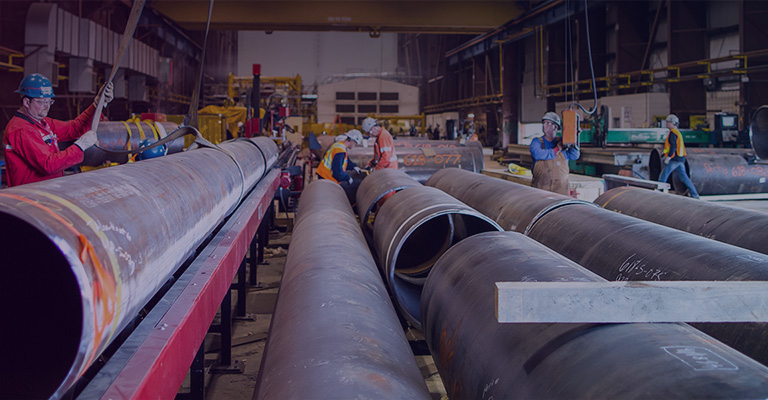
Unlike seamless mills, ERW mills operate on a continuous coil-to-pipe production model.
Once production begins, steel strip is continuously formed, welded, sized, and cut into finished pipe with minimal interruption.
This allows manufacturers to maintain high output rates, shorter lead times, and stable supply for standard pipe sizes.
For large pipeline, infrastructure, and structural projects, production capacity can be just as important as mechanical performance.
1.3 Excellent Dimensional Consistency
In pipeline construction, dimensional variation creates cumulative installation problems.
A small deviation in outside diameter may seem insignificant on a single pipe, but across hundreds of field welds it can increase fit-up time, alignment adjustments, and installation costs.
Because ERW pipe is produced through controlled roll-forming and sizing operations, dimensional variation is generally lower and more predictable.
This consistency is one reason ERW pipe is widely used in transmission pipelines, structural fabrication, and automated manufacturing environments.
1.4 Smooth Surface Finish
After welding, the external weld bead is typically removed through scarfing operations, resulting in a cleaner and more uniform surface profile.
This smoother surface can simplify subsequent coating, painting, and galvanizing processes while improving the overall appearance of the finished pipe.
1.5 Mature Global Supply Chain
ERW pipe is produced by a large number of manufacturers worldwide, providing buyers with greater flexibility in supplier selection and sourcing strategy.
For large projects, the ability to compare pricing, delivery schedules, and production capacity across multiple suppliers can help reduce procurement risk and improve schedule reliability.
The maturity of the global ERW supply chain is one of the reasons the product has become widely adopted across pipeline, construction, infrastructure, and industrial markets.
For buyers, sourcing flexibility is often just as important as product performance. A mature supply network helps reduce procurement uncertainty and provides greater confidence when managing large-scale projects.
2. Disadvantages of ERW Pipe
Despite its commercial and manufacturing advantages, ERW pipe is not the optimal solution for every application.
2.1 Presence of a Weld Seam
Modern high-frequency welding technology produces a strong and reliable bond, and when manufactured according to standards such as API 5L or ASTM A53, the weld can achieve mechanical properties comparable to the surrounding base material.
For most industrial applications, this distinction has little practical impact. However, in highly demanding service conditions, engineers may give additional consideration to the presence of a weld seam when evaluating long-term performance, fatigue resistance, or critical safety requirements.
2.2 Dependence on Manufacturing Quality
The performance of ERW pipe is closely linked to manufacturing quality.
Weld integrity depends on precise control of strip preparation, forming accuracy, welding parameters, and inspection procedures.
As a result, two ERW pipes produced to the same specification may not necessarily offer the same level of quality if manufacturing standards differ.
For critical applications, evaluating the manufacturer's production capability and quality control system is often as important as reviewing the product specification itself.
2.3 Limitations in Extreme Service Conditions
ERW pipe performs well in the vast majority of commercial, structural, and pipeline applications.
Applications involving extremely high pressure, severe cyclic loading, elevated temperature, or critical safety requirements place greater demands on long-term pipe integrity.
In these environments, some specifications may favor seamless pipe because of its homogeneous structure and the absence of a longitudinal weld seam.
2.4 Less Common in Heavy-Wall Applications
Heavy-wall pipe requirements are traditionally served by seamless manufacturing, resulting in broader product availability across certain thickness ranges and pressure classes.
As a result, engineers and buyers frequently encounter seamless pipe options when sourcing thick-wall products for high-pressure process systems, power generation facilities, and specialized industrial equipment.
For standard wall thicknesses used in line pipe, structural tubing, and general industrial service, ERW pipe remains one of the most widely available and economically attractive solutions. However, in the heavy-wall segment of the market, seamless pipe often continues to occupy a larger share.
3. When Is ERW Pipe a Good Choice?
In practice, ERW pipe is often selected when project requirements prioritize:
• Cost efficiency for large procurement volumes
• Stable dimensional accuracy
• Reliable supply availability
• Standard pressure service conditions
• Shorter manufacturing and delivery lead times
Where these factors are more important than the specific benefits offered by seamless construction, ERW pipe is often the more practical and economical choice.
4. Conclusion
ERW pipe combines cost efficiency, production scalability, and dimensional consistency within a mature manufacturing process.
For standard pressure service, structural applications, and large-volume projects, it remains one of the most practical and widely adopted steel pipe solutions available today.
Understanding both its advantages and limitations allows engineers, buyers, and project managers to make more informed material selection decisions.
Read more: What Does ERW Mean? and What is ERW Pipe?





 Eastern Steel Manufacturing Co.,Ltd not only improve product production and sales services, but also provide additional value-added services. As long as you need, we can complete your specific needs together.