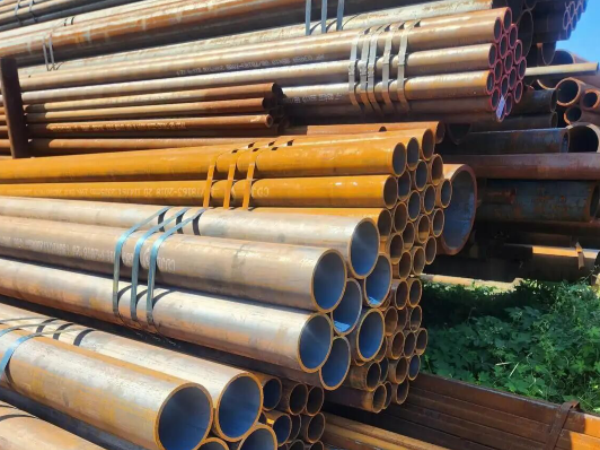
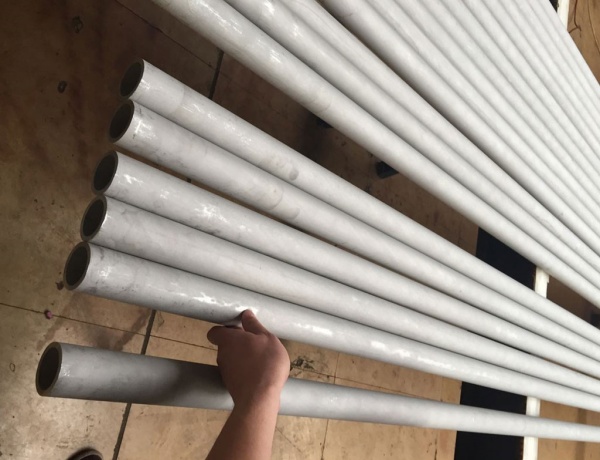
Choosing between seamless and welded pipe usually comes down to three factors: pressure, pipe size, and project cost. Seamless pipe is preferred for high-pressure and critical service, while welded pipe is often more practical for large-diameter and cost-sensitive applications. This guide compares the key differences, applications, and selection criteria.
Because there is no longitudinal weld seam, seamless pipe avoids stress concentration and potential corrosion risks associated with welded areas. It is generally preferred for high-pressure (Class 1500 and above), high-temperature, and sour service environments (H₂S, in compliance with NACE MR0175), where reliability is critical.
However, due to manufacturing limitations, large-diameter sizes (typically above DN 600 / 24") come with higher costs and longer lead times.
(2) Welded pipe:
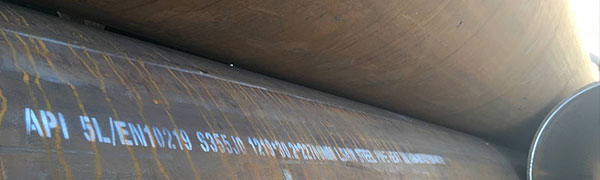
Welded pipes include types such as ERW (Electric Resistance Welded) and LSAW (Longitudinal Submerged Arc Welded).
Among them, LSAW fills the gap in large-diameter and thick-wall applications (typically > DN 600), making it a common choice for long-distance pipelines and structural piling.
Meanwhile, ERW dominates the small-to-medium diameter range (≤ DN 600), offering clear advantages in cost efficiency and shorter delivery times for general transportation and structural applications.
In real procurement scenarios, these two options are not fully interchangeable. The final choice is usually made by balancing applicable standards, design pressure, and project budget.
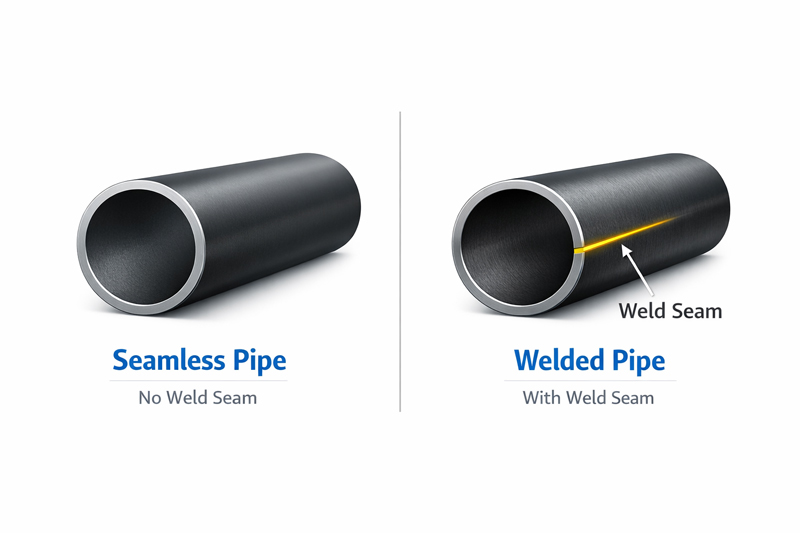
1. Seamless Pipe vs Welded Pipe: Which One Is Better?
|
Application
|
Better Choice
|
|
High Pressure
|
Seamless Pipe
|
|
High Temperature
|
Seamless Pipe
|
|
Sour Service
|
Seamless Pipe
|
|
Water Pipeline
|
Welded Pipe
|
|
Structural Applications
|
Welded Pipe
|
|
Large Diameter Projects
|
Welded Pipe
|
|
Budget-Sensitive Projects
|
Welded Pipe
|
Neither seamless pipe nor welded pipe is universally better. The right choice depends on pressure, pipe size, service conditions, and budget.
2. Seamless vs Welded Pipe (Comparison Table)
Before making a selection, it is recommended to evaluate the following key factors side by side:
Seamless vs Welded Pipe Comparison
Seamless vs Welded Pipe Comparison
|
Feature
|
Seamless Pipe
|
Welded Pipe
|
|
Manufacturing
|
No weld seam (formed from solid billet)
|
Welded from steel plate or coil (ERW / LSAW / SSAW)
|
|
Reliability under pressure
|
Excellent – uniform structure with no weak points
|
Good – depends on weld quality and inspection
|
|
Risk of failure point
|
Very low – no seam-related defects
|
Moderate – weld seam is the critical zone
|
|
Corrosion risk
|
Lower – no preferential corrosion path
|
Higher at weld seam if not properly treated
|
|
Size range
|
Limited (typically ≤ DN 600)
|
Wide range, especially large diameters
|
|
Cost
|
Higher (typically +20%–40%)
|
Lower and more cost-efficient
|
|
Availability & lead time
|
Longer for large sizes
|
Faster and more flexible
|
|
Typical applications
|
High-pressure, high-temperature, critical systems
|
General piping, structural use, pipelines
|
|
Decision trigger (when to choose)
|
High pressure / critical service / harsh environments
|
Cost-sensitive projects / large diameter / standard service
|
Note: In engineering practice, “welded pipe” is not a single category. ERW is commonly used for small to medium diameters, while LSAW is preferred for large-diameter and high-pressure applications.
When selecting pipe, the decision should be based on a combination of design pressure, pipe size, and project budget—balancing reliability with cost efficiency.
3. What is Seamless Pipe
3.1 Definition
A seamless pipe is a steel pipe manufactured from a solid billet through piercing and rolling, with no longitudinal weld seam in the pipe body.
By eliminating the weld seam—typically the weakest point in welded pipes—seamless pipes offer higher structural integrity and reliability, making them the preferred choice for high-pressure, high-temperature, and corrosive service conditions.
3.2 Key Characteristics
(1) High pressure resistance
Without weld-related stress concentration, seamless pipes can withstand higher pressure and temperature, making them suitable for demanding applications, particularly Class 1500 and above.
(2) Better corrosion resistance
The absence of a weld seam eliminates preferential corrosion paths. As a result, seamless pipes tend to perform more reliably in sour service (H₂S-containing environments).
(3) Size limitations
Due to manufacturing constraints, seamless pipes are typically limited to DN 600 (24") and below. Larger diameters or heavy-wall specifications are available but come with significantly higher costs and longer lead times.
(4) Surface quality
Seamless pipes generally feature smooth and uniform inner and outer surfaces, making them suitable for applications requiring good flow characteristics and high dimensional accuracy.
3.3 Typical Applications
Critical process lines and high-pressure piping in refining and petrochemical plants
Superheater and reheater tubes in power plant boilers
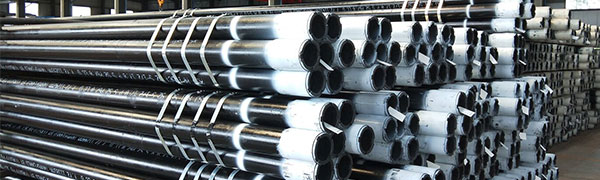
Drilling pipes and casing for oil and gas wells
High-precision mechanical components, such as hydraulic cylinders and aerospace parts
4. What is Welded Pipe
4.1 Definition
Welded pipe is manufactured by forming steel plates or hot-rolled coils into a tubular shape and joining the seam through welding.
Depending on the forming and welding process, it is mainly classified into ERW (Electric Resistance Welded), LSAW (Longitudinal Submerged Arc Welded), and SSAW (Spiral Submerged Arc Welded) pipes—each serving different diameter ranges and pressure applications.
4.2 Key Characteristics
(1) Cost-effective
Welded pipes are produced from steel coils, enabling high production efficiency. For the same specification, they are typically 20%–40% lower in cost than seamless pipes, with shorter and more flexible lead times.
(2) Wide size range
ERW pipe is commonly used for small- to medium-diameter applications, offering uniform wall thickness and efficient large-volume production. For larger diameters beyond the practical range of seamless pipe, LSAW and SSAW provide economical and widely available alternatives.
(3) Controlled weld quality
Modern welded pipes—especially ERW and LSAW—utilize 100% non-destructive testing (NDT) and post-weld heat treatment (normalizing), allowing the weld zone to achieve mechanical properties close to the base material.
As a result, they meet major industry standards such as API 5L and ASTM A53.
(4) Surface protection options
Welded pipes are commonly used in water and gas transmission and can be hot-dip galvanized to significantly enhance corrosion resistance and service life.
4.3 Typical Applications
ERW: Municipal water supply, gas distribution, fire protection pipelines, low-pressure process lines, as well as structural applications such as scaffolding and guardrails.
LSAW / SSAW: Long-distance oil and gas transmission pipelines, offshore wind foundation piles, large bridge and port piling, and large-diameter process pipelines in petrochemical facilities.
5. Key Differences Explained
While tables provide a quick comparison, understanding the reasons behind these differences is essential for making more reliable procurement decisions. The following highlights four critical dimensions.
5.1 Pressure-bearing capability
For the same material, wall thickness, and grade, seamless pipes are produced from a solid billet, resulting in a continuous structure without a longitudinal weld seam.
Welded pipes contain a weld seam, which is generally considered the most critical area under pressure or cyclic loading. For this reason, design codes such as ASME B31.3 may apply weld joint efficiency factors when calculating allowable stress and wall thickness requirements.
As a result, seamless pipe is often preferred for high-pressure and critical-service applications, while welded pipe is widely used in standard industrial and pipeline systems.
5.2 Sour service conditions
In H₂S-containing acidic environments (Sour Service), welded seams are theoretically more susceptible to sulfide stress cracking (SSC) due to differences in hardness and residual stress. Seamless pipes, with a uniform microstructure, generally perform more consistently under the same material grade.
However, in practice, welded pipes that comply with NACE MR0175 and undergo strict hardness control and heat treatment are also widely used in sour service applications. The key during selection is to ensure thorough weld quality verification, rather than automatically excluding welded pipes.
5.3 Large-diameter applications
Seamless pipes are limited by the piercing process, and when the diameter exceeds DN 600 (24 inches), production becomes more challenging and costly, with longer lead times for thick-walled sizes.
LSAW pipes, formed from steel plates and welded on both sides, can reliably produce DN 400–DN 1600+ large-diameter thick-walled pipes, offering a clear advantage in the large-diameter segment. Therefore, for large-diameter projects, welded pipes are often the more practical choice, whereas in small- to medium-diameter ranges, seamless and ERW pipes often overlap and compete.
5.4 ERW vs. seamless pipes: substitute or complement?
Modern ERW pipes, with full-body heat treatment (normalizing) and 100% NDT (UT/ECT), can achieve mechanical properties in the weld zone close to the base metal. For conventional medium- and low-pressure applications—such as urban gas or water pipelines—ERW pipes have become a more cost-effective alternative to seamless pipes, provided they meet standards such as API 5L or ASTM A53.
However, the two are not entirely interchangeable. In high-pressure, high-temperature, ultra-deep well, or other extreme conditions where microstructural uniformity is critical, seamless pipes remain the preferred choice. In practice, the two types of pipes complement each other, with selection based on specific service conditions.
6. How to Choose by Application
The following provides selection guidance for typical project types to help make quick, informed decisions:
(1) High-pressure steam boiler piping
Recommended: Seamless pipes (ASTM A106 / A335)
Reason: High temperature and pressure conditions demand excellent pipe continuity. Welds are prone to long-term creep risk.
(2) Core process pipelines in petrochemical facilities
Recommended: Seamless pipes (ASTM A106 / API 5L seamless)
Reason: The conveyed medium is often flammable, explosive, or corrosive, requiring minimal leakage risk.
(3) Sour oil & gas field pipelines (H₂S-containing service)
Recommended: Seamless pipes preferred, or fully certified welded pipes (compliant with NACE MR0175)
Reason: Weld zones are susceptible to sulfide stress cracking (SSC); special attention must be paid to hardness control and heat treatment during selection.
(4) Urban water / gas medium- and low-pressure networks
Recommended: ERW welded pipes (ASTM A53 / API 5L ERW)
Reason: Low-pressure service, cost-sensitive projects; ERW pipes offer the best cost-performance ratio and flexible lead times.
(5) Large-diameter long-distance oil & gas pipelines (>DN 600)
Recommended: LSAW or SSAW welded pipes (API 5L LSAW / SSAW)
Reason: Seamless pipes are either unavailable or prohibitively expensive; LSAW/SSAW is the only practical option for large diameters.
(6) Structural supports / pile pipes
Recommended: Welded pipes (ERW / LSAW / SSAW)
Reason: Primarily subjected to static loads; welds are less critical than in pressure service, and cost efficiency is prioritized.
(7) High-precision hydraulic / pneumatic cylinders
Recommended: Cold-drawn seamless pipes (ASTM A519)
Reason: High requirements for dimensional accuracy and inner surface finish; welded pipes cannot meet these standards.
Risk Reminder:
Selection should consider design pressure, medium corrosivity, environmental temperature, and applicable project specifications. Relevant standards may include ASME B31.3, API 5L, ASTM A106, and NACE MR0175 depending on service conditions.
8. FAQ
Q1. Is seamless pipe stronger than welded pipe?
Seamless pipes are generally stronger because they have no weld seam, resulting in more uniform structure and stress distribution.
However, modern welded pipes—especially ERW and LSAW—can achieve very similar strength after proper heat treatment and inspection. The difference becomes significant mainly in high-pressure or critical applications.
Q2. What is the price difference between seamless and welded pipe?
Seamless pipes are typically 20%–40% more expensive than welded pipes of the same specification.
This price difference is a key reason why welded pipes are widely used in cost-sensitive projects.
Q3. Which is better for high-pressure applications, seamless or welded pipe?
For high-pressure applications, seamless pipes are generally preferred because they eliminate the risk associated with weld seams.
While welded pipes can perform well under moderate pressure, seamless pipes offer higher reliability in demanding conditions such as high temperature, high pressure, or corrosive environments.
Q4. Can welded pipe replace seamless pipe?
In many standard applications, yes. Welded pipes—especially ERW—can be used as a cost-effective alternative when pressure and service conditions are not extreme.
However, for critical systems or harsh environments, seamless pipes remain the safer choice.
Q5. What is the difference between ERW pipe and seamless pipe?
The main difference is manufacturing: ERW pipes are made by welding steel coils, while seamless pipes are produced from solid billets without any weld seam.
Q6. Is welded pipe acceptable for API 5L high-pressure service?
Yes. API 5L welded pipe can be used for high-pressure service if the required grade, inspection, and weld quality meet project specifications. For severe conditions such as high temperature, sour service, or critical systems, seamless pipe is often preferred.
Q7. Which pipe is cheaper, seamless or welded pipe?
Welded pipe is generally less expensive than seamless pipe because it is produced from steel coil or plate with higher manufacturing efficiency. Depending on specification and market conditions, seamless pipe is often 20%–40% more expensive.
Q8. What does seamless pipe mean?
A seamless pipe is a steel pipe manufactured from a solid billet without a longitudinal weld seam. The absence of a weld seam provides a continuous structure, making seamless pipe widely used in high-pressure and critical-service applications.
9. Conclusion
Seamless and welded pipes serve different priorities.
Seamless pipe is typically selected for critical service where pressure, temperature, or corrosion resistance is a major concern.
Welded pipe is often preferred where cost, availability, and large-diameter supply matter more.
In practice, the right choice depends on selecting the most practical and economical solution that meets project requirements.
If you need help selecting the right specification, standard, or size for your project, feel free to contact us.
Read more: What is ERW Pipe? and ERW Pipe vs Seamless Pipe: Key Differences, Performance and Selection





 Eastern Steel Manufacturing Co.,Ltd not only improve product production and sales services, but also provide additional value-added services. As long as you need, we can complete your specific needs together.