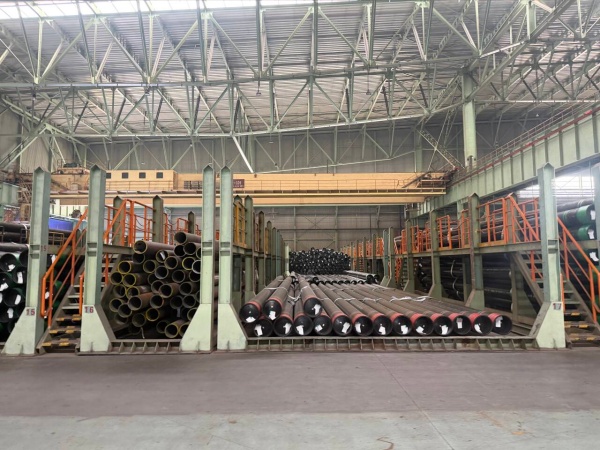
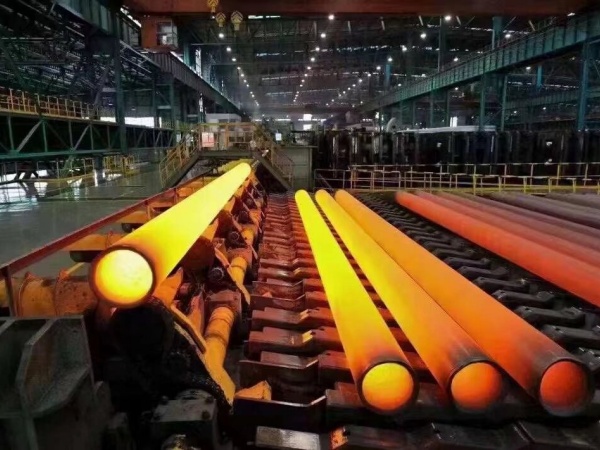
Cold-drawn and cold
rolled pipes, as two common steel pipe processing methods, play
important roles in industrial production. Although their names are similar and
both fall under the category of cold working, their production processes,
surface quality, dimensional accuracy, quality control, mechanical properties,
processing temperatures, and application areas differ significantly. These
differences will be analyzed in detail below.
Commonalities between Cold Drawn and
Cold Rolled Pipes
Both processes significantly improve
material properties through room-temperature deformation:
1. Increased Strength
Cold deformation refines the grain size,
increasing tensile strength by 20%-30% compared to the raw material.
2. Improved Surface Quality
Both processes achieve a smooth surface
with Ra≤1.6μm, superior to the
Ra≥12.5μm of hot
rolled pipes.
3. Dimensional Accuracy
Outer diameter tolerances are generally 3-5
grades better than hot rolled pipes, making them particularly suitable for
precision fitting applications such as hydraulic cylinders.
4. Common Limitations of Cold Working
Due to work hardening, the plasticity
indicators (such as elongation) of finished pipes are typically 15%-25% lower
than those of hot-rolled pipes. For complex forming, intermediate annealing is
required to restore processing performance.
1. Manufacturing Process
Cold drawn pipe manufacturing is carried
out on a cold-drawing machine. The billet steel pipe is heated to a certain
temperature and then pressed through a die, subjecting the steel pipe to
tensile stress on both the inner and outer sides simultaneously. Under tension,
the diameter and wall thickness of the steel pipe both decrease until the
desired size is achieved.
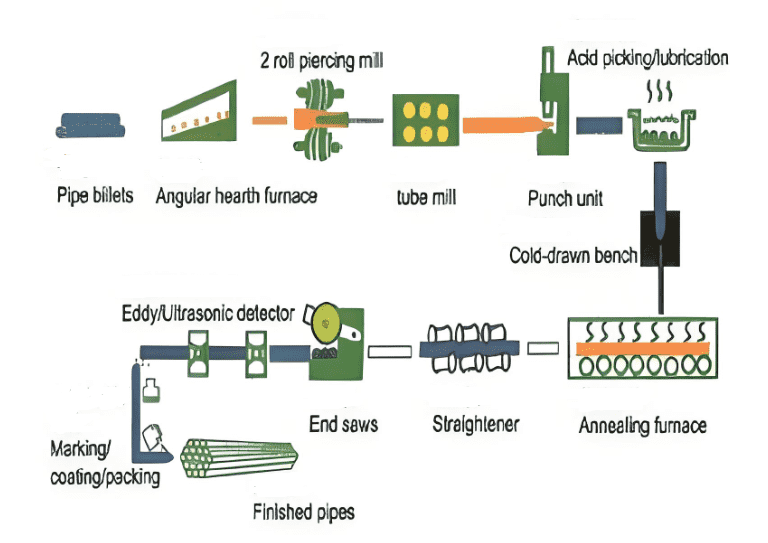
Cold drawn process: Round billet → Pickling → Lubrication → Multi-pass drawing → Annealing (stress
relief) → Straightening;
Cold rolled pipe manufacturing involves
heating the billet steel pipe to a certain temperature and then rolling it.
Unlike cold-drawn pipes, cold rolled pipes undergo only unidirectional
extrusion during rolling, and the radial dimensions and wall thickness of the
steel pipe do not change significantly. Therefore, the manufacturing cost of
cold-rolled pipes is relatively lower than that of cold-drawn pipes.
Cold rolled process: Hot-rolled pipe → Pickling → Continuous rolling on a cold
rolling mill → Online inspection → Finishing.
2. Dimensional Accuracy
Cold drawn steel pipes typically achieve an
outer diameter accuracy of ±0.1mm and a wall thickness
tolerance of around ±5%, making them suitable for
producing pipes with smaller diameters (usually ≤150mm)
and larger length-to-diameter ratios.
Cold rolled steel pipes offer even greater
advantages in dimensional control, with an outer diameter accuracy of ±0.05mm and a wall thickness tolerance controlled within ±3%, making them particularly suitable for producing precision
hydraulic pipes, bearing pipes, and other dimensionally sensitive products.
3. Surface Quality
Cold drawn pipes often have longitudinal
striations on their surface, with a roughness Ra value typically ranging from
1.6 to 3.2μm. Cold rolled pipes, on the other hand,
have a smoother surface, with an Ra value reaching 0.4-0.8μm when using high-precision rolls.
This difference gives cold rolled pipes an
advantage in applications such as surface coating and precision fitting.
However, it is worth noting that the cold rolling process may produce unique
"rolling marks," which need to be controlled by optimizing the mill
rigidity and process parameters.
4. Mechanical Properties
Cold drawn pipes possess higher axial
strength and hardness, making them suitable for manufacturing components
subjected to axial loads.
Cold rolled pipes, due to uniform work
hardening, combine good strength and plasticity, and their fatigue performance
is generally superior to that of cold-drawn pipes.
5. Key Quality Control Points
Cold drawing steel production requires
close attention to die wear, lubrication, and drawing force fluctuations; cold rolling
steel production, on the other hand, requires more precise control over the
matching of roll gap, feed rate, and rotation speed.
Statistical Process Control (SPC) data
shows that the critical dimension CPK value of cold rolling is typically
0.2-0.3 higher than that of cold drawing, indicating better process stability.
6. Processing of Special Materials
Cold rolling is more advantageous for
difficult-to-deform materials such as high-strength alloy steel and titanium
alloys. Its multi-directional stress state effectively prevents crack
formation.
Cold drawing often requires more
intermediate annealing cycles when processing these materials.
7. Residual Stress Distribution
Residual stress distribution is a key
factor affecting product stability.
The residual stress in cold drawn steel
pipes exhibits a distinct layered distribution, with the surface in a tensile
stress state. Cold rolled steel pipes, due to more uniform deformation, show
lower peak residual stress and a more gradual distribution.
This difference makes cold-drawn pipes more
prone to deformation during subsequent processing, requiring stress-relief
annealing to improve this. A precision hydraulic system manufacturer's tests
found that the straightness stability of cold-rolled pipe fittings was more
than 35% higher than that of cold-drawn products.
8. Different Processing Temperatures
The processing temperatures for cold
rolling and cold drawing also differ. Cold rolling is performed below the
crystallization temperature, generally at room temperature, while cold drawing
is performed under heating conditions at approximately 800°C to 950°C.
Therefore, cold drawing requires heating
the steel pipe in a furnace before sending it to a drawing machine for
processing, ensuring that defects such as cracks do not appear on the steel
pipe surface.
9. Application Areas
Cold-drawn pipes are used in the
manufacture of precision mechanical parts, automotive components, pipes,
hydraulic cylinder housings, diesel engine fuel injection pumps, and other
high-precision steel products.
Cold rolled pipes are used to manufacture
general steel products such as low- and medium-pressure boiler pipes, hydraulic
supports, automobile axle sleeves, automobile bearing housings, and bicycle
frames.
Pros and Cons of Cold Drawn Seamless
Pipe
1. Cold Drawn Seamless Pipe Pros
Improved Mechanical Properties: The cold drawing
process allows for greater plastic deformation of the steel pipe, thereby
improving its toughness and tensile strength, resulting in better mechanical
properties.
High Dimensional Accuracy: The cold drawing
process allows for precise control of the seamless
steel pipe sizes, meeting the requirements of high-precision
applications.
Good Surface Quality: The surface of the
seamless pipe is less prone to oxide scale formation during cold drawing,
resulting in better surface quality, which is beneficial for subsequent
processing and use.
2. Cold Drawn Seamless Pipe Cons
Large Residual Stress: During cold drawing,
significant residual stress is generated inside the seamless pipe, which may
affect its overall and local buckling characteristics.
Limited Drawing Length: Due to the presence
of residual stress, the length of cold-drawn seamless steel pipes is limited
and cannot be drawn too long.
Higher Cost: The cold drawing process is
relatively complex and requires advanced equipment and technology, resulting in
relatively high production costs.
Pros and Cons of Cold Rolled Seamless Pipes
1. Cold Rolled Seamless Pipe Pros
High Forming Speed and Output: Cold rolling
allows for rapid forming at room temperature, resulting in high production
efficiency and no damage to the coating.
Diverse Cross-Sectional Shapes: Cold
rolling can produce a variety of cross-sectional shapes to adapt to different
application conditions.
Increased Yield Point: The cold rolling
process induces plastic deformation in the seamless pipe, thereby increasing
its yield point and enhancing the material's load-bearing capacity.
2. Cold Rolled Seamless Pipe Cons
Residual Stress: Although there is no hot
plastic compression during cold rolling, residual stress still exists within
the cross-section, which may affect the performance of the steel pipe.
Poor Torsional Resistance: Cold rolled
steel sections are generally open, resulting in lower free torsional stiffness
and relatively poor torsional resistance.
Smaller Wall Thickness: Cold rolled steel
has a thinner wall thickness, and there is no thickening at the corners where
plates meet, making it less able to withstand localized concentrated loads.
How to Choose?
1. Diameter Range
Cold-drawn pipes are better suited for
diameters of Φ6-127mm, while cold rolled pipes excel in
the Φ4-80mm thin-walled pipe segment.
2. Batch Size Requirements
Cold drawing offers high single-batch
forming efficiency, suitable for small to medium batches; cold rolling is
suitable for large-volume precision orders.
3. Cost Control
Cold drawn pipes are 8%-12% cheaper for the
same specifications, but cold rolling is more economical for ultra-thin walls
(<1mm).
4. Subsequent Processing
Cold rolled pipes are preferred for deep
drawing due to their lower anisotropy.



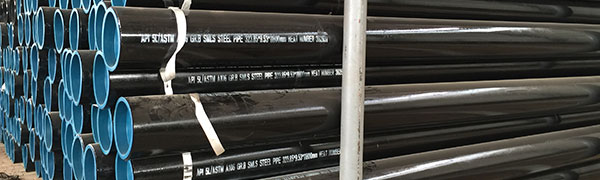
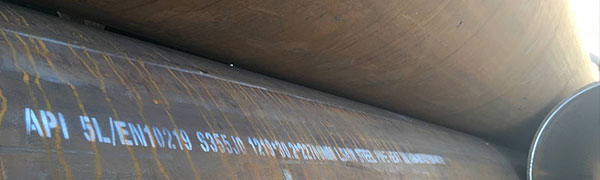
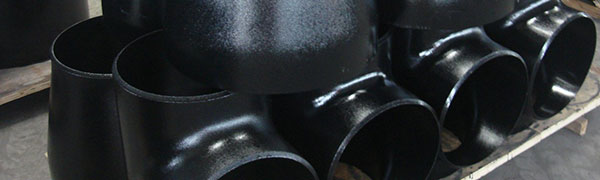
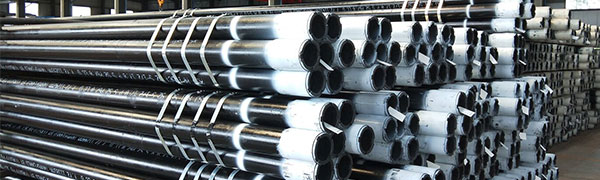


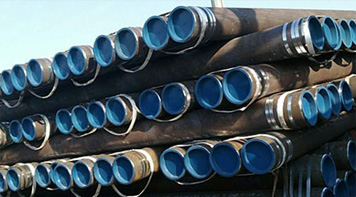 Eastern Steel Manufacturing Co.,Ltd not only improve product production and sales services, but also provide additional value-added services. As long as you need, we can complete your specific needs together.